Donald Trump has sweeping plans for a second administration. Here’s what he’s proposed
Advertisement
Read this article for free:
or
Already have an account? Log in here »
To continue reading, please subscribe:

Digital Subscription
One year of digital access for only $205*
- Enjoy unlimited reading on winnipegfreepress.com
- Read the E-Edition, our digital replica newspaper
- Access News Break, our award-winning app
- Play interactive puzzles
*First annual payment billed as $205.00 + GST for one year. This annual subscription will automatically renew at $233.00 + GST every 52 weeks (10% off the regular annual price of $259.35). Offer available to new and qualified returning subscribers only. Cancel any time.
To continue reading, please subscribe:
Add Free Press access to your Brandon Sun subscription for only an additional
$1 for the first 4 weeks*
- Enjoy unlimited reading on winnipegfreepress.com
- Read the E-Edition, our digital replica newspaper
- Access News Break, our award-winning app
- Play interactive puzzles
*Your next Brandon Sun subscription payment will increase by $1.00 and you will be charged $17.95 plus GST for four weeks. After four weeks, your payment will increase to $24.95 plus GST every four weeks.
Read unlimited articles for free today:
or
Already have an account? Log in here »
Hey there, time traveller!
This article was published 06/11/2024 (694 days ago), so information in it may no longer be current.
WASHINGTON (AP) — Donald Trump has promised sweeping action in a second administration.
The former president and now president-elect often skipped over details but through more than a year of policy pronouncements and written statements outlined a wide-ranging agenda that blends traditional conservative approaches to taxes, regulation and cultural issues with a more populist bent on trade and a shift in America’s international role.
Trump’s agenda also would scale back federal government efforts on civil rights and expand presidential powers.
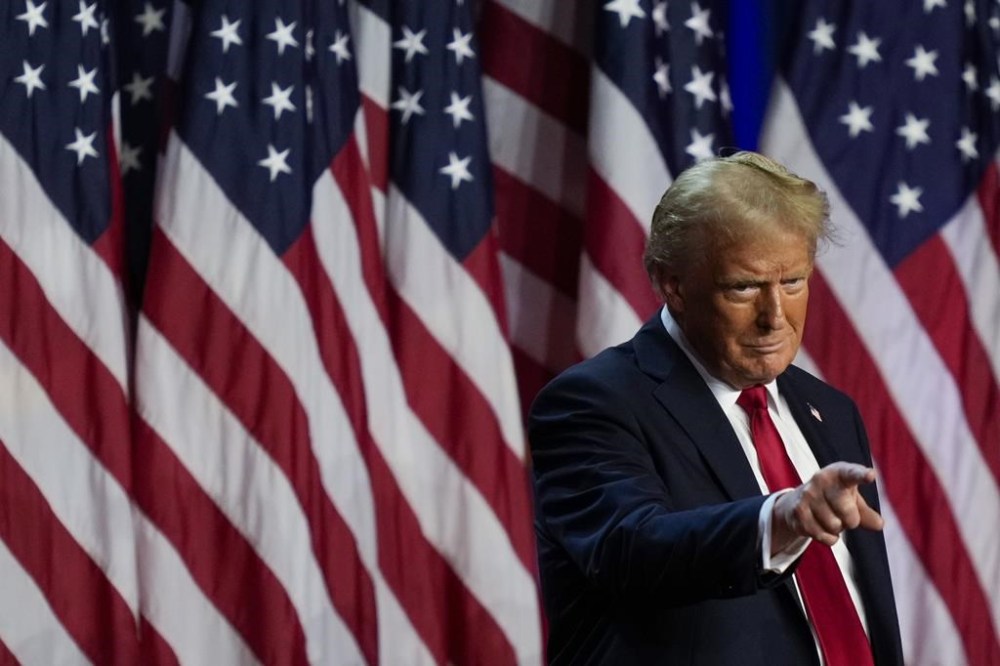
A look at what Trump has proposed:
Immigration
“Build the wall!” from his 2016 campaign has become creating “the largest mass deportation program in history.” Trump has called for using the National Guard and empowering domestic police forces in the effort. Still, Trump has been scant on details of what the program would look like and how he would ensure that it targeted only people in the U.S. illegally. He’s pitched “ideological screening” for would-be entrants, ending birth-right citizenship (which almost certainly would require a constitutional change), and said he’d reinstitute first-term policies such as “Remain in Mexico,” limiting migrants on public health grounds and severely limiting or banning entrants from certain majority-Muslim nations. Altogether, the approach would not just crack down on illegal migration, but curtail immigration overall.
Abortion
Trump played down abortion as a second-term priority, even as he took credit for the Supreme Court ending a woman’s federal right to terminate a pregnancy and returning abortion regulation to state governments. At Trump’s insistence, the GOP platform, for the first time in decades, did not call for a national ban on abortion. Trump maintains that overturning Roe v. Wade is enough on the federal level. Trump said last month on his social media platform Truth Social that he would veto a federal abortion ban if legislation reached his desk — a statement he made only after avoiding a firm position in his September debate against Democratic nominee Kamala Harris.
But it’s unclear if his administration would aggressively defend against legal challenges seeking to restrict access to abortion pills, including mifepristone, as the Biden administration has. Anti-abortion advocates continue to wage legal battles over the Food and Drug Administration’s approval of the drug as well as the agency’s relaxed prescribing restrictions. Trump is also unlikely to enforce Biden’s guidance that hospitals must provide abortions for women who are in medical emergencies, even in states with bans.
Taxes
Trump’s tax policies broadly tilt toward corporations and wealthier Americans. That’s mostly due to his promise to extend his 2017 tax overhaul, with a few notable changes that include lowering the corporate income tax rate to 15% from the current 21%. That also involves rolling back Democratic President Joe Biden’s income tax hikes on the wealthiest Americans and scrapping Inflation Reduction Act levies that finance energy measures intended to combat climate change.
Those policies notwithstanding, Trump has put more emphasis on new proposals aimed at working- and middle class Americans: exempting earned tips, Social Security wages and overtime wages from income taxes. It’s noteworthy, however, that his proposal on tips, depending on how Congress might write it, could give a back-door tax break to top wage earners by allowing them to reclassify some of their pay as tip income — a prospect that at its most extreme could see hedge-fund managers or top-flight attorneys taking advantage of a policy that Trump frames as being designed for restaurant servers, bartenders and other service workers.
Tariffs and trade
Trump’s posture on international trade is to distrust world markets as harmful to American interests. He proposes tariffs of 10% to 20% on foreign goods — and in some speeches has mentioned even higher percentages. He promises to reinstitute an August 2020 executive order requiring that the federal government buy “essential” medications only from U.S. companies. He pledges to block purchases of “any vital infrastructure” in the U.S. by Chinese buyers.
DEI, LGBTQ and civil rights
Trump has called for rolling back societal emphasis on diversity and for legal protections for LGBTQ citizens. Trump has called for ending diversity, equity and inclusion programs in government institutions, using federal funding as leverage.
On transgender rights, Trump promises generally to end “boys in girls’ sports,” a practice he insists, without evidence, is widespread. But his policies go well beyond standard applause lines from his rally speeches. Among other ideas, Trump would roll back the Biden administration’s policy of extending Title IX civil rights protections to transgender students, and he would ask Congress to require that only two genders can be recognized at birth.
Regulation, federal bureaucracy and presidential power
The president-elect seeks to reduce the role of federal bureaucrats and regulations across economic sectors. Trump frames all regulatory cuts as an economic magic wand. He pledges precipitous drops in U.S. households’ utility bills by removing obstacles to fossil fuel production, including opening all federal lands for exploration — even though U.S. energy production is already at record highs. Trump promises to unleash housing construction by cutting regulations — though most construction rules come from state and local government. He also says he would end “frivolous litigation from the environmental extremists.”
The approach would in many ways strengthen executive branch influence. That power would come more directly from the White House.
He would make it easier to fire federal workers by classifying thousands of them as being outside civil service protections. That could weaken the government’s power to enforce statutes and rules by reducing the number of employees engaging in the work and, potentially, impose a chilling effect on those who remain.
Trump also claims that presidents have exclusive power to control federal spending even after Congress has appropriated money. Trump argues that lawmakers’ budget actions “set a ceiling” on spending but not a floor — meaning the president’s constitutional duty to “faithfully execute the laws” includes discretion on whether to spend the money. This interpretation could set up a court battle with Congress.
As a candidate, he also suggested that the Federal Reserve, an independent entity that sets interest rates, should be subject to more presidential power. Though he has not offered details, any such move would represent a momentous change to how the U.S. economic and monetary systems work.

Education
The federal Department of Education would be targeted for elimination in a second Trump administration. That does not mean that Trump wants Washington out of classrooms. He still proposes, among other maneuvers, using federal funding as leverage to pressure K-12 school systems to abolish tenure and adopt merit pay for teachers and to scrap diversity programs at all levels of education. He calls for pulling federal funding “for any school or program pushing Critical Race Theory, gender ideology, or other inappropriate racial, sexual, or political content on our children.”
In higher education, Trump proposes taking over accreditation processes for colleges, a move he describes as his “secret weapon” against the “Marxist Maniacs and lunatics” he says control higher education. Trump takes aim at higher education endowments, saying he will collect “billions and billions of dollars” from schools via “taxing, fining and suing excessively large private university endowments” at schools that do not comply with his edicts. That almost certainly would end up in protracted legal fights.
As in other policy areas, Trump isn’t actually proposing limiting federal power in higher education but strengthening it. He calls for redirecting the confiscated endowment money into an online “American Academy” offering college credentials to all Americans without a tuition charges. “It will be strictly non-political, and there will be no wokeness or jihadism allowed—none of that’s going to be allowed,” Trump said on Nov. 1, 2023.
Social Security, Medicare and Medicaid
Trump insists he would protect Social Security and Medicare, popular programs geared toward older Americans and among the biggest pieces of the federal spending pie each year. There are questions about how his proposal not to tax tip and overtime wages might affect Social Security and Medicare. If such plans eventually involved only income taxes, the entitlement programs would not be affected. But exempting those wages from payroll taxes would reduce the funding stream for Social Security and Medicare outlays. Trump has talked little about Medicaid during this campaign, but his first administration reshaped the program by allowing states to introduce work requirements for recipients.
Affordable Care Act and Health Care
As he has since 2015, Trump calls for repealing the Affordable Care Act and its subsidized health insurance marketplaces. But he still has not proposed a replacement: In a September debate, he insisted he had the “concepts of a plan.” In the latter stages of the campaign, Trump played up his alliance with former presidential candidate Robert F. Kennedy Jr., a longtime critic of vaccines and of pesticides used in U.S. agriculture. Trump repeatedly told rally crowds that he would put Kennedy in charge of “making America healthy again.”
Climate and energy
Trump, who claims falsely that climate change is a “hoax,” blasts Biden-era spending on cleaner energy designed to reduce U.S. reliance on fossil fuels. He proposes an energy policy – and transportation infrastructure spending – anchored to fossil fuels: roads, bridges and combustion-engine vehicles. “Drill, baby, drill!” was a regular chant at Trump rallies. Trump says he does not oppose electric vehicles but promises to end all Biden incentives to encourage EV market development. Trump also pledges to roll back Biden-era fuel efficiency standards.
Workers’ rights
Trump and Vice President-elect JD Vance framed their ticket as favoring America’s workers. But Trump could make it harder for workers to unionize. In discussing auto workers, Trump focused almost exclusively on Biden’s push toward electric vehicles. When he mentioned unions, it was often to lump “the union bosses and CEOs” together as complicit in “this disastrous electric car scheme.” In an Oct. 23, 2023, statement, Trump said of United Auto Workers, “I’m telling you, you shouldn’t pay those dues.”
National defense and America’s role in the world
Trump’s rhetoric and policy approach in world affairs is more isolationist diplomatically, non-interventionist militarily and protectionist economically than the U.S. has been since World War II. But the details are more complicated. He pledges expansion of the military, promises to protect Pentagon spending from austerity efforts and proposes a new missile defense shield — an old idea from the Reagan era during the Cold War. Trump insists he can end Russia’s war in Ukraine and the Israel-Hamas war, without explaining how. Trump summarizes his approach through another Reagan phrase: “peace through strength.” But he remains critical of NATO and top U.S. military brass. “I don’t consider them leaders,” Trump said of Pentagon officials that Americans “see on television.” He repeatedly praised authoritarians like Hungary’s Viktor Orban and Russia’s Vladimir Putin.
—- Associated Press reporter Amanda Seitz contributed.
__
This story first moved Nov. 6, 2024. It was updated Nov. 7, 2024, with video.
Related Articles
Trump clinches victory; Trudeau touts Canada-U.S. relationship as 'envy of the world'
Advertisement Advertise With Us
Advertisement Advertise With Us