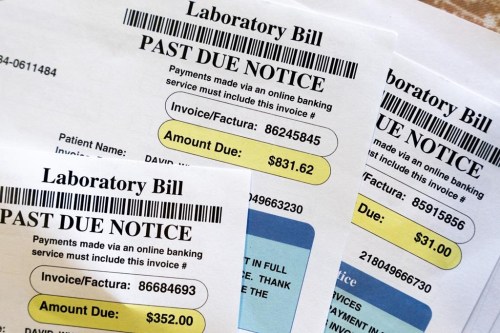
How removing unpaid medical bills from credit reports could help consumers
Advertisement
Read this article for free:
or
Already have an account? Log in here »
To continue reading, please subscribe:

Digital Subscription
One year of digital access for only $205*
- Enjoy unlimited reading on winnipegfreepress.com
- Read the E-Edition, our digital replica newspaper
- Access News Break, our award-winning app
- Play interactive puzzles
*First annual payment billed as $205.00 + GST for one year. This annual subscription will automatically renew at $233.00 + GST every 52 weeks (10% off the regular annual price of $259.35). Offer available to new and qualified returning subscribers only. Cancel any time.
To continue reading, please subscribe:
Add Free Press access to your Brandon Sun subscription for only an additional
$1 for the first 4 weeks*
- Enjoy unlimited reading on winnipegfreepress.com
- Read the E-Edition, our digital replica newspaper
- Access News Break, our award-winning app
- Play interactive puzzles
*Your next Brandon Sun subscription payment will increase by $1.00 and you will be charged $17.95 plus GST for four weeks. After four weeks, your payment will increase to $24.95 plus GST every four weeks.
Read unlimited articles for free today:
or
Already have an account? Log in here »
Hey there, time traveller!
This article was published 07/01/2025 (640 days ago), so information in it may no longer be current.
NEW YORK (AP) — Lenders will no longer be able to consider unpaid medical bills as a credit history factor when they evaluate potential borrowers in the U.S. for mortgages, car loans or business loans, according to a rule the Consumer Financial Protection Bureau finalized Tuesday.
Removing medical debts from consumer credit reports is expected to increase the credit scores of millions of families by an average of 20 points, the bureau said. The CFPB says its research showed that outstanding health care claims are a poor predictor of someone’s ability to repay a loan yet often are used to deny mortgage applications.
The three national credit reporting agencies — Experian, Equifax and TransUnion — said last year that they were removing medical collections under $500 from U.S. consumer credit reports. The government agency’s new rule goes further by banning all outstanding medical bills from appearing on credit reports and prohibiting lenders from using the information.

The rule is set to take effect 60 days after publication in the Federal Register, although President-elect Donald Trump has proposed sweeping changes and limits to the CFPB’s regulatory reach.
Here’s what to know:
How many people will this affect?
The CFPB estimates the rule will remove $49 million in medical debt from the credit reports of 15 million Americans. According to the agency, one in five Americans have at least one medical debt collection account on their credit reports, and over half of collection entries on credit reports are for medical debts.
The problem disproportionately affects people of color, the CFPB has found: 28% of Black people and 22% of Latino people in the U.S. carry medical debt versus 17% of white people. While the national credit reporting agencies voluntarily agreed to disregard medical debt below $500, many consumers have amounts much higher than this threshold on their reports.
What will the impact be for consumers?
The CFPB says its action will give millions of consumers increased access to loans and lead to the approval of approximately 22,000 additional mortgages a year. Americans with outstanding medical bills may see their credit scores rise by an average of 20 points, according to the bureau.
The rule was also drafted to increase privacy protections and to help keep debt collectors from using the credit reporting system to coerce people into paying bills they don’t owe. The CFPB has found that consumers frequently receive inaccurate bills or are asked to pay bills that should have been covered by insurance or financial assistance programs.
What’s more, lenders will be barred from using information about medical devices, such as prosthetic limbs, to make them serve as collateral for a loan and subject to repossession, according to the CFPB’s announcement.
How are advocates responding?
Nonprofits in the healthcare space are pleased.
“This decision is great news for everyday Americans,” said Carrie Joy Grimes, founder of personal finance organization WorkMoney. “Medical debt is not a reflection of being bad with money — any one of us can experience illness or injury. With this new rule, Americans will now be able to focus less on the strain of medical debt and more on getting back on their feet.”
Patricia Kelmar, health care campaigns director for the U.S. Public Interest Research Group, said the rule would help “many financially responsible families who have accumulated medical debt from unpredictable health issues, high out-of-pocket costs, insurance claim denials and billing errors.”
What should you do after receiving an unexpectedly high medical bill?
While high medical bills are common in the US, including for individuals and households with insurance, there are ways to get relief.
First, determine whether you qualify for charity care. Federal law requires nonprofit hospitals to lower or write off bills for individuals depending on household income. To determine if you qualify, do an internet search for the hospital or health care provider along with the phrase “charity care” or “financial assistance policy.” The nonprofit organization Dollar For also provides a simplified online tool for patients.
Next, appeal under the provisions of the No Surprises Act, a federal law that says insurance companies must reasonably cover any out-of-network services related to emergency and some non-emergency medical care. If you’re being charged more than you’re used to or expect when you receive in-network services, that bill may be illegal.
Also: Always ask for an itemized bill. Medical billing is notoriously complicated and rife with errors. An itemized bill includes the billing codes of all care received. If something is off between these codes and the care provided, contesting your bill can yield changes.
Another approach — comparing the bill with insurance companies’ estimates of fair charges for services can also help. If the price you were charged is more than average, you may have your costs lowered. You could even take the provider to small claims court over the discrepancy – or let them know you have a case.
Finally, always compare your insurance company’s “explanation of benefits” to the bill. The hospital’s bill must match the explanation of costs that are covered and not covered. If it does not, you have another reason not to pay and to ask the provider to work with your insurance company further first.
Even after taking these steps, you can always appeal health claims with your insurance company if you believe there is any reason the bills should be covered entirely or more than the company initially decided. You may also contact your state insurance commissioner for support.
___
This version has been corrected to show a consumer organization mentioned in the 13th paragraph is the U.S. Public Interest Research Group, not the U.S. Public Interest Resource Group.
___
The Associated Press receives support from Charles Schwab Foundation for educational and explanatory reporting to improve financial literacy. The independent foundation is separate from Charles Schwab and Co. Inc. The AP is solely responsible for its journalism.