Facts, not fear: Inside Mexico’s pioneering drug harm reduction programs
Advertisement
Read this article for free:
or
Already have an account? Log in here »
To continue reading, please subscribe:

Digital Subscription
One year of digital access for only $205*
- Enjoy unlimited reading on winnipegfreepress.com
- Read the E-Edition, our digital replica newspaper
- Access News Break, our award-winning app
- Play interactive puzzles
*First annual payment billed as $205.00 + GST for one year. This annual subscription will automatically renew at $233.00 + GST every 52 weeks (10% off the regular annual price of $259.35). Offer available to new and qualified returning subscribers only. Cancel any time.
To continue reading, please subscribe:
Add Free Press access to your Brandon Sun subscription for only an additional
$1 for the first 4 weeks*
- Enjoy unlimited reading on winnipegfreepress.com
- Read the E-Edition, our digital replica newspaper
- Access News Break, our award-winning app
- Play interactive puzzles
*Your next Brandon Sun subscription payment will increase by $1.00 and you will be charged $17.95 plus GST for four weeks. After four weeks, your payment will increase to $24.95 plus GST every four weeks.
Read unlimited articles for free today:
or
Already have an account? Log in here »
Hey there, time traveller!
This article was published 16/03/2025 (574 days ago), so information in it may no longer be current.
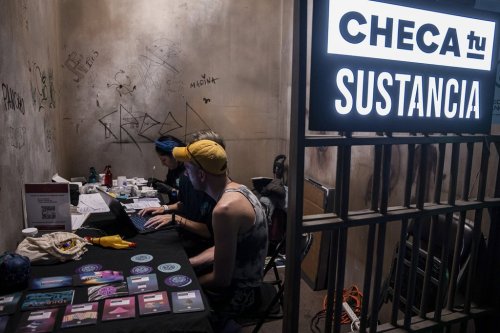
MEXICO CITY (AP) — Under warm strobe lights and pulsing house beats, a recent festival in Mexico City offered more than music, food and booze. Amidst the usual festival fare, a booth provided free, anonymous drug testing.
The initiative, known as “Checa tu Sustancia” (Check Your Substance), is one of several recent efforts by Mexican civil society to reduce risk among people taking drugs. Spearheaded by the Instituto RIA, a Mexico-based drug policy research and advocacy organization, it aims to address drug use from a public health and social justice perspective, rather than a security one.
In a well-lit corner of the festival, members of the Instituto RIA used reagents and laboratory porcelain plates to test substances that some of the partygoers planned to use and recorded the data. Their analysis uses color changes to indicate what’s in the drug: It can reveal the presence of adulterants but not their exact proportion.
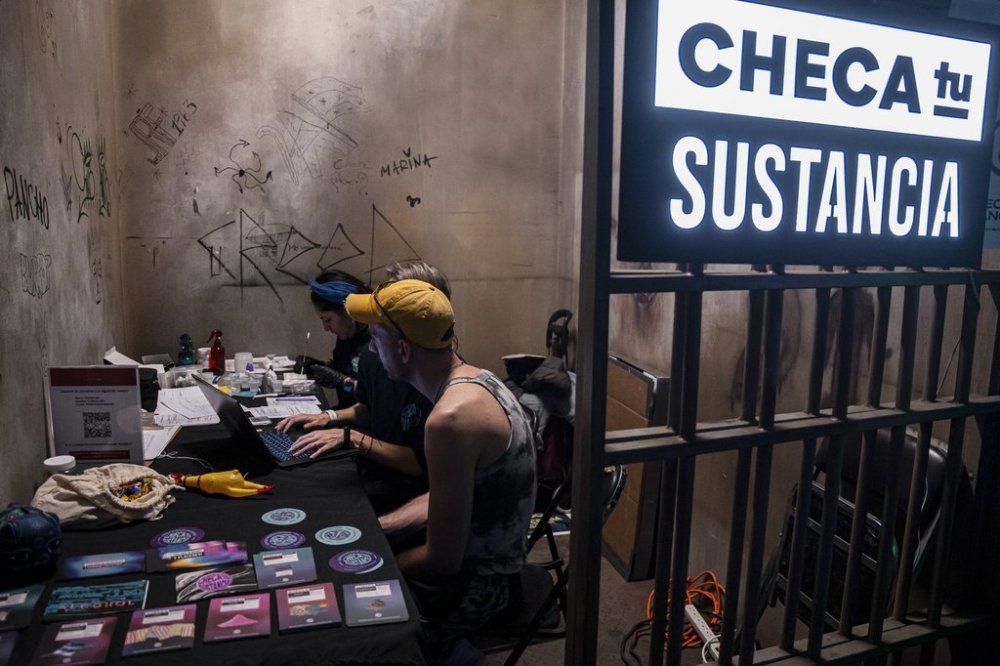
They also offered test strips that can detect the presence of fentanyl and nasal sprays of naloxone, a medication designed to rapidly reverse opioid overdose.
Also available were informational flyers detailing the effects of various psychoactive substances and what to do to reduce the risks associated with using them, including simple but critical measures like staying hydrated and eating well.
While some partygoers seemed wary of the initiative, others approached it with curiosity.
“(There is) amazement, but also a little bit of fear, because there is a whole context of criminalization,” said social psychology student Jessica Reyes Moreno, 27, a volunteer with Checa tu Sustancia.
When unexpected substances are detected, users receive detailed information on what they are, about their risks, potential interactions with other substances and dosage adjustments, empowering them to make informed choices.
Harm reduction vs. abstinence
When people understand that the focus is not on prohibiting but on offering information and safe, non-judgmental spaces where they can be heard, trust is built, said Reyes Moreno.
“I think it’s information we should have. Because (drug use) is taboo, and if we’re uninformed, we can overdose,” said a 34-year-old Mexican partygoer, who requested anonymity due to his use of illicit substances.
He said he feels there isn’t enough information about illegal drugs in Mexico, and when there is, it’s either confusing or all stigma. “It’s just ‘Don’t do it,’ but there’s no such thing as ‘If you do it, take this precaution.’”
The “don’t do it” approach sees abstinence as the solution. In contrast, harm reduction, as defined by Harm Reduction International, aims to minimize the negative health, social and legal effects of substance use by working with people without judgment or requiring them to stop using drugs.
The approach focuses more on people — and their communities— than on the substance.
“We never say, ‘you shouldn’t consume this,’” said Zara Snapp, a political scientist and director of the Instituto RIA. “The best way to reduce your risks is not to consume at all. But if you have made the decision to consume, we want you to have as much information as possible so you can take care of yourself.”
‘Choose to be happy’
The prohibitionist, hardline approach of the war on drugs in Mexico has led to the perception of the user as someone who is necessarily associated with drug trafficking or criminal activities.
Earlier this year, Mexico President Claudia Sheinbaum unveiled her government’s latest anti-drug campaign, “Stay away from drugs. Fentanyl kills,” which centers on the synthetic opioid responsible in its deadliest year for more than 70,000 overdose deaths each year in the U.S. — now down to an estimated 52,000 deaths a year.
Aimed at young Mexicans, the campaign frames drug use as a public health issue, but some of the videos and glowing neon billboards show scenarios in which death and loneliness (drug use) are contrasted with life and family (not using drugs). They read, “Choose to be happy.”
“It’s not that if I use drugs I won’t be happy, or if I stop using drugs I’ll be happy,” said Lilia Pacheco, operational director of PrevenCasa A.C., a Tijuana-based organization that runs harm-reduction initiatives for opioid users, mostly deportees from the United States who report that they started using in that country.
“How can we say that to someone who is using because they are cold, hungry or in withdrawal?” she said.
Mexico’s health department did not immediately respond to inquiries regarding concerns that its latest campaign stigmatizes drug use.
Dr. Carlos Magis, a professor at Mexico’s National Autonomous University’s medical school and member of a working group on opioids, said that stigma poses serious challenges. He cited examples of health workers refusing treatment without abstinence, limited access to naloxone or the scarcity of public methadone clinics.
Breaking down fear and social isolation
A recent report by the Mexican Observatory of Mental Health and Drug Use, found that between 2013 and 2024, 5,901 people in Mexico were treated for emergencies related to opioid use, with it trending up.
PrevenCasa reduces harm not by asking users to stop using, but by showing that their lives matter by providing them with safe injection equipment, showers, toiletries and social events like Friday movie nights.
“These interventions improve quality of life, unlike a sign that says ‘fentanyl kills you,’” said Pacheco. “The right to health should be universal.”
Both Pacheco and Snapp emphasized that collective care is at the heart of harm reduction efforts. Whether practiced in the facilities of organizations working on the border or at electronic music festivals, the goal is to break down social isolation and fear in concrete ways.
“This is a service that will save lives…it’s very forward-thinking,” said a 43-year-old man, who requested anonymity because he is a user of illicit substances, after members of Instituto RIA tested his ecstasy at a recent festival.
He said that drug testing kits are available in the United States, where he’s from, but that in his experience so far, it’s something people mostly do on their own or behind closed doors.
The visibility and organization of Checa tu Sustancia was a surprise to him.
“I feel good that I’m not doing anything wrong. I’m just here to have fun, but now with peace of mind,” he said with a smile. He then rejoined his friends and disappeared into the dancing crowd.
____
Follow AP’s coverage of Latin America and the Caribbean at https://apnews.com/hub/latin-america