NYC will eventually have to abandon part of its water supply if it keeps getting saltier

Advertisement

Advertise with us

The suburban reservoirs that supply 10% of New York City's vaunted drinking water are getting saltier due to decades of road salt being spread near the system — and they will eventually have to be abandoned if nothing is done to reverse the trend, city officials warn.

Read this article for free:


or

Already have an account? Log in here »

To continue reading, please subscribe:

Subscribe and receive a limited-edition Free Press branded hat or tote.

Digital Subscription

One year of digital access for only $205*

  • Enjoy unlimited reading on winnipegfreepress.com
  • Read the E-Edition, our digital replica newspaper
  • Access News Break, our award-winning app
  • Play interactive puzzles

*First annual payment billed as $205.00 + GST for one year. This annual subscription will automatically renew at $233.00 + GST every 52 weeks (10% off the regular annual price of $259.35). Offer available to new and qualified returning subscribers only. Cancel any time.

To continue reading, please subscribe:

Add Free Press access to your Brandon Sun subscription for only an additional

$1 for the first 4 weeks*

  • Enjoy unlimited reading on winnipegfreepress.com
  • Read the E-Edition, our digital replica newspaper
  • Access News Break, our award-winning app
  • Play interactive puzzles
Start now

*Your next Brandon Sun subscription payment will increase by $1.00 and you will be charged $17.95 plus GST for four weeks. After four weeks, your payment will increase to $24.95 plus GST every four weeks.

Hey there, time traveller!
This article was published 21/03/2025 (550 days ago), so information in it may no longer be current.

The suburban reservoirs that supply 10% of New York City’s vaunted drinking water are getting saltier due to decades of road salt being spread near the system — and they will eventually have to be abandoned if nothing is done to reverse the trend, city officials warn.

The plug wouldn’t have to be pulled until early next century, according to a new study. But the soaring saltiness could eventually affect the famous taste of the Big Apple’s water, which is sometimes called the champagne of tap water, and poses a challenge to managers of a system that serves more than 9 million people.

“The conclusion of this study is that if we don’t change our ways, in 2100 the Croton Water System becomes a nice recreational facility, but it ceases to be a water supply,” Rohit Aggarwala, the city’s environmental protection commissioner, said in an interview with The Associated Press. “And that will directly impact everybody who drinks New York City water.”
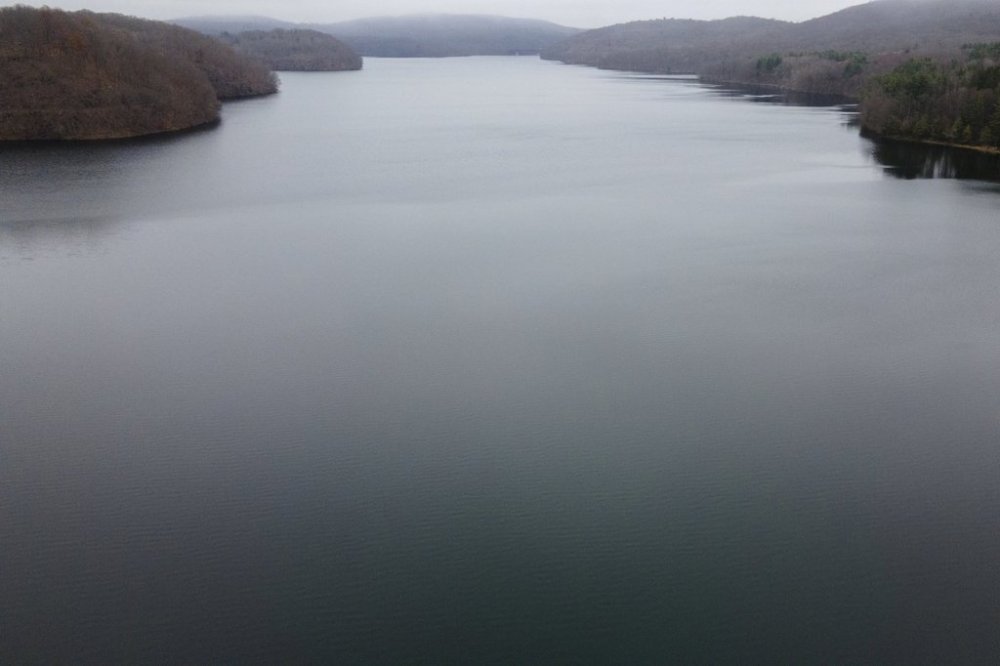
The New Croton Reservoir that supplies part of New York City's drinking water is seen in Cortlandt, N.Y., on Thursday, March 20, 2025. (AP Photo/Ted Shaffrey)

The Croton system dates back to 1842 — when the first Croton Aqueduct began delivering water to a reservoir in what is now Manhattan’s Central Park — and is now comprised of 12 reservoirs and three controlled lakes north of the city.

The report found the concentration of chlorides — an indicator of salinization — tripled from 1987 to 2019 in the system’s main reservoir, which is about 20 miles (32 kilometers) north of the city line. Concentrations are on track to exceed the state’s maximum contaminant level for chloride by 2108.

The report found salinity increases across the sprawling system of city reservoirs in upstate New York. However, the problem is far less of an issue in the Delaware and Catskill watersheds west of the Hudson River, which supply about 90% of the city’s water. That’s likely because there’s far less development in those watersheds.

Road salt is considered a main driver of the increase, along with sewage treatment plant discharges and water softeners. Millions of tons of rock salt is spread on U.S. roads each winter as a cheap and effective way to reduce accidents.

“It’s really a problem across the country in areas with a lot of snow,” said Shannon Roback, science director for the environmental group Riverkeeper. “We’ve seen rising levels of salt in water in the Northeast, in the Midwest and in most places that use road salt.”

Roback noted that high salt levels in drinking water pose a host of environmental concerns and can be harmful to people on low-sodium diets.

Aggarwala said the city has a few options.
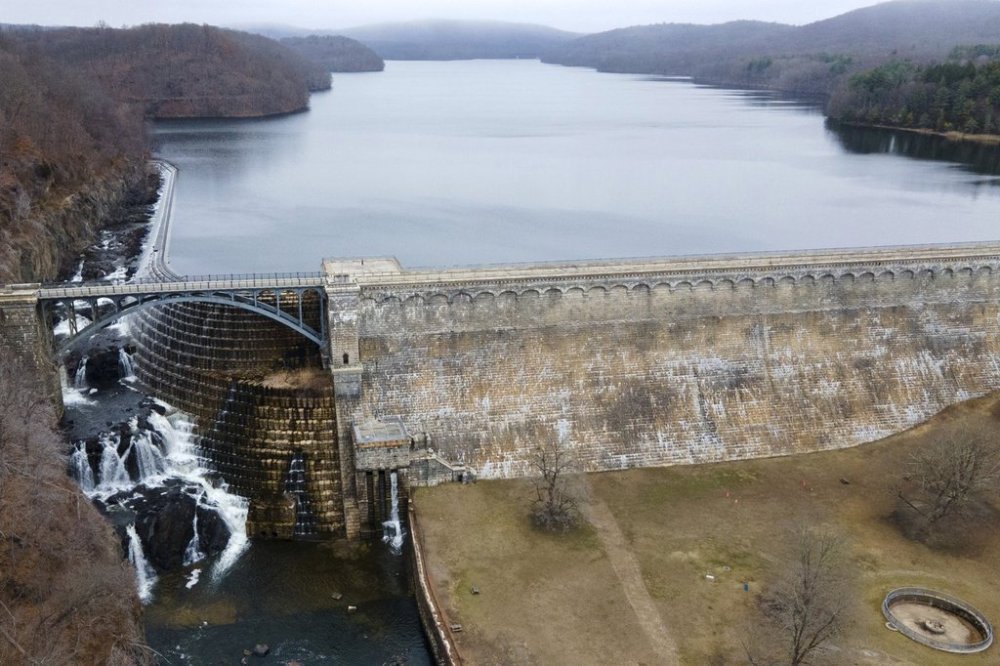
The New Croton Dam and the New Croton Reservoir that supplies part of New York City's drinking water is seen in Cortlandt, N.Y., on Thursday, March 20, 2025. (AP Photo/Ted Shaffrey)

Salt can be removed from water supplies through reverse osmosis systems, though the technology is expensive and requires a lot of energy. The city also could mix Croton water with less salty water from its other two watersheds. But the commissioner said that would not be a solution for the more than a dozen municipalities north of New York City that draw water from the Croton system.

City officials believe reducing the use of road salt locally is the most sensible option. That could involve persuading state and local road crews to use alternatives to salt, or sensors on plows to gauge road surface temperatures, or shutting off the applicators when plows make U-turns or K turns.

State Sen. Pete Harckham, who represents the area, called the new report alarming, but not surprising given a number of community wells taken offline due to high chloride levels. The Democrat is sponsoring bills that would address the road salt issue, including one that would study the issue in the Croton watershed.

“State agencies, local governments, everyone needs to come together on this,” he said, “because this is a real challenge.”

Report Error Submit a Tip

More Stories

Puzzles Palace

1 minute read Monday, Jul. 27, 2026

To solve our puzzles, please subscribe with this special offer: |

Former private-school teacher jailed nine months for luring after sending messages declaring love for teen

Dean Pritchard 4 minute read Preview

Former private-school teacher jailed nine months for luring after sending messages declaring love for teen

Dean Pritchard 4 minute read 5:06 PM CDT

A former Catholic school teacher who sent inappropriate romantic messages to a teenage student, professing his love for her, has been sentenced to nine months in jail.

Ketan Badiani, 59, previously pleaded guilty to one count of child luring connected to more than 150 messages he sent the girl between October 2024 and March 2025 while a teacher at St. Maurice School.

Provincial court Judge Tim Killeen said he was satisfied Badiani had no sexual intent in sending the messages, noting a forensic psychologist’s report that described him as a lonely, isolated man with few friends and a limited history of social interaction.

“He appears to have genuinely cared for (the student) and somehow thought she would reciprocate his feelings,” Killeen said.

Read
5:06 PM CDT

Today’s horoscope

Georgia Nicols 4 minute read Preview

Today’s horoscope

Georgia Nicols 4 minute read 2:00 AM CDT

MOON ALERT: Avoid shopping (except food and gas) and important decisions from 9 a.m. until 12:45 p.m. After that, the moon moves from Capricorn into Aquarius.

ARIES (March 21-April 19)

You’re high-viz as this day begins. People notice you. It’s a high-energy day and excellent for communication with partners, spouses and your kids. Discussions about the arts, vacations and fun outings will be interesting and imaginative.

TAURUS (April 20-May 20)

Read
2:00 AM CDT

Serious crash at West Kildonan intersection known for collisions

Nicole Buffie 3 minute read Preview

Serious crash at West Kildonan intersection known for collisions

Nicole Buffie 3 minute read Updated: Yesterday at 6:09 PM CDT

Residents in West Kildonan say an intersection that was the site of a serious car crash Sunday morning is notoriously dangerous.

Rob Lick heard a loud bang around 7 a.m. and rushed out of his home on Leila to see what the commotion was. He saw two crushed SUVs, a white and black one, in the intersection. Police vehicles arrived shortly after.

“It sounded like when (garbage trucks) drop a big dumpster,” he said. “I heard somebody crying or wailing, they were standing by the vehicle so I don’t know who exactly it was or if someone was injured.”

The sound of sirens followed shortly after when emergency crews came to the scene. The intersection was immediately blocked off.

Read
Updated: Yesterday at 6:09 PM CDT

Hellebuyck standoff caused by… Nathan MacKinnon?

Mike McIntyre 6 minute read Preview

Hellebuyck standoff caused by… Nathan MacKinnon?

Mike McIntyre 6 minute read Friday, Sep. 18, 2026

Looking for someone to blame in the Connor Hellebuyck fiasco and cast as public enemy No. 1? How about long-time Winnipeg Jets nemesis Nathan MacKinnon?

Allow us to explain as we fire up the time machine and head back to February in Italy.

Oh, what could have been if MacKinnon had been able to score on what appeared to be an open net late in the third period of the men’s gold medal game with Hellebuyck down and seemingly out of position.

Instead, the star forward fired wide, keeping the score deadlocked at 1-1 as the clock ticked down on regulation.

Read
Friday, Sep. 18, 2026

NYC will eventually have to abandon part of its water supply if it keeps getting saltier

Michael Hill, The Associated Press 4 minute read Preview

NYC will eventually have to abandon part of its water supply if it keeps getting saltier

Michael Hill, The Associated Press 4 minute read Friday, Mar. 21, 2025

The suburban reservoirs that supply 10% of New York City's vaunted drinking water are getting saltier due to decades of road salt being spread near the system — and they will eventually have to be abandoned if nothing is done to reverse the trend, city officials warn.

The plug wouldn't have to be pulled until early next century, according to a new study. But the soaring saltiness could eventually affect the famous taste of the Big Apple’s water, which is sometimes called the champagne of tap water, and poses a challenge to managers of a system that serves more than 9 million people.

“The conclusion of this study is that if we don’t change our ways, in 2100 the Croton Water System becomes a nice recreational facility, but it ceases to be a water supply,” Rohit Aggarwala, the city’s environmental protection commissioner, said in an interview with The Associated Press. “And that will directly impact everybody who drinks New York City water.”

The Croton system dates back to 1842 — when the first Croton Aqueduct began delivering water to a reservoir in what is now Manhattan’s Central Park — and is now comprised of 12 reservoirs and three controlled lakes north of the city.

Read
Friday, Mar. 21, 2025