Anti-overdose naloxone kits at transit stops could help save lives, study suggests

Advertisement

Advertise with us

VANCOUVER - Researcher Benjamin Leung carries a naloxone kit in his backpack in case of encountering an opioid overdose — but he admits that's about as practical as carrying a fire extinguisher in case of fire.

Read this article for free:


or

Already have an account? Log in here »

To continue reading, please subscribe:

Subscribe and receive a limited-edition Free Press branded hat or tote.

Digital Subscription

One year of digital access for only $205*

  • Enjoy unlimited reading on winnipegfreepress.com
  • Read the E-Edition, our digital replica newspaper
  • Access News Break, our award-winning app
  • Play interactive puzzles

*First annual payment billed as $205.00 + GST for one year. This annual subscription will automatically renew at $233.00 + GST every 52 weeks (10% off the regular annual price of $259.35). Offer available to new and qualified returning subscribers only. Cancel any time.

To continue reading, please subscribe:

Add Free Press access to your Brandon Sun subscription for only an additional

$1 for the first 4 weeks*

  • Enjoy unlimited reading on winnipegfreepress.com
  • Read the E-Edition, our digital replica newspaper
  • Access News Break, our award-winning app
  • Play interactive puzzles
Start now

*Your next Brandon Sun subscription payment will increase by $1.00 and you will be charged $17.95 plus GST for four weeks. After four weeks, your payment will increase to $24.95 plus GST every four weeks.

Hey there, time traveller!
This article was published 23/03/2025 (532 days ago), so information in it may no longer be current.

VANCOUVER – Researcher Benjamin Leung carries a naloxone kit in his backpack in case of encountering an opioid overdose — but he admits that’s about as practical as carrying a fire extinguisher in case of fire.

Instead Leung is now advocating a new tactic of placing the overdose-reversing kits at transit locations near where drug poisonings are known to occur, after co-authoring a study suggesting the benefits of the strategy.

“We just want to know, ‘Where can I go get one so that I can use it right away,'” said Leung.

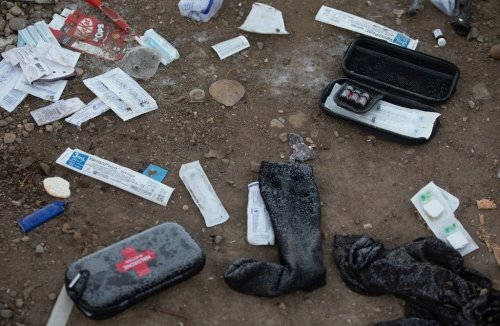
Naloxone kits lie on the ground at a homeless encampment in Edmonton in this file photo from on Friday, December 29, 2023. THE CANADIAN PRESS/Jason Franson

The study, published in the Canadian Medical Association Journal on March 17, found that naloxone kits placed at public transit locations had the “greatest coverage” and efficiency for potentially reversing drug overdoses.

It compared the locations of 14,089 opioid poisonings in Metro Vancouver from 2014 to 2020 with 647 locations supplying take-home naloxone.

Those locations “covered” about 35 per cent of poisonings, meaning they were within a three-minute walk.

By comparison, placing naloxone at just 10 particular transit stops resulted in coverage of more than 20 per cent, while 1,000 kit locations at transit stops would have resulted in coverage of more than 53 per cent.

While “blanket placement” of kits at take-home naloxone locations meant coverage of a “substantial portion” of poisonings, “optimized placement … at transit locations was most effective at improving public accessibility of naloxone,” the study says.

Placing kits at pharmacies meanwhile resulted in coverage of about 22 per cent, while placement at fast-food restaurants was 16.5 per cent.

Leung, a research fellow at Duke University in North Carolina and a recent PhD graduate at the University of Toronto in health systems engineering, said the current program raised the question: “How often are we carrying the naloxone kits with us?”

Leung said he has a kit in his backpack, but doesn’t always carry his backpack around — just as we don’t always carry a fire extinguisher.

The study led by Leung identified more than 8,900 public transit stops across Metro Vancouver as candidate locations for the placement of public naloxone kits.

However, Leung said that while opioid poisoning could occur anywhere, it would not be cost-effective to place naloxone kits at every transit stop.

Naloxone kits cost between $30 and $50 each, and distribution fees and putting them in a container for public access raised the cost to between $150 and $200 per kit, said Leung.

“We’re not necessarily saying we should put one on every bus stop, but in high-risk areas,” said Leung.

Leung said public transit stops are “easily recognizable.”

“We already do this strategy with defibrillators … and we can use this same kind of strategy to inform us of where these naloxone kits should be placed,” he said.

He added that downtown Vancouver, Surrey, and New Westminster are overdose “hot spots” based on the research.

Leung said downtown Vancouver, north of False Creek, is “well-served” by the current take-home naloxone programs, but coverage of other areas needs to be improved.

“We can strike a balance of between having them consistently available in places that are easy to remember but also in high-risk areas or areas experiencing high rates of opioid poisoning where we can best allocate our resources.”

The study said researchers hope the findings will inform policy-makers to maximize naloxone accessibility and prevent overdose deaths.

More than 16,000 people have died of toxic drug overdoses in B.C. since the province declared a public health emergency in 2016.

The BC Coroners Service recently announced that 152 people died of toxic drug overdoses in January. That was down more than 30 per cent from January 2024, part of a broad decline in overdose fatalities across Canada and the United States.

This report by The Canadian Press was first published Mar. 23, 2025.
Report Error Submit a Tip

More Stories

Career, domestic shake-up could bode well

Maureen Scurfield 4 minute read Yesterday at 2:00 AM CDT

DEAR MISS LONELYHEARTS: I gave a big “present” to my husband this summer and it backfired royally.

My gift? He was free to work overtime without family concerns for the whole summer, to give the big boost to his business, which he needed badly. My newly-retired parents were happy to keep us at their cottage for the summer, and have the grandkids close to them. My dad stood in as the active on-site father figure, and he loved it! This was a break I know my husband never thought he was going to get, after marrying me and having kids right away.

I thought his work dream these days was to go from a medium to a major competitor in his building field! Summer is the biggest money-making time for him, so I really wanted to support him in that.

But a major shock was waiting for me at summer’s end! My husband wants to go back to university, first part-time and later full-time. And he needs me to go back to my career! Another shock? He’s already spoken to my parents behind my back!

Mayoralty candidate Vogiatzakis decries war of words

Joyanne Pursaga 4 minute read Preview

Mayoralty candidate Vogiatzakis decries war of words

Joyanne Pursaga 4 minute read Friday, Sep. 4, 2026

A mayoral candidate took aim at personal insults among two of his competitors Friday, stressing the election campaign should focus on city issues instead.

“I’m really embarrassed by the mayoral candidates slinging mud at each other. We should be more professional … I don’t think we need to bring up people’s past or garbage that they’ve been involved in. I think this needs to be about the City of Winnipeg and what we’re going to do for the City of Winnipeg,” Mike Vogiatzakis said at a press conference Friday.

He confirmed he was referring specifically to skirmishes between Scott Gillingham, who is seeking re-election as mayor, and Kevin Klein, a former city councillor and provincial cabinet minister who registered for the race this week.

Within a few hours of Klein’s Tuesday announcement that he would enter the mayoral contest, Gillingham issued a statement labelling Klein “toxic,” a “Caribbean political fixer” for Peter Nygard and a supporter of U.S. President Donald Trump.

Read
Friday, Sep. 4, 2026

Woman died while getting wisdom teeth out; case raises questions about transparency of dental association

Nicole Buffie 5 minute read Preview

Woman died while getting wisdom teeth out; case raises questions about transparency of dental association

Nicole Buffie 5 minute read Friday, Sep. 4, 2026

The parents of a 23-year-old southwestern Manitoba woman who died after receiving a local anesthetic during a wisdom tooth extraction say they are in the dark about the investigation into their daughter’s death.

Dulaney and Victoria Blatz say the Manitoba Dental Association has been unwilling to give them information about the probe into their daughter’s death, saying the self-governing regulatory body must be more transparent with the public.

“We have pushed through various channels trying to get information, but it’s nothing but stalling and sidelining,” Victoria said Friday. “This has crashed our world to pieces and we just want answers.”

Virginia Blatz went to Boundary Trails Dental Centre in Morden on Nov. 27, 2024, to have her wisdom teeth removed, but never returned home.

Read
Friday, Sep. 4, 2026

Today’s horoscope

Georgia Nicols 4 minute read 2:00 AM CDT

MOON ALERT: There are no restrictions to shopping or important decisions today. The moon is in Cancer.

ARIES (March 21-April 19)

Relations with parents and authority figures might be strained. Resist the urge to be too pushy. Likewise, avoid other people who are pushy. Your best choice is to work hard and get better organized. Fortunately, relations with partners are good.

TAURUS (April 20-May 20)

A life's story: translator, poet, radio host, actor loved life to the fullest

Tiago Resko 7 minute read Preview

A life's story: translator, poet, radio host, actor loved life to the fullest

Tiago Resko 7 minute read Yesterday at 3:00 AM CDT

Born with an innate sense of curiosity, Charles Leblanc always wanted to understand the world around him. To him, words and theatre weren’t just pastimes. They were means of understanding the human experience and helping others see different perspectives.

The poet, translator, actor and radio host dedicated his life to this practice, founding the Winnipeg International Writers’ Festival, establishing French community radio station Envol — where he hosted a show for 25 years — and acting as a core member of the Association of Translators, Terminologists and Interpreters of Manitoba.

Leblanc’s contributions and dedication to Manitoba’s arts and literary scenes made an impact that continues to be felt by the community.

He died June 26 at the age of 75.

Read
Yesterday at 3:00 AM CDT

Agriculture sector wary of ‘strong headwind’ from south

Laura Rance-Unger 5 minute read Yesterday at 2:01 AM CDT

Industry analysts talked in circles on a recent webinar as they discussed the implications for agriculture of Canada’s deteriorating relationship with its largest trading partner.

On one hand, panellists for the hastily convened Canadian AgriFood Policy Institute event acknowledged the futility of negotiating on quicksand: a deal made today with the United States might be sucked into the muck tomorrow.

But on the other, webinar panellists speculated with varying degrees of optimism over what it will take to get negotiators back to bargaining.

This disconnect isn’t unique to this cluster of analysts. However, it underscores the difficulty of coming to terms with the seismic shift in America’s attitudes towards Canada.