Sewage sludge can find a second life on farm fields. Here’s how it’s made

Advertisement

Advertise with us

What goes down your toilet can end up on farm fields across the United States.

Read this article for free:


or

Already have an account? Log in here »

To continue reading, please subscribe:

Subscribe and receive a limited-edition Free Press branded hat or tote.

Digital Subscription

One year of digital access for only $205*

  • Enjoy unlimited reading on winnipegfreepress.com
  • Read the E-Edition, our digital replica newspaper
  • Access News Break, our award-winning app
  • Play interactive puzzles

*First annual payment billed as $205.00 + GST for one year. This annual subscription will automatically renew at $233.00 + GST every 52 weeks (10% off the regular annual price of $259.35). Offer available to new and qualified returning subscribers only. Cancel any time.

To continue reading, please subscribe:

Add Free Press access to your Brandon Sun subscription for only an additional

$1 for the first 4 weeks*

  • Enjoy unlimited reading on winnipegfreepress.com
  • Read the E-Edition, our digital replica newspaper
  • Access News Break, our award-winning app
  • Play interactive puzzles
Start now

*Your next Brandon Sun subscription payment will increase by $1.00 and you will be charged $17.95 plus GST for four weeks. After four weeks, your payment will increase to $24.95 plus GST every four weeks.

Hey there, time traveller!
This article was published 26/03/2025 (542 days ago), so information in it may no longer be current.

What goes down your toilet can end up on farm fields across the United States.

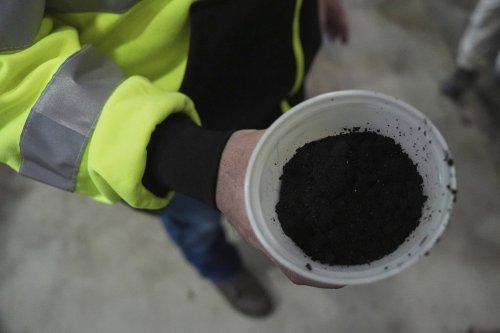
Biosolids, or sewage sludge, are the solid byproducts of the wastewater treatment process. Rich in nutrients, they can be used as fertilizer on agricultural fields or compost on lawns.

But the process for producing these materials can vary greatly, and some unwanted things can end up in those biosolids. A recent study released by the U.S. Environmental Protection Agency suggested that human health risks associated with toxic per- and polyfluoroalkyl substances (PFAS) were elevated in some places where sludge was applied to farm fields.
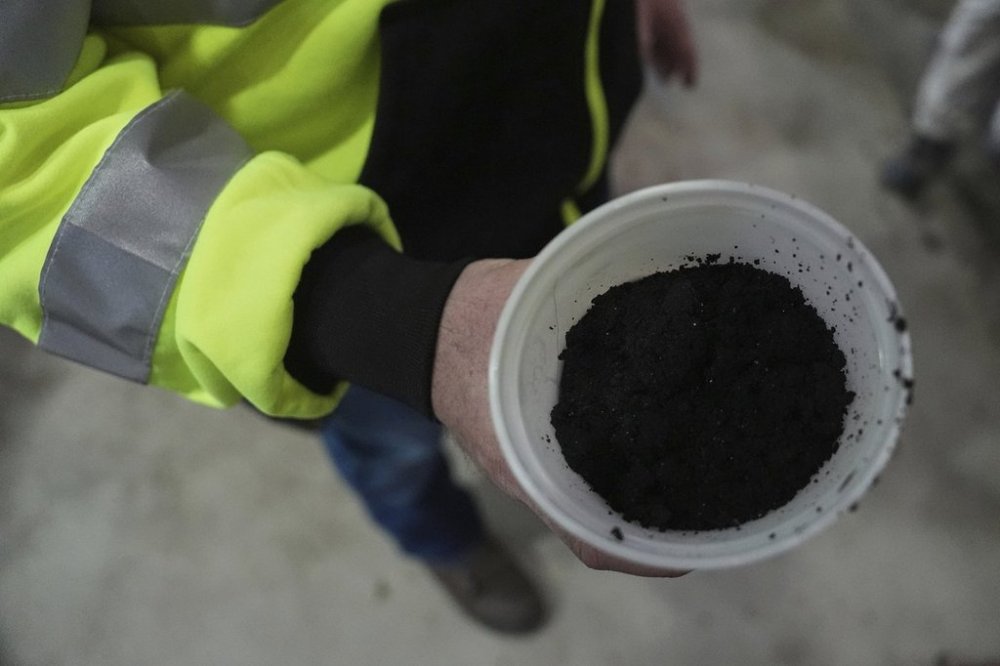
Josh Lutz displays some biosolids, also known as sewage sludge, Friday, March 7, 2025, at a wastewater treatment facility in Lockbourne, Ohio. (AP Photo/Joshua A. Bickel)

The amount of these “forever chemicals” that could end up in biosolids depends on how much were in the water coming into the plant.

“They are very widespread,” said Carsten Prasse, an assistant professor at Johns Hopkins University who studies biosolids. But they’re not in all biosolids and sometimes it’s only in small amounts, he added.

Here’s how they’re made:

At most treatment plants, wastewater is pumped in through large pipes and large debris removal begins immediately. At a facility just outside Columbus, Ohio, a machine screens out large debris such as toilet paper and trash. That debris is collected, compacted and taken to a landfill for disposal.

After large debris is removed, the wastewater flows into a sedimentation tank, a large, open-air and cone-shaped tank where gravity pulls heavier solids to the bottom. A long mechanical arm corrals floating solids into a drain on the top of the tank. A similar arm at the bottom of the tank gathers up the solids there.

The liquid is moved from the sedimentation tanks to an aeration tank where air encourages the growth of microbes that further break down organic particles. The wastewater then gets moved back to another sedimentation tank where more solids are removed.

The solids that are removed at each step of the process are put through thickening centrifuges, then go into these tanks for anaerobic digestion, where microbes continue breaking down organic matter. The tanks are heated to a prescribed temperature for a certain number of days to kill off most pathogens.

After another thickening step, the solids are ready to apply to farm fields based on the U.S. Environmental Protection Agency’s regulations for land-applied biosolids.

“There are values in using biosolids in agriculture because of their high nutrient concentrations,” including nitrogen and phosphorus, Prasse said. They can also help strengthen soil and help with irrigation, he added.

Some treatment facilities further dry out sludge, turning it into a dirt-like material that can emit steam as microbes do their work in decomposition.

The waste that make up biosolids can vary widely depending on what’s in the water. In addition to human waste, biosolids might contain all kinds of everyday household chemicals like beauty products and pharmaceuticals, some of which may contain forever chemicals, Prasse added. At the Columbus facility, the majority of their waste comes from households and businesses.

The Columbus facility tests the final product for metals and nutrients such as phosphorus and nitrogen every month even when they are being stored before land application.

In Columbus, the city takes half of these dirt-like biosolids to a composting facility nearby, where they are mixed with other organic material like trees and leaves and turned into compost after an additional round of heating and aeration to further kill off pathogens. These biosolids are less regulated and can be used on land such as parks or a residential yard.

The Columbus facility, like most such operations, doesn’t test the incoming material for PFAS, an expensive proposition. Dixon said any future testing or treatment of wastewater for PFAS at his facility would depend on future federal regulations.

——

Follow Joshua A. Bickel on Instagram, Bluesky and X @joshuabickel.

——

The Associated Press’ climate and environmental coverage receives financial support from multiple private foundations. AP is solely responsible for all content. Find AP’s standards for working with philanthropies, a list of supporters and funded coverage areas at AP.org.
Report Error Submit a Tip

More Stories

Siloam Mission, WFPS discussing on-site paramedic to reduce staggering number of emergency calls

Scott Billeck 4 minute read Preview

Siloam Mission, WFPS discussing on-site paramedic to reduce staggering number of emergency calls

Scott Billeck 4 minute read 2:00 AM CDT

Winnipeg’s fire-paramedic service and its largest homeless-serving organization are discussing what it would look like to station at least one paramedic at Siloam Mission, as emergency calls to the downtown facility surge.

The ongoing discussions come as Winnipeg Fire Paramedic Service crews were dispatched 1,771 times during the first eight months of the year to the two adjacent Siloam properties at 303 Stanley St. and 300 Princess St.

WFPS said most of the calls were related to overdoses or other consequences of substance use, with the total nearly double the 854 calls recorded over the same period last year. By comparison, there were 831 calls during the same span in 2024, and 591 in 2023.

“The number of emergency calls isn’t sustainable for us as a service, but it’s certainly not sustainable for them as an agency trying to provide services,” WFPS chief Ryan Sneath told the Free Press. “And they recognize that they’re impacting emergency services, not them specifically, but the site in a significant way.”

Read
2:00 AM CDT

‘A new future’: city dentist Cholakis donates $2M to school of dental hygiene

Melissa Martin 3 minute read Preview

‘A new future’: city dentist Cholakis donates $2M to school of dental hygiene

Melissa Martin 3 minute read Updated: 5:04 PM CDT

Dental hygienist training in Manitoba is getting a big boost, after a major gift from a local dentist.

On Thursday, the dental hygiene school at the University of Manitoba’s Dr. Gerald Niznick College of Dentistry unveiled a new $2-million donation from Dr. Ernest Cholakis. It’s the largest gift the program has ever received, and in honour of the funding, the school will be named the Cholakis School of Dental Hygiene.

The gift was unveiled at a ceremony Thursday morning at the Brodie Centre at the U of M's Bannatyne campus. The benefactor and other dignitaries, including Premier Wab Kinew, were in attendance, as well as the three-year program’s current students.

Cholakis, who graduated from the U of M’s dentistry school in 1982, had high praise for the dental hygiene profession.

Read
Updated: 5:04 PM CDT

Canada-U.S. trade relationship is broken, but the damage can — and will — be repaired

Tom Brodbeck 5 minute read Preview

Canada-U.S. trade relationship is broken, but the damage can — and will — be repaired

Tom Brodbeck 5 minute read Yesterday at 1:35 PM CDT

Canada needs to get serious about diversifying its trade beyond the United States. But at the same time, Canadians should expect relations with the U.S. to normalize after Donald Trump is no longer in the White House.

For generations, Canada-U.S. trade was considered almost a fact of geography. The two countries share the world’s longest undefended border, deeply integrated supply chains and a century of commercial relationships.

Canadian manufacturers depend on American customers. American manufacturers depend on Canadian suppliers. Energy, agriculture, automotive production and countless other industries operate across the border as though it barely exists.

That isn’t going to change dramatically, even in the midst of a bitter trade war unleashed by the U.S. president.

Read
Yesterday at 1:35 PM CDT

Sod turned on new apartment complex for Old Kildonan

Aaron Epp 4 minute read Preview

Sod turned on new apartment complex for Old Kildonan

Aaron Epp 4 minute read 7:27 PM CDT

Blue blazers and black hard hats were front and centre as developers and politicians dug their shovels into the ground Friday at the sod-turning ceremony for a new apartment building near the north Perimeter Highway.

Real estate development and investment company Rockport Investment Group Inc. is constructing the building at 928 Fernbank Ave. in the Highland Pointe development in Winnipeg’s Old Kildonan neighbourhood.

The $40-million apartment building will include 90 units and is expected to be completed in the next 24 months.

It’s Phase 1 of 920 North, a three-phase, $160-million project Rockport is undertaking that will result in four multi-family residential developments and a centralized amenities building.

Read
7:27 PM CDT

Steinbach Credit Union member warns others after scammer steals $10K

Scott Billeck 5 minute read Preview

Steinbach Credit Union member warns others after scammer steals $10K

Scott Billeck 5 minute read 5:19 PM CDT

A Winnipeg single mother whose bank account was drained of nearly $10,000 says Steinbach Credit Union needs to warn its members about what she believes is a broader security problem.

The woman, who is not being named to protect her identity, said a scammer gained access to her account earlier this week after calling SCU’s contact centre, claiming to be her and successfully completing the credit union’s authentication process.

She said she knows of at least six others who have experienced similar incidents in which callers impersonate SCU account holders and pass the authentication checks.

The woman discovered something was wrong when her minor son asked why money had been transferred out of an account they jointly hold.

Read
5:19 PM CDT

‘One of a kind’: CEO, philanthropist Doug Harvey dies at 72

Morgan Modjeski 5 minute read Preview

‘One of a kind’: CEO, philanthropist Doug Harvey dies at 72

Morgan Modjeski 5 minute read Updated: Yesterday at 12:57 PM CDT

Doug Harvey, a Winnipeg business titan and philanthropist, has died after battling cancer for more than a decade.

Harvey gave millions of dollars to Winnipeg organizations while he was CEO of DLH Group, a nationwide network of businesses that support heavy duty truck and trailer users.

Loren Remillard, CEO and president of the Winnipeg Chamber of Commerce, said the business community is mourning the loss of the influential businessman who helped shape Winnipeg.

“We are a transportation and logistics hub in Winnipeg and it was partly the result of geography, and a big part because of leaders and visionaries like Doug Harvey,” he said.

Read
Updated: Yesterday at 12:57 PM CDT