Canada loses measles elimination status after ongoing outbreaks
Advertisement
Read this article for free:
or
Already have an account? Log in here »
To continue reading, please subscribe:

Digital Subscription
One year of digital access for only $205*
- Enjoy unlimited reading on winnipegfreepress.com
- Read the E-Edition, our digital replica newspaper
- Access News Break, our award-winning app
- Play interactive puzzles
*First annual payment billed as $205.00 + GST for one year. This annual subscription will automatically renew at $233.00 + GST every 52 weeks (10% off the regular annual price of $259.35). Offer available to new and qualified returning subscribers only. Cancel any time.
To continue reading, please subscribe:
Add Free Press access to your Brandon Sun subscription for only an additional
$1 for the first 4 weeks*
- Enjoy unlimited reading on winnipegfreepress.com
- Read the E-Edition, our digital replica newspaper
- Access News Break, our award-winning app
- Play interactive puzzles
*Your next Brandon Sun subscription payment will increase by $1.00 and you will be charged $17.95 plus GST for four weeks. After four weeks, your payment will increase to $24.95 plus GST every four weeks.
Read unlimited articles for free today:
or
Already have an account? Log in here »
Hey there, time traveller!
This article was published 10/11/2025 (311 days ago), so information in it may no longer be current.
Canada is no longer measles-free because of ongoing outbreaks, international health experts said Monday, as childhood vaccination rates fall and the highly contagious virus spreads across North and South America.
The loss of the country’s measles elimination status comes more than a year after the highly contagious virus started spreading.
Canada has logged 5,138 measles cases this year and two deaths. Both were babies who were exposed to the measles virus in the womb and born prematurely.
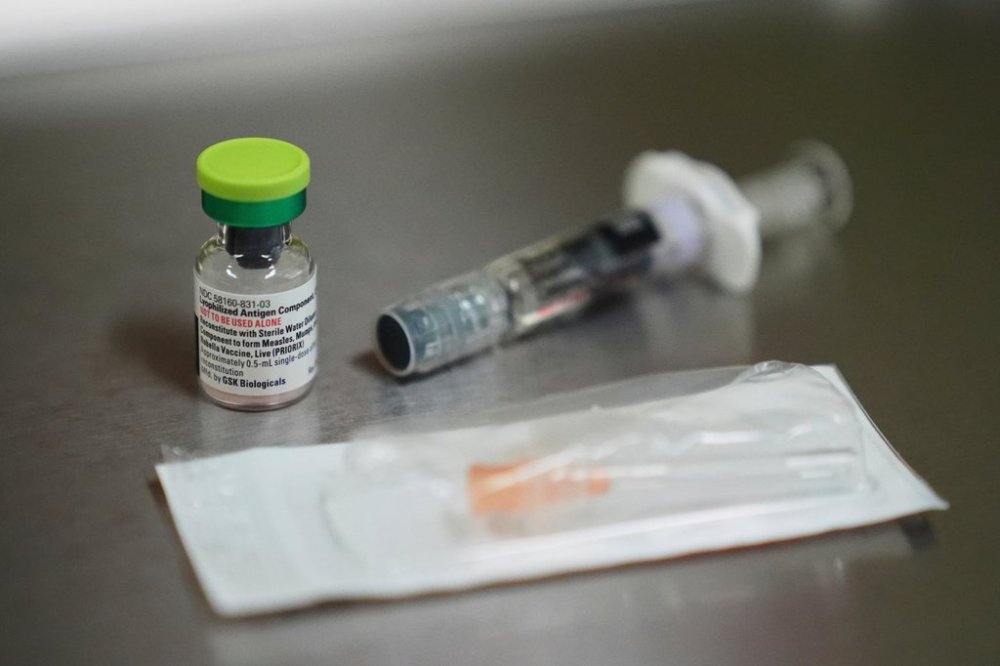
Measles elimination is a symbolic designation, but it represents a hard-won battle against the infectious disease. It is earned when a country shows it stopped continuous spread of the virus within local communities, though occasional cases might still pop up from travel.
Measles typically begins with a high fever followed by a telltale rash that starts on the face and neck. Most people recover, but it’s one of the leading causes of death among young children, according to the World Health Organization. Serious complications, including blindness and swelling of the brain, are more common in young children and adults over age 30.
It is prevented by a vaccine administered routinely and safely to children around the world.
“It’s a deeply disheartening development. It’s a deeply worrisome development. And, frankly, it’s an embarrassing development,” said Jennifer Nuzzo, a Brown University infectious disease expert. “No country with the amount of resources of Canada — or other countries in North America even — should lose their measles elimination status.”
Vaccination campaigns led to elimination
Canada eliminated measles in 1998, followed by the United States two years later. After hugely successful vaccination campaigns, the Americas became the first region in the world to be free of measles in 2016. Health officials estimate the measles vaccine prevented 6.2 millions deaths in the Americas between 2000 and 2023.
But vaccination rates have since slipped below the 95% coverage rate needed to stop outbreaks. Large outbreaks in Venezuela and Brazil in 2018 and 2019 cost the region its elimination status. It was reclaimed in 2024, but ends again with Canada’s loss.
Experts from the Pan American Health Organization, an independent health agency, made the determination after analyzing data on Canada’s outbreaks that showed the virus has spread continuously for a year.
It has never been easy to stop measles from circulating in local communities, Dr. Jarbas Barbosa, director of the Pan American Health Organization, said in a briefing Monday.
“As a region, we have eliminated measles twice,” Barbosa said. “We can do it a third time.”
In a statement, Canadian health officials said they were working with government and community partners to improve vaccination coverage, share data and provide evidence-based guidance.
The virus is one of the most contagious known to medicine. One infected person can spread it to up to 9 out of 10 unprotected people they come into close contact with. Health experts say, by far, the best prevention against measles is the vaccine, which provides 97% protection after two doses.
Barbosa’s organization has confirmed nearly 12,600 cases this year across 10 countries, a 30-fold increase from 2024. The vast majority are in Canada, the U.S. and Mexico, but Bolivia, Brazil, Paraguay, and Belize also have active outbreaks.
In 2024, the region had a 79% vaccination rate, an increase from years past but still too low, he said.
United States could be next to lose status
The U.S. eliminated measles in 2000. That status is at risk even though the large outbreak that killed three and sickened nearly 900 across Texas, New Mexico and Oklahoma earlier this year is over.
Current outbreaks in the U.S. include 34 cases in South Carolina and one hitting towns on the Arizona-Utah border that has sickened more than 150 since mid-August.
A major question now is if either are linked to the Texas outbreak. To lose elimination status, health data must show a continuous chain of measles spread for one year.
International health officials have recommended the U.S. “enhance case investigation protocols,” because closing data gaps is key to stopping the virus from taking hold again, said Dr. Daniel Salas, who leads immunization efforts at the Pan American Health Organization.
The U.S. Centers for Disease Control and Prevention has confirmed 1,681 cases and 44 outbreaks this year, making it the worst year for measles in the U.S. in more than three decades. Only nine states haven’t confirmed cases, according to the CDC.
A large outbreak also continues in Chihuahua, Mexico, where health officials have confirmed 4,430 cases as of last week and 21 deaths, according to state health data.
Mexican and U.S. officials have said the genetic strains of measles spreading in Canada match those in the Texas and Chihuahua outbreaks. All those outbreaks affected certain Mennonite Christian communities who trace their migration over generations from Canada to Mexico to Seminole, Texas.
In August, officials said Mennonite communities in Belize, Argentina, Bolivia, Brazil, and Paraguay had outbreaks of the same type of measles virus.
Mennonite churches do not formally discourage vaccination, though more conservative Mennonite communities historically have low vaccination rates and a distrust of government.
It’s tempting to look at the outbreaks in a vacuum, Nuzzo said. But many are likely linked, she said, not just by sick people traveling but also by anti-vaccine disinformation.
“It’s not a religious prohibition in most of these cases,” she said. “It is just people being, perhaps, distrustful of authorities, but also preyed upon by these anti-vaccine influencers who profit off of the fears that some people may have.”
___
The Associated Press Health and Science Department receives support from the Howard Hughes Medical Institute’s Department of Science Education and the Robert Wood Johnson Foundation. The AP is solely responsible for all content.