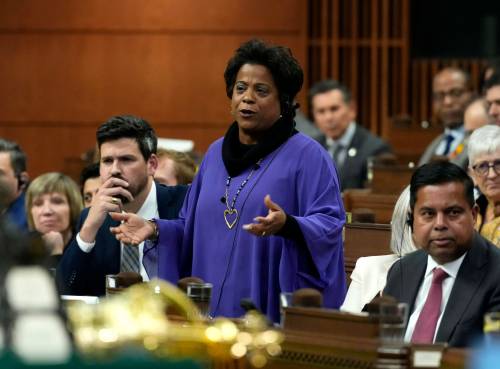
How did Canada’s young people become its unhappiest generation?
Advertisement
Read this article for free:
or
Already have an account? Log in here »
To continue reading, please subscribe:
Digital Subscription
One year of digital access for only $1.44 a week*
- Enjoy unlimited reading on winnipegfreepress.com
- Read the E-Edition, our digital replica newspaper
- Access News Break, our award-winning app
- Play interactive puzzles
*Billed as $5.77 plus GST every four weeks. After 52 weeks, price increases to the regular rate of $19.95 plus GST every four weeks. Offer available to new and qualified returning subscribers only. Cancel any time.
To continue reading, please subscribe:
Add Free Press access to your Brandon Sun subscription for only an additional
$1 for the first 4 weeks*
- Enjoy unlimited reading on winnipegfreepress.com
- Read the E-Edition, our digital replica newspaper
- Access News Break, our award-winning app
- Play interactive puzzles
*Your next Brandon Sun subscription payment will increase by $1.00 and you will be charged $17.95 plus GST for four weeks. After four weeks, your payment will increase to $24.95 plus GST every four weeks.
Read unlimited articles for free today:
or
Already have an account? Log in here »
Hey there, time traveller!
This article was published 15/12/2025 (308 days ago), so information in it may no longer be current.
VANCOUVER – As a teen growing up in Toronto, Bhavik Sharma imagined what life would look like at 25.
He and his high school friends would be starting families. They’d be on six-figure salaries and living comfortably.
Now 27, he’s back living with his parents in Kitchener, Ont., driven out of Toronto by high rent and other costs.
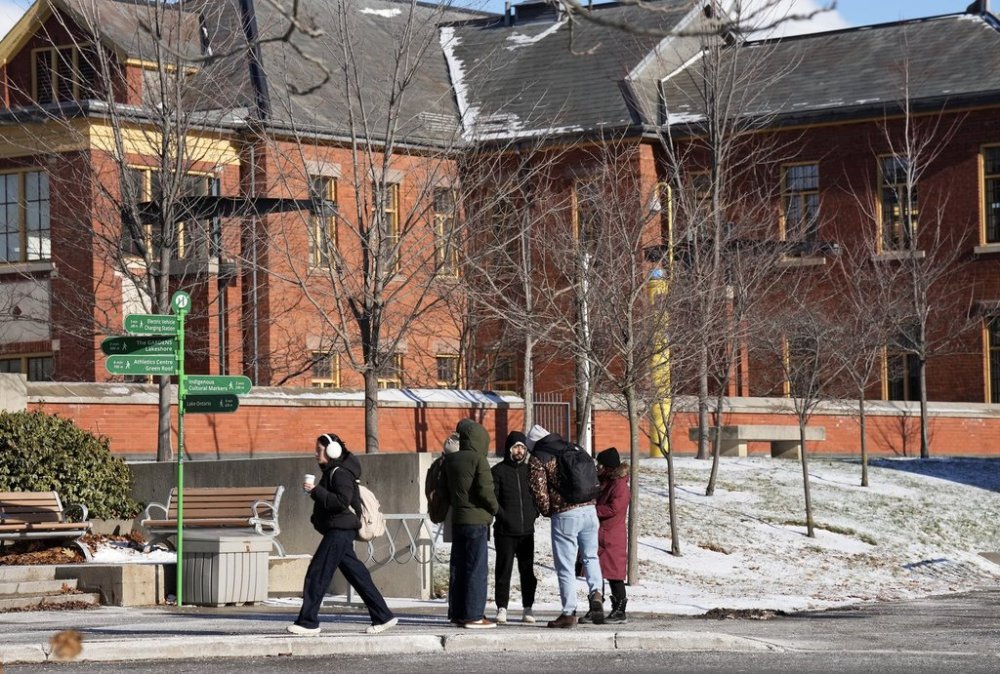
“I think back then, in that generation, it was definitely a lot easier,” Sharma said of the path to adulthood for his parents, who moved to Canada from India about 30 years ago.
“You’d get your job, you would save up, you’d get a house, you could invest in business.”
Now, as he saves for the down payment on his first home, Sharma understands those things come later for many in his generation. And everything costs more, he said, from housing to food.
Sharma is among a generation of Canadians whose idea of a dream life could be in a state of “flux,” researchers say, forcing them to reconsider what it means, and what it takes, to be happy.
From families to finances, benchmarks are happening later for Canada’s young — and their happiness levels have been plummeting.
The World Happiness Report says Canadians under 30 were the happiest age group in the country as recently as 2011.
Now, they’re the unhappiest.
The 2024 edition of the decades-long study of global happiness, published by the Wellbeing Research Centre at the University of Oxford, asked participants to picture their life as a ladder, with the best possible life at 10 and the worst at zero.
While many countries among the 134 covered by the research have also seen happiness levels fall among those under 30 since 2006, the slide of young Canadians down the ladder is exceptional.
Only four countries have seen a worse decline — Jordan, Venezuela, Lebanon and Afghanistan.
Yet, over all age groups, Canada ranked the 15th happiest country. In the 2025 report — which did not contain the same level of detail about young people as last year’s report — Canada ranked 18th.
Anthony McCanny, the lead author of the separate 2024 Canadian Happiness Report, published by the University of Toronto’s Population and Well-being Lab, said young Canadians are reconfiguring expectations.
“We had a vision about what becoming an adult meant in terms of your job, and your financial security and having a home,” he said.
“Exactly what it looks like to reach that later stage of life is changing.”
Young people across Canada interviewed by The Canadian Press described the challenge of building lives they once imagined, bogged down by an unaffordable housing market, struggles to save for the future, online gloom and a growing youth mental health crisis.
Fitness instructor Taylor Arnt of Winnipeg, 27, said she’s processing the idea she might never get married or have children, as she grapples with day-to-day challenges.
Ontario graduate Thivian Varnacumaaran, 25, applied for more than 400 jobs before finding work and considers living with his parents a privilege.
Communications CEO Kathryn LeBlanc, 31, spoke of the demands of the 24-hour news cycle.
And some in a B.C. mental health program told of limited support.
Many also spoke of finding ways to be happy in the moment, even if their lives haven’t yet turned out the way they pictured.
“I am happy, yeah,” said Sharma. Family, friends, vacations and balancing work expectations bring him joy.
“I try to stay positive.”
DEMISE OF THE U-SHAPED TRAJECTORY
Before 2014, well-being in Canada could be broadly described as a U-shaped trajectory. Satisfaction was high among youth, declined to a low point in mid-life, then rose again as people got older.
John Helliwell, an emeritus professor of economics at the University of British Columbia and a founding editor of the World Happiness Report, said that U-shape is no more.
“The happiness of the young has dropped sufficiently far … below that of the middle-aged that used to be the least happy. It’s now the young and then the middle-aged, and then the uprising at the end is still there.”
Helliwell said social and economic conditions are not seen by today’s young as promising, unlike previous generations.
“The chances of getting a job and the chances of getting a job with a future — that’s one dimension. And the other is the price of housing,” he said.
“Where you live is a very important part of how you feel about your life. Feelings of economics and residential security clearly (are) important to happiness, so uncertainty about either of those aspects of life is going to play in a negative way.”
In 2023, the Bank of Canada’s housing affordability index hit its worst level in 41 years. While it has eased, it remains at levels akin to the early 1990s, when interest rates were more than nine per cent.
The situation has been particularly acute for Canada’s young.
Non-profit Generation Squeeze says that in 1986, it took five years for a typical 25-to-34-year-old to save for a 20 per cent down payment on a representative home in Canada.
By 2021, it took 17 years. And in the greater Vancouver and Toronto areas, it was 27.
Other life benchmarks have been shifting, too.
Statistics Canada says the average age of marriage has steadily increased, from 25 in 1968 to 35 in 2019. (Data since has been skewed by the COVID-19 pandemic, which StatCan says saw many delay marriage plans).
Over the same period, the agency says the average age of first-time mothers rose from 22 to 29, while the average age of all mothers rose to nearly 32 in 2024, up from almost 27 in 1976.
“A lot of people don’t prioritize love, kids, as much as they used to,” said Violet Rode, an 18-year-old theatre student at Montreal’s Dawson College.
“And because of the money thing, people aren’t having as many kids, people aren’t going out as on many dates.”
Varnacumaaran, now working as an electrical designer in Markham, Ont., said he longed for his own family and children one day.
But for now, he’s focused on saving, as he lives with his parents.
“I don’t want to spend on unnecessary things, so I try my best to do that,” said Varnacumaaran.
Arnt recently lost her job as a policy analyst and is working as a contracted consultant and group fitness instructor. She said many young people can’t have the same timeline as older generations, whether with marriage, children or financial goals.
“It’s really difficult to plan for a future and think about those goals when you’re struggling to meet your day-to-day basic needs.”
‘ADAPTING TO A NEW WAY THE WORLD IS’
Following the release of the 2024 World Happiness Report, Canadian researchers looked closely at the numbers and confirmed the findings.
But they say the size of the happiness decline among young Canadians could depend on how they were questioned.
McCanny, lead author of the Canadian Happiness Report, said the global study asked people to compare their current life to the best possible life they could be living.
When Statistics Canada asked Canadian youth how satisfied they were currently, the decline in happiness was significantly less dramatic, he said.
Statistics Canada’s Canadian Community Health Surveys found a modest decline in satisfaction for young people from 8.2 in 2015 to 7.9 in 2021, the Canadian report said.
McCanny, 32, called the differences in questions a thin but possibly significant distinction. He said it’s possible the age group is “just in flux.”
“We’re adapting to a new way the world is, which certainly can be very hard to do. But also, when we do ask people if they feel satisfied with their lives, they also say yes,” he said.
“So that does seem to be some indication that things maybe are not entirely bad.”
The social and online environment occupied by today’s young people may be one of those new worlds.
Rode said her generation struggles with their attention span. Social media hampers mental health “one-hundred-thousand-million per cent.”
“Depending on what you’re feeding yourself online, it really changes the way you think,” she said.
Thirty-one-year-old LeBlanc, from Winnipeg, said her generation is expected to be more plugged in than those before.
“It’s like the 24/7 news cycle but on steroids, as we have obligations from work and also algorithms sort of pulling us back in.”
The pull to answer emails creeps into her nights and weekends, she said. Working at a communications firm specializing in social advocacy, it’s easy to have online notifications always turned on.
“If I didn’t put up boundaries, I would work every minute of every day,” said LeBlanc.
Helliwell said data is being collected on social media use and the impact on happiness.
He noted that the decline in happiness among Canadian youth has been smaller in Quebec. Since 2014, it’s slightly up, said the Canadian Happiness Report.
Helliwell remains optimistic for a couple reasons.
He said happiness researchers have found reality is often a lot better than people think. In tests where wallets are dropped to see if they’re returned, people are pessimistic — but twice as many wallets are handed back than people expect.
A key component of being happy where you live is a feeling of community, Helliwell said. His advice: “step out of yourself and get out of your gloom,” and do a small thing to improve the world around you.
“It’s creating the better world yourself by paying more attention to the people you should be paying attention to, by connecting more readily with those around you in positive ways,” he said.
“It’s as simple as the traffic wave … this kind of generalized friendliness has a huge ripple effect.”
Helliwell also said the speed at which happiness has declined is a sign it can be improved.
“Anything that happens that quickly about how people think, it isn’t genetic, it isn’t permanent. It isn’t about life as a whole,” he said.
Nicholas Schorn, 32, a writer who works in a Vancouver café, said they’re in “turmoil” for reasons including the cost of housing, financial and job security, and a lack of support for people working in the arts.
Yet life is “decently happy” for Schorn, who finds comfort in community spaces like a local coffee shop, as well as “soul-nourishing” volunteer work as a mover, helping women leave abusive relationships.

Instead of focusing on distant “green hills,” like home ownership or a secure job, Schorn has drawn their sights closer.
“I’m less so imagining myself when I’m … retired and more so imagining myself like in a couple years,” Schorn said.
“The green hills are like, starting a new (Dungeons & Dragons) campaign or finishing this short story that I’m writing, seeing my family at Christmas, reading a new book.”
— With files by Ritika Dubey and Cassidy McMackon in Toronto, Miriam Lafontaine in Montreal, Brenna Owen and Nono Shen in Vancouver, and Catherine Morrison in Ottawa
This report by The Canadian Press was first published Dec. 15, 2025.