NYC nursing walkout ends as last striking nurses approve new contract

Advertisement

Advertise with us

NEW YORK (AP) — Nurses at a big New York hospital system approved a new contract Saturday, voting to end a major nursing strike after more than a month.

Read this article for free:


or

Already have an account? Log in here »

To continue reading, please subscribe:

Subscribe and receive a limited-edition Free Press branded hat or tote.

Digital Subscription

One year of digital access for only $205*

  • Enjoy unlimited reading on winnipegfreepress.com
  • Read the E-Edition, our digital replica newspaper
  • Access News Break, our award-winning app
  • Play interactive puzzles

*First annual payment billed as $205.00 + GST for one year. This annual subscription will automatically renew at $233.00 + GST every 52 weeks (10% off the regular annual price of $259.35). Offer available to new and qualified returning subscribers only. Cancel any time.

To continue reading, please subscribe:

Add Free Press access to your Brandon Sun subscription for only an additional

$1 for the first 4 weeks*

  • Enjoy unlimited reading on winnipegfreepress.com
  • Read the E-Edition, our digital replica newspaper
  • Access News Break, our award-winning app
  • Play interactive puzzles
Start now

*Your next Brandon Sun subscription payment will increase by $1.00 and you will be charged $17.95 plus GST for four weeks. After four weeks, your payment will increase to $24.95 plus GST every four weeks.

Hey there, time traveller!
This article was published 21/02/2026 (220 days ago), so information in it may no longer be current.

NEW YORK (AP) — Nurses at a big New York hospital system approved a new contract Saturday, voting to end a major nursing strike after more than a month.

More than 4,000 nurses in the privately run NewYork-Presbyterian system went on strike Jan. 12. They are now due to start returning to work in the coming week. The union, called the New York State Nurses Association, said 93% of its members at NewYork-Presbyterian voted to ratify the three-year contract.

Two other big private hospital systems, Montefiore and Mount Sinai, ended their nurses’ walkout earlier this month by inking contract agreements with the same union.
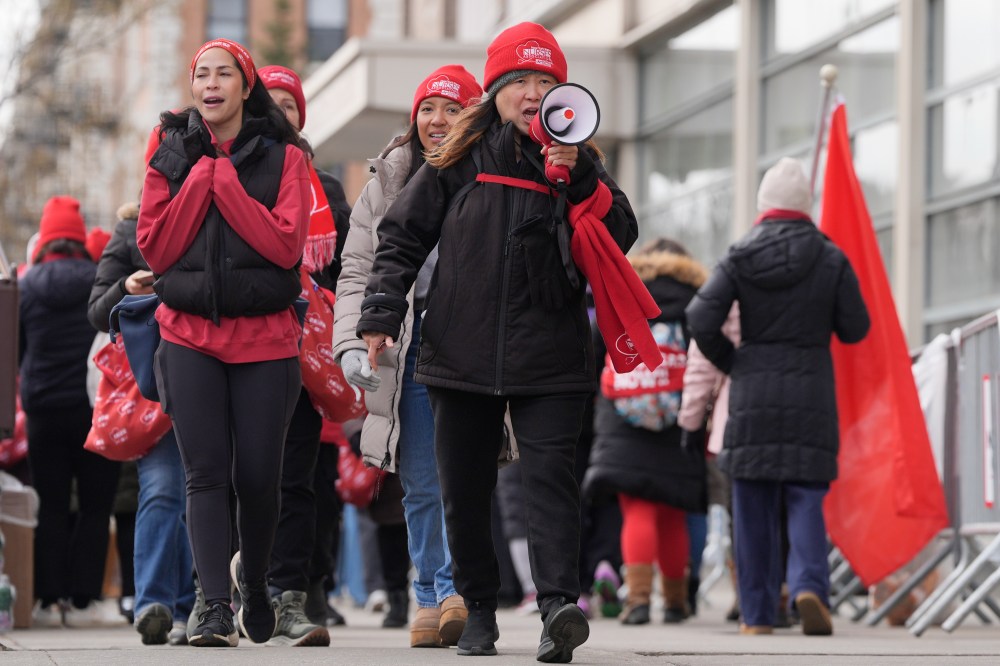
Nurses and their supporters strike in front of NewYork-Presbyterian hospital in New York, Thursday, Feb. 19, 2026. (AP Photo/Seth Wenig)

“We are so happy with the wins we achieved, and now the fight to enforce these contracts and hold our employers accountable begins,” union President Nancy Hagans said in a statement Saturday.

NewYork-Presbyterian said that it looked forward to its nurses’ return and that the contract “reflects our respect for our nurses and the critical role they play as part of our exceptional care teams.”

Both sides had said Friday that they had reached a tentative deal. Union members voted on it Friday and Saturday.

Provisions included staffing improvements, raises topping 12% over three years and safeguards on the use of artificial intelligence, according to the union.

The union has said the strike initially involved about 15,000 nurses overall at Montefiore, Mount Sinai and NewYork-Presbyterian. It affected only some facilities within the three systems and didn’t involve any city-run hospitals.

During the strike, Montefiore, Mount Sinai and NewYork-Presbyterian brought on thousands of temporary nurses, transferred some patients and canceled some procedures. The hospitals insisted they were smoothly delivering care, including complex surgeries. But some vulnerable patients and their families said some routine tasks took longer.

The strikers complained of unmanageable workloads and accused the hospitals of trying to chip away at health benefits. The hospitals contested those claims and said the union’s demands were exorbitant.

Nurses at some Mount Sinai and Montefiore hospitals also walked out in 2023. That strike ended in three days.
Report Error Submit a Tip

More Stories

What does the PC stand for in party’s name? Seems to be Pretty Confused

Tom Brodbeck 5 minute read Preview

What does the PC stand for in party’s name? Seems to be Pretty Confused

Tom Brodbeck 5 minute read 1:11 PM CDT

It should have been obvious from the beginning that the Manitoba Progressive Conservative party was going to have trouble holding itself together under Obby Khan.

The warning came in April 2025, when the now-former PC party leader narrowly won the leadership over far-right populist candidate Wally Daudrich.

Technically, Khan won. Politically, however, it was a more complicated result.

Daudrich received more votes than Khan, but Khan prevailed because the party used a constituency-weighted points system that gave him just enough of an advantage to put him over the top.

Read
1:11 PM CDT

Perfumer battling city hall to keep his shop open

Gabrielle Piché 5 minute read Preview

Perfumer battling city hall to keep his shop open

Gabrielle Piché 5 minute read Yesterday at 5:45 PM CDT

Michael O’Malley has been here before — fighting the City of Winnipeg to keep his business open.

He usually spends his days concocting scents. He’s owned La Parfumerie, a Wolseley shop, since 1993.

Twenty-seven natural perfumes line shelves on 145 Evanson St.’s bottom floor. O’Malley lives above the space.

Now, he’s required to change the home’s zoning or shut out walk-in customers. Either would kill the company, O’Malley said.

Read
Yesterday at 5:45 PM CDT

Wab Kinew as ‘communicator in chief’

Paul G. Thomas 6 minute read Preview

Wab Kinew as ‘communicator in chief’

Paul G. Thomas 6 minute read Yesterday at 2:00 AM CDT

Premier Wab Kinew and his party have been riding high in the polls longer than normal for a government one year or less away from its first re-election contest. One reason is his ubiquitous, dominating communications presence as NDP leader and premier.

The argument here is that Kinew has supplemented his prerogatives as premier and party leader (such as appointing cabinet ministers and approving party nominations) with the skilful use of communications to advance his policy agenda, boost his personal popularity and maintain the competitive advantage of his party over the opposition Progressive Conservatives.

Communications has always been a significant part of politics and policy making. However, in the contemporary political and media environments, communications considerations have moved from the background to the foreground of decision-making by political parties, including when they are performing in the role of government. Campaigning and governing now overlap in what has been described as a permanent election campaign.

Political parties use communications strategies for several purposes: to establish an image of the leader which makes a positive emotional connection with voters; to promote a coherent message and to keep party members on message; and to gain favourable media coverage for its policies and other actions on almost a daily basis.

Read
Yesterday at 2:00 AM CDT

Dealing now with increasing judicial dangers

Ben Wickstrom 5 minute read 2:00 AM CDT

For years, the Manitoba Association of Crown Attorneys (“MACA”) has been engaged in a dispute with the Manitoba government over the workload of its lawyers. That dispute is expected to come to a head at the end of November, when two weeks of grievance hearings are scheduled.

We remain hopeful that we can reach an agreement with our employer. But if we cannot, our union’s lawyers are prepared to make our case. As those hearings approach, we want to explain how we got here, what is at stake, and why this dispute matters beyond the working conditions of our members.

These problems are longstanding and predate the election of Manitoba’s current government. Our concern with the current government is not that it created these problems, but that it is now responsible for addressing them.

Despite the evidence before it, the government has not meaningfully addressed the workload concerns we have raised throughout its time in office.

Is another goalie on Jets’ wish list?

Ken Wiebe 7 minute read Preview

Is another goalie on Jets’ wish list?

Ken Wiebe 7 minute read Sunday, Sep. 27, 2026

Kevin Cheveldayoff and company are down to the short strokes.

With the opening-day roster due on Monday afternoon, the Winnipeg Jets took steps on the weekend to get down to the final number.

As it stood on Sunday, the Jets were down to 24 healthy players in training camp after centre Danny Zhilkin and defenceman Henry Thrun were placed on waivers.

With a maximum of 23 spots available, the only things left to determine are whether the Jets are interested in claiming a more experienced goalie to serve as the backup to Stuart Skinner and if centre Brayden Yager will break camp with the big club.

Read
Sunday, Sep. 27, 2026

Canada resorting to its tried and true playbook

Niigaan Sinclair 5 minute read Preview

Canada resorting to its tried and true playbook

Niigaan Sinclair 5 minute read Yesterday at 6:00 AM CDT

In 1846, Britain faced an emergency influenced by the Irish famine, so leaders repealed the country’s “Corn Laws” and restrictions on imported food and grain, transitioning to a system of free trade.

This created a crisis in the then Province of Canada, which had relied on British “preferential” status to prop up its agricultural and resource industries.

As a result, Canada looked south for new markets and eventually negotiated a free trade agreement with the United States.

This required land to be acquired and converted for industrial use quickly, so Canada quickly dispatched Commissioner William Robinson to negotiate with Indigenous communities along Lake Huron and Lake Superior for land.

Read
Yesterday at 6:00 AM CDT