Summer air quality alerts will become routine in U.S. without action: UWaterloo study
Advertisement
Read this article for free:
or
Already have an account? Log in here »
To continue reading, please subscribe:

Digital Subscription
One year of digital access for only $205*
- Enjoy unlimited reading on winnipegfreepress.com
- Read the E-Edition, our digital replica newspaper
- Access News Break, our award-winning app
- Play interactive puzzles
*First annual payment billed as $205.00 + GST for one year. This annual subscription will automatically renew at $233.00 + GST every 52 weeks (10% off the regular annual price of $259.35). Offer available to new and qualified returning subscribers only. Cancel any time.
To continue reading, please subscribe:
Add Free Press access to your Brandon Sun subscription for only an additional
$1 for the first 4 weeks*
- Enjoy unlimited reading on winnipegfreepress.com
- Read the E-Edition, our digital replica newspaper
- Access News Break, our award-winning app
- Play interactive puzzles
*Your next Brandon Sun subscription payment will increase by $1.00 and you will be charged $17.95 plus GST for four weeks. After four weeks, your payment will increase to $24.95 plus GST every four weeks.
Read unlimited articles for free today:
or
Already have an account? Log in here »
A new study out of the University of Waterloo is underlining how North American air quality could deteriorate by the end of the century unless efforts are taken to fight climate change.
The study, which homes in on the United States, suggests one in three Americans could be breathing summer air considered unhealthy for sensitive groups by 2100, a seven-fold increase compared to the turn of this century.
In that worst-case scenario, the study suggests young children, the elderly and other sensitive groups could be alerted to stay inside every other summer day on average.
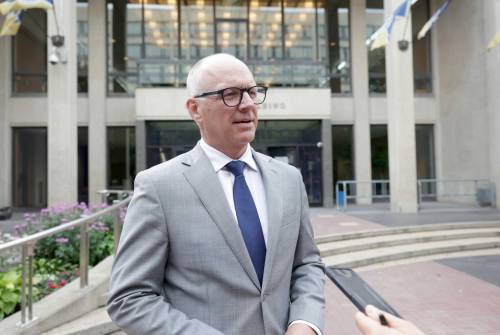
University of Waterloo associate professor Rebecca Saari says the results indicate that just telling people to stay inside cannot compensate for the rising climate-driven health risks of poor air quality.
“It’s not a short-term problem anymore, it’s a chronic issue,” said Saari, a Canada Research Chair in global change, atmosphere and health.
Alongside efforts to cut planet-warming emissions driven by fossil fuels, she said there needs to be a greater emphasis on improving indoor air filtration and the airtightness of buildings to keep out harmful pollutants.
“We need attention on longer-term protective adaptations,” she said.
While other studies have detailed how climate change worsens pollution, the authors suggest this is one of the most detailed accounts of how it could affect U.S. air quality alerts that tell people to stay indoors. Saari and former PhD student Matt Sparks worked with three U.S. researchers on the project.
The study models those alerts during the smog season, from May 1 to September 30, under three scenarios: if global warming hits two degrees above pre-industrial levels, if it is kept to 2.5 C or if, in the worst case, no action is taken to fight climate change. Two key pollutants are modelled: ozone and fine particulate matter, known as PM2.5.
Unmitigated climate change could add an average of 28 alert days for sensitive groups by 2100, the study finds. That number would be cut by about 30 per cent if climate action is taken to cap global warming at 2 or 2.5 C.
The sharpest rise would appear in already population- and pollution-dense areas in California and the eastern United States, with the latter getting two months of additional alerts for sensitive groups per year, the study says. Keeping global warming to two degrees would cut down about a month of those alerts.
People 65 and older, compared to other age groups, shoulder the bulk of the health burden linked to poor air quality, the study suggests. They also see the highest benefits in complying with air quality alerts to stay inside.
Yet widespread compliance cannot compensate for the rising costs of poor air quality, the study says. Under the worst-case scenario, full compliance with “unhealthy” alerts would only offset about 15 per cent of the economic impact of poor air quality, such as from spiralling health-care costs and lost wages. Those savings rise to about 40 per cent if global warming is limited to 2 C by end of the century.
There are limits to the study. The scenarios are modelled on 2005 population data. Larger and older populations in the future could increase the estimated health burden.
It also doesn’t account for wildfire smoke, a pollution source expected to get worse as climate change increases wildfire frequency and intensity.
Wildfire smoke exposure, largely from the tiny particles of burned vegetation that can penetrate deep into lungs, poses one of the greatest risks to outdoor air quality in Canada.
A recent Health Canada review estimated that PM2.5 exposure from the record-breaking 2023 wildfire season could contribute to around 400 acute and 5,400 chronic premature deaths. The study suggests that could translate into $52 billion in economic costs, including from medical costs, reduced productivity, and pain and suffering.
A warming climate is also likely to increase ozone levels in heavily populated and industrialized areas of Canada, including southern Ontario and southwestern Quebec.
Ozone, which thrives on hotter and sunnier days, forms when sunlight reacts with certain precursors, such as nitrogen oxides and volatile organic compounds. Short-term exposure can exacerbate asthma and other lung diseases, while long-term exposure has been linked to onset of asthma and increased respiratory symptoms in some groups.
The University of Waterloo-led, peer-reviewed study was published this month in Environmental Science & Technology.
This report by The Canadian Press was first published March 31, 2026.
Related Articles
Leaders seek better plans for wildfires
Advertisement Advertise With Us
Advertisement Advertise With Us