Small study hints that revving up immune cells might help fight HIV

Advertisement

Advertise with us

WASHINGTON (AP) — Scientists are tweaking a powerful cancer therapy in hopes it could fight HIV instead, by supercharging patients' own immune cells.

Read this article for free:


or

Already have an account? Log in here »

To continue reading, please subscribe:

Subscribe and receive a limited-edition Free Press branded hat or tote.

Digital Subscription

One year of digital access for only $205*

  • Enjoy unlimited reading on winnipegfreepress.com
  • Read the E-Edition, our digital replica newspaper
  • Access News Break, our award-winning app
  • Play interactive puzzles

*First annual payment billed as $205.00 + GST for one year. This annual subscription will automatically renew at $233.00 + GST every 52 weeks (10% off the regular annual price of $259.35). Offer available to new and qualified returning subscribers only. Cancel any time.

To continue reading, please subscribe:

Add Free Press access to your Brandon Sun subscription for only an additional

$1 for the first 4 weeks*

  • Enjoy unlimited reading on winnipegfreepress.com
  • Read the E-Edition, our digital replica newspaper
  • Access News Break, our award-winning app
  • Play interactive puzzles
Start now

*Your next Brandon Sun subscription payment will increase by $1.00 and you will be charged $17.95 plus GST for four weeks. After four weeks, your payment will increase to $24.95 plus GST every four weeks.

WASHINGTON (AP) — Scientists are tweaking a powerful cancer therapy in hopes it could fight HIV instead, by supercharging patients’ own immune cells.

On Tuesday, researchers said a single dose of those revved-up cells strongly suppressed HIV in two people — one for nearly a year and the other for nearly two years — without requiring their usual medicines.

Larger and longer studies are needed to prove if what’s called CAR-T cell therapy might really offer long-lasting help for HIV, cautioned Dr. Steven Deeks of the University of California, San Francisco, who led the research.
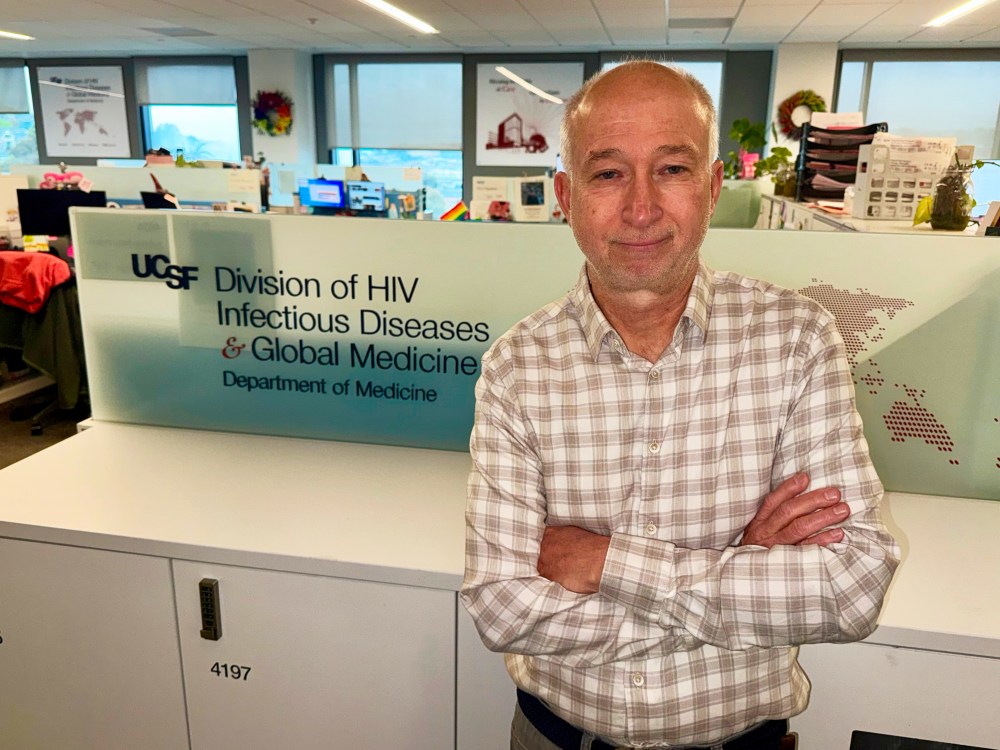
Dr. Steven Deeks at the UCSF Division of HIV Infectious Diseases and Global Medicine on May 5, 2026, in San Francisco. (AP photo/Haven Daley)

“We find the fact that two people have had such a really sustained response provocative,” he said. “There is a real need for a one-and-done, safe and scalable cure … and this is one of the strategies that we’re pursuing.”

The data is being presented at a meeting of the American Society of Gene and Cell Therapy in Boston.

There are nearly 40 million people living with HIV around the world. Today’s medicines have turned the virus that causes AIDS from a fast killer into a manageable chronic disease, often keeping the virus at undetectable levels, but only if people can afford the drugs and stick with them. The virus hides out in reservoirs in the body and rebounds fast if people stop treatment.

Researchers have long hunted an elusive cure, pursuing such clues as a rare gene mutation that makes some people naturally resistant to HIV or how a handful of HIV patients who also had certain cancers were declared cured or in long-term remission after receiving a stem cell transplant, something too risky for most people.

CAR-T therapy involves taking immune soldiers called T cells out of a person’s blood, genetically engineering them into “living drugs” and infusing them back into the patient. They’re widely used to cure certain types of cancer and are being studied for other diseases.

For HIV, scientists at the nonprofit drug developer Caring Cross created CAR-T cells with dual features. They’re programmed to better find and kill HIV-infected cells — and engineered with protection against infection by the very virus they’re supposed to fight.

With that added armor, they should be able to reproduce enough to keep HIV in check, said Caring Cross executive director Boro Dropulić.

Deeks’ early-stage experiment tested different dosing strategies in people who stopped their HIV medicine the day they received their CAR-T cells. There were no serious side effects. The first three recipients showed no response and resumed their usual medicines.

Six others received a small amount of chemotherapy to make space for the new T cells. Those two strong responders saw their HIV drop to undetectable levels, inching up only occasionally when the CAR-T cells presumably got to work again. A third patient had a temporary response and resumed regular HIV treatment.

Those three patients all had started their original HIV treatment soon after they’d been infected, Deeks said. That makes sense because people treated early tend to have less HIV hiding in the body and a healthier immune system.

“This is certainly very fascinating that they’ve had this positive response,” said Dr. Hans-Peter Kiem, a gene therapy expert at Seattle’s Fred Hutchinson Cancer Center who wasn’t part of the new study. He cautioned that it will take additional research to prove if CAR-T really works.

But the strategy is exciting because it’s “boosting what our body, our immune system, can already do,” said Andrea Gramatica, vice president for research at amfAR, The Foundation for AIDS Research, which is funding some work to create easier-to-use versions.

___

The Associated Press Health and Science Department receives support from the Howard Hughes Medical Institute’s Department of Science Education and the Robert Wood Johnson Foundation. The AP is solely responsible for all content.


Report Error Submit a Tip

More Stories

Canadians do not want to sacrifice nature for development

Emily McMillan and Akaash Maharaj 4 minute read 2:00 AM CDT

Prime Minister Mark Carney’s pledge to build faster — “Build, baby, build” — helped propel the Liberals to victory, but his government’s push to fast-track major development projects by cutting environmental oversight is sharply out of step with Canadians’ priorities.

It is a political miscalculation that could come back to haunt the Liberals at the ballot box.

New polling, commissioned by Nature Canada and conducted by EKOS Research Associates, shows strong support among Canadians for protecting nature and endangered species while building the economy.

Canadians soundly reject the notion that they must sacrifice conservation protections for economic development.

The first day of school is a promise

Ann Evangelista 6 minute read Preview

The first day of school is a promise

Ann Evangelista 6 minute read 2:00 AM CDT

This week, thousands of Manitoba students will walk through school doors carrying backpacks filled with new supplies, new hopes and, for some, new worries.

For parents and caregivers, this may be a familiar September routine — shopping for school supplies, adjusting schedules, preparing lunches and getting children ready for another year of learning.

For educators and school staff, it is the beginning of another demanding year.

But for Manitoba, this week should mean something more. It should be a renewal of our promise to every child.

Read
2:00 AM CDT

Today’s horoscope

Georgia Nicols 4 minute read Preview

Today’s horoscope

Georgia Nicols 4 minute read 2:00 AM CDT

MOON ALERT: There are no restrictions to shopping or important decisions today. The moon is in Leo.

ARIES (March 21-April 19)

You are the artisan of the zodiac, and this is a creative and productive day! Socialize, enjoy sporting events and the company of kids. It’s the perfect day to hone a technique and improve your creative skills. You rock!

TAURUS (April 20-May 20)

Read
2:00 AM CDT

Small study hints that revving up immune cells might help fight HIV

Lauran Neergaard, The Associated Press 4 minute read Preview

Small study hints that revving up immune cells might help fight HIV

Lauran Neergaard, The Associated Press 4 minute read Tuesday, May. 12, 2026

WASHINGTON (AP) — Scientists are tweaking a powerful cancer therapy in hopes it could fight HIV instead, by supercharging patients' own immune cells.

On Tuesday, researchers said a single dose of those revved-up cells strongly suppressed HIV in two people — one for nearly a year and the other for nearly two years — without requiring their usual medicines.

Larger and longer studies are needed to prove if what's called CAR-T cell therapy might really offer long-lasting help for HIV, cautioned Dr. Steven Deeks of the University of California, San Francisco, who led the research.

“We find the fact that two people have had such a really sustained response provocative,” he said. “There is a real need for a one-and-done, safe and scalable cure ... and this is one of the strategies that we’re pursuing.”

Read
Tuesday, May. 12, 2026

Thousands affected by storm-related power outages

1 minute read Updated: Yesterday at 8:45 PM CDT

Thousands are still without power in Winnipeg after high winds and thunderstorms knocked out power lines Sunday.

About 4,000 Manitoba Hydro customers were still dealing with outages this morning after crews worked to restore power in the Westwood and River Heights areas, Hydro spokesman Peter Chura said. On Sunday, Hydro reported outages affecting approximately 6, 700 customers.

The high winds and heavy rain brought down trees and broke power poles, causing "very severe damage," in River Heights, one of the hardest-hit neighbourhoods, while some of the damage in the Westwood area appeared to be caused by lightning strikes, Chura said.

Thunderstorms rolled in at about 6 p.m. Sunday and brought heavy rain and high winds to some areas of the province. Winnipeg received about 35 mm of rain, while some areas got almost double that. More than 62 mm was recorded at The Forks and 68.8 mm was recorded at Portage Southport, according to Environment Canada.

For newcomer pizza purveyors, it’s all about crafting solid foundations

David Sanderson 7 minute read Preview

For newcomer pizza purveyors, it’s all about crafting solid foundations

David Sanderson 7 minute read Saturday, Sep. 5, 2026

A recent poll conducted by an Internet-based market-research firm determined that close to 20 per cent of people eschew their leftover pizza crust.

Some argued that the residual crust lacks flavour. Others submitted that it’s too hard or crunchy to enjoy sans toppings. Given that information, what are we to make of Crusty Craft Pizza, a five-month-old takeout spot whose owners are so confident in their European-style pizza crust that they’ve chosen to highlight it in their business moniker?

Whenever somebody informs them they don’t like pizza crust, their response is, well, they haven’t tried theirs, says Oleksii Samokvhal, who together with his wife, Iryna Mehedyn, opened Crusty Craft Pizza in early April, at 1311 Day St. in Transcona.

“It’s thin in the middle, with raised edges we hand-form ourselves,” says Mehedyn, a native of Ukraine who, like her Kyiv-born husband, relocated to Winnipeg to escape the conflict in their home country.

Read
Saturday, Sep. 5, 2026