Canadian Dental Association report finds dental care program limits coverage

Advertisement

Advertise with us

OTTAWA - The national dental care program has "transformed access to care for millions of patients" but claims are being denied without explanations and too many people are confused about what's covered, says a new report from the Canadian Dental Association.

Read this article for free:


or

Already have an account? Log in here »

To continue reading, please subscribe:

Subscribe and receive a limited-edition Free Press branded hat or tote.

Digital Subscription

One year of digital access for only $205*

  • Enjoy unlimited reading on winnipegfreepress.com
  • Read the E-Edition, our digital replica newspaper
  • Access News Break, our award-winning app
  • Play interactive puzzles

*First annual payment billed as $205.00 + GST for one year. This annual subscription will automatically renew at $233.00 + GST every 52 weeks (10% off the regular annual price of $259.35). Offer available to new and qualified returning subscribers only. Cancel any time.

To continue reading, please subscribe:

Add Free Press access to your Brandon Sun subscription for only an additional

$1 for the first 4 weeks*

  • Enjoy unlimited reading on winnipegfreepress.com
  • Read the E-Edition, our digital replica newspaper
  • Access News Break, our award-winning app
  • Play interactive puzzles
Start now

*Your next Brandon Sun subscription payment will increase by $1.00 and you will be charged $17.95 plus GST for four weeks. After four weeks, your payment will increase to $24.95 plus GST every four weeks.

OTTAWA – The national dental care program has “transformed access to care for millions of patients” but claims are being denied without explanations and too many people are confused about what’s covered, says a new report from the Canadian Dental Association.

The association commissioned the report to assess the dental care program’s progress and make recommendations to the federal government on how it can be improved.

“We have a strong program, it’s got a good foundation, but continuous improvement is essential if the program is ever going to reach its potential,” said Dr. Kirk Preston, president of the Canadian Dental Association.
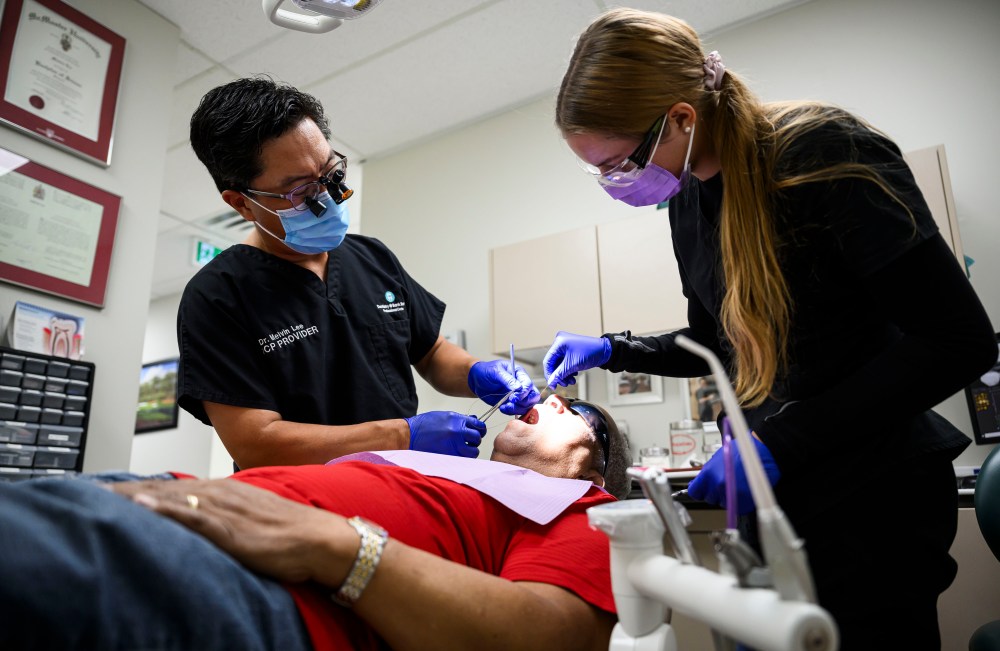
Dr. Melvin Lee, left, performs a tooth extraction for patient Robert McFarlane, who is eligible for the Canadian Dental Care Plan, as team member Sofia Christow-Filleul assists at his dental clinic in Ottawa, on Wednesday, Aug. 7, 2024. THE CANADIAN PRESS/Justin Tang

The program, which launched in 2022, was created as part of the supply-and-confidence agreement between the NDP and Justin Trudeau’s minority Liberal government.

The first phase offered coverage for seniors before the program was expanded to include adults with disabilities and children.

The final expansion, which was announced the day before Prime Minister Mark Carney called the 2025 election, opened coverage to all adults with a household income under $90,000 who do not have private insurance.

It’s been billed as the largest single expansion in public health care in decades, with an estimated nine million people eligible. Around 6.5 million have signed on to the program so far.

Colloquially, politicians have referred to the dental care program as free dental care — something that has created lasting confusion.

“I had a patient just last week that came in and he said, ‘I thought it was free,'” Preston said.

The program provides different levels of coverage depending on income. Those in the highest income bracket must cover 60 per cent of their fees.

Coverage is also based on set fees for services the CDA said are often below the cost of treatment.

That leaves many patients with unexpected bills, the report says.

Ondina Love, CEO of the Canadian Dental Hygienists Association, said confusion over what the plan covers has added to the administrative burdens on clinics.

“We are recommending enhanced public education and clear communications regarding what’s covered,” she said.

Preston said dentists’ biggest concerns are about pre-authorization.

Clinics need to submit treatment plans ahead of time for things like root canals, specialist services, or care above what the dental care plan typically covers. The insurance provider, Sun Life, determines if the care will be covered.

Those claims are denied half the time, the report said.

“It’s frustrating for dentists and patients because there’s no clear explanation in most cases as to why the claims are not approved,” Preston said.

The report said denials can lead to a manageable condition getting worse, forcing patients into more invasive and expensive care.

“It’s not consistent and I don’t understand what their guidelines are for approving or denying treatment in the pre-authorization process,” Preston said.

The CDA report calls for better education for care providers, more transparency and clear clinical criteria for pre-authorizations.

It also calls for fee increases to keep up with rising costs in dental clinics, along with better workforce planning to address shortages of dental hygienists and assistants.

Love said that last point is critical.

“We do know that in certain regions, there’s a sufficient supply — maybe even oversupply — and in other regions, there definitely is a shortage,” she said.

Health Minister Marjorie Michel said Tuesday the government is looking to work with the CDA on its recommendations.

“As we are moving forward and we are (getting) feedback, we are taking action,” she said.

The report noted that patients, especially seniors, have reported difficulties with reapplying for coverage each year. The income criteria can mean patients who had care one year might lose it the next.

Overall, patients report a high level of satisfaction with the program. The report includes surveys of both patients and dentists, commissioned by the CDA and carried out by Abacus Data.

More than half of the patients surveyed said they’ve been able to free up savings to spend on groceries and other essentials.

“This is a notable achievement for a program of such scale and ambition,” it said.

Notable, too, is the uptake from dentists themselves.

In early 2024, nearly 70 per cent of dentists told the CDA they were opposed to the program.

Its initial phases required providers to opt in, and uptake was so slow that government eliminated that requirement.

The new report says over 90 per cent of dentists are taking part in the program, and 70 per cent are supportive.

The CDA recommends the federal government commission an independent evaluation of the program’s effectiveness, and use that to decide whether it’s reaching the intended patients.

This report by The Canadian Press was first published Oct. 6, 2026.

Report Error Submit a Tip

More Stories

Puppies, stocks — ‘zoomies’ abound

Andrew Froese 4 minute read Yesterday at 2:01 AM CDT

This spring, I adopted a three-month-old rescued German Shepherd mix. To say she is easily excitable is an understatement.

It is not really her fault. A puppy’s frontal cortex, the part of the brain that helps with decision-making and impulse control, is still developing. When an older dog, or a human, gets tired, we generally understand we should rest. Puppies have not quite figured that out. They often interpret tiredness as a signal something is wrong, which makes them more alert, more reactive and harder to settle.

That creates a feedback loop. The puppy gets tired, which makes her frantic, which makes her more tired, which makes her even more frantic. Eventually, this becomes what people call the “zoomies”: frantic sprinting, biting, jumping and general chaos.

From the outside, it looks like the puppy has too much energy. In reality, the opposite is true. The zoomies are not a sign of excess energy. They are a sign the puppy is overtired and does not know it yet.

Protein crests current appetite wave

Laura Rance-Unger 4 minute read Preview

Protein crests current appetite wave

Laura Rance-Unger 4 minute read Yesterday at 2:01 AM CDT

Holiday feasts often reflect the latest fads and trends influencing how we eat.

This Thanksgiving’s table is likely to feature more Canadian content than it might otherwise as a point of national pride.

In the recent past, the carb-free craze has made cauliflower a substitute for the mashed potatoes on some family spreads. Some have gone meatless, while others have added more. Still others offer gluten-free, dairy-free or fat-free alternatives.

Nowadays, it seems consumers can’t get enough protein. Desmond Sobool, deputy chief economist Farm Credit Canada, told a recent economic update for the agri-food sector there are two converging influences in play.

Read
Yesterday at 2:01 AM CDT

A Life's Story: Writer built bridges with genuine curiosity, compassion for diversity of religious practices

Janine LeGal 6 minute read Preview

A Life's Story: Writer built bridges with genuine curiosity, compassion for diversity of religious practices

Janine LeGal 6 minute read Yesterday at 6:00 AM CDT

Brenda Suderman knew how to make people feel comfortable. For a journalist, that character trait is a real strength, and it made people trust and appreciate her.

Whether covering musicals, worship spaces, the effects of pandemic shutdowns, death rituals and practices of different traditions, the discovery of the burial of 2,284 infants in unmarked graves, or any other of the countless topics she wrote about in her four- decade career, Suderman did it with genuine interest and care.

Born and raised in Winkler, Suderman grew up on a farm. Much of her childhood was spent in gardens and sugar beet fields.

Baptized at 16, she became a member of the Winkler Bergthaler Mennonite Church. The restrictions against women at the time contributed to planting the seeds of Suderman’s feminist perspective.

Read
Yesterday at 6:00 AM CDT

Longtime voice of the Blue and Gold marks major milestone

David Sanderson 8 minute read Preview

Longtime voice of the Blue and Gold marks major milestone

David Sanderson 8 minute read Friday, Oct. 9, 2026

Bob McGregor made his debut as the Winnipeg Blue Bombers’ public-address announcer on June 7, 1997, during a pre-season game at Winnipeg Stadium between the hometown Blue Bombers and their western rivals, the Calgary Stampeders.

McGregor will be behind the microphone again this Saturday, detailing the action on the field in addition to leading a boisterous Princess Auto Stadium crowd through what has become his signature call, “And that is another Winnipeg Blue Bombers first down!”

The Bombers’ final home date of the 2026 regular season will mark a major milestone for McGregor, and the former newscaster feels it’s only fitting the same two teams as 10,717 days ago — the Bombers and Stampeders — will be the ones butting helmets.

“I knew at the start of the season I was closing in on 300 games as the PA guy, only it wasn’t until I went through the schedule that I realized my 300th would be Winnipeg-Calgary, which struck me as kind of cool,” McGregor says, seated in a St. James breakfast nook, dressed in dark trousers and a blue-and-gold Blue Bombers golf shirt.

Read
Friday, Oct. 9, 2026

Police looking into robbery of children captured on video

Morgan Modjeski 3 minute read Preview

Police looking into robbery of children captured on video

Morgan Modjeski 3 minute read Friday, Oct. 9, 2026

The Winnipeg Police Service said it is aware of a video circulating online that appears to show two children robbed while walking home from the library.

The mother of the siblings said the Sept. 26 incident, which happened in the area of Andrews Street and Magnus Avenue at around 7:30 p.m., has left her children afraid and her feeling guilty.

“I should have been there with them. I felt horrible,” said Brittany Beaudet. “I would have been out the door if I knew any sooner to help them out.”

In the 40-second video, the two children, 14-year-old Mason and nine-year-old Kenzie, are approached by a man wearing a black shirt, black pants and white shoes.

Read
Friday, Oct. 9, 2026

Final hurdles are moving on in your mind and life

Maureen Scurfield 3 minute read Yesterday at 2:01 AM CDT

DEAR MISS LONELYHEARTS: I just ran into my former husband with his new woman. It was a shock. She looked nothing like me — not nearly as good. In fact, she’s the opposite of me — red-haired, freckled, tall and skinny like a rake. I’m short, dark, with golden skin from my Italian background. That was what my husband used to say he loved in a woman.

Does that mean he lied — that he really didn’t like my looks and secretly longed for the opposite? That seems crazy to me. But I should mention that in our last miserable years together he didn’t even want to hold me in his arms and look at me. He sometimes slept at his office (or so he said) because he was “too tired to drive home.”

He could have been elsewhere — like in some other woman’s home — because he always used his cellphone to call me, not his office line.

How can I forget about the man I loved so much and finally move on?