A look at how provinces plan to emerge from COVID-19 shutdown
Advertisement
Read this article for free:
or
Already have an account? Log in here »
To continue reading, please subscribe:

Digital Subscription
One year of digital access for only $205*
- Enjoy unlimited reading on winnipegfreepress.com
- Read the E-Edition, our digital replica newspaper
- Access News Break, our award-winning app
- Play interactive puzzles
*First annual payment billed as $205.00 + GST for one year. This annual subscription will automatically renew at $233.00 + GST every 52 weeks (10% off the regular annual price of $259.35). Offer available to new and qualified returning subscribers only. Cancel any time.
To continue reading, please subscribe:
Add Free Press access to your Brandon Sun subscription for only an additional
$1 for the first 4 weeks*
- Enjoy unlimited reading on winnipegfreepress.com
- Read the E-Edition, our digital replica newspaper
- Access News Break, our award-winning app
- Play interactive puzzles
*Your next Brandon Sun subscription payment will increase by $1.00 and you will be charged $17.95 plus GST for four weeks. After four weeks, your payment will increase to $24.95 plus GST every four weeks.
Read unlimited articles for free today:
or
Already have an account? Log in here »
Hey there, time traveller!
This article was published 01/05/2020 (2290 days ago), so information in it may no longer be current.
Provinces have been releasing plans for easing restrictions that were put in place to limit the spread of COVID-19.
Here is what some of the provinces have announced so far:
Newfoundland and Labrador
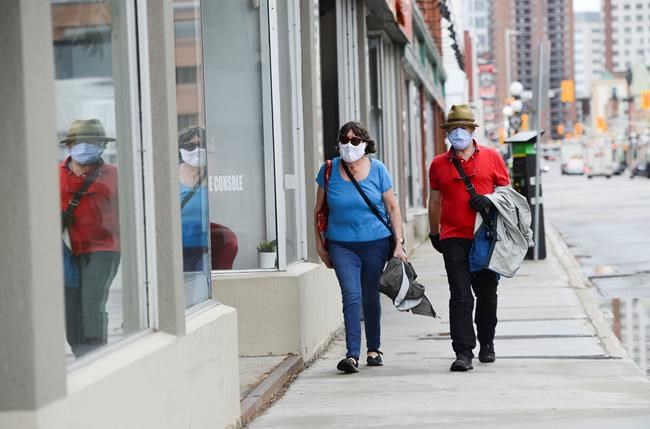
Newfoundland and Labrador plans to loosen some public health restrictions in a series of “alert levels” descending from five. The move to Level 4 on May 11 is to allow some medical procedures to resume as well as low-risk activities, such as golf, hunting and fishing. Low-risk businesses, including garden centres, and professional services such as law firms are to reopen at this level.
Alert Level 4 is to remain in place for at least 28 days.
At Level 3, private health clinics, such as optometrists and dentists, are to be permitted to open, as well as medium-risk businesses such as clothing stores and hair salons.
At Level 2, some small gatherings are to be allowed, and businesses with performance spaces and gyms are to reopen.
Level 1 would represent “the new normal.”
—
Nova Scotia
Nova Scotia’s top doctor has offered hope that a reopening plan is in the works, while cautioning it is likely to be weeks before anything happens.
Dr. Robert Strang says the province still has a “significant amount of virus activity” and it would be premature to loosen restrictions any time soon.
Strang says the pandemic is not playing out in a common or consistent way across the country, and: “We have to have a plan that works and is appropriate for Nova Scotia.”
—
Prince Edward Island
Priority non-urgent surgeries and select health-service providers, including physiotherapists, optometrists and chiropractors, were to resume May 1 under The Renew P.E.I. Together plan.
Also to begin May 1 were outdoor gatherings and non-contact outdoor recreational activities of no more than five individuals from different households.
Screening is to continue at points of entry into the province and all people coming into P.E.I. are required to isolate for 14 days.
—
New Brunswick
Premier Blaine Higgs put the first phase of his four-phase reopening plan into action April 24. It allows limited play on golf courses as well as fishing and hunting.
Two families are allowed to interact as part of a so-called “two-family bubble.” Post-secondary students can return if it’s deemed safe by the school, and outdoor church services can be held, if people remain in their vehicles and are two metres apart.
The second phase is to see resumption of elective surgeries, and reopening of daycares, offices, restaurants, ATV trails and seasonal campgrounds.
The third phase would allow regular church services, dentistry work and reopened fitness centres.
The final phase, which would probably come only after a vaccine is available, would include large gatherings.
—
Quebec
Premier Francois Legault has set May 11 as reopening day for schools and daycares outside greater Montreal. The city is to follow suit on May 19.
Legault says attendance won’t be mandatory. High schools, junior colleges and universities are to remain closed until September.
Quebec aims to open retail stores outside Montreal by May 4 while those in the greater Montreal region are to reopen May 11.
The construction industry is to completely start up May 11, while manufacturing companies are to resume operations the same day with initial limits on the total number of employees who can work per shift.
—
Ontario
Premier Doug Ford released a three-step plan on April 27, but did not include a timeline.
Stage 1 could include opening select workplaces that could modify operations such as providing curbside pickup or delivery, opening parks, allowing for more people at certain events such as funerals, and having hospitals resume some non-urgent surgeries.
Stage 2 could include opening more businesses, opening more outdoor spaces, and allowing some larger public gatherings.
Stage 3 would include having all workplaces open and further relaxing rules on public gatherings — though large ones such as sporting events and concerts would still be restricted.
—
Saskatchewan
The Saskatchewan government’s five-phase plan to reopen parts of its economy is to start May 4 when dentists, optometrists and other health professionals are to be allowed to resume services. Phase 1 also includes reopened golf courses and campgrounds.
Phase 2 would give the green light to retail businesses and salons. Restaurants and gyms could open in
Phase 3 but with limited capacity.
Phase 4 could see arenas, swimming pools and playgrounds opening.
In Phase 5, the province would consider lifting restrictions on the size of public gatherings.
—
Manitoba
May 4 is the day Manitoba plans to allow reopening of health offices, including dentists, chiropractors and physiotherapists. Retail businesses are to reopen at half occupancy as long as they can ensure physical spacing. Restaurants are to reopen patios and walk-up service.
Museums and libraries are to open doors, but occupancy to be limited to 50 per cent. Playgrounds, golf courses and tennis courts to reopen along with parks and campgrounds.
A second phase is to begin no earlier than June 1. That’s when restaurants would be allowed to open indoor dining areas and non-contact children’s sports would resume.
Mass gatherings such as concerts and major sporting events will not be considered before September.
—
Alberta
Alberta plans to allow some scheduled, non-urgent surgeries to start May 4. Service provided by dentists, physiotherapists and other medical professionals are also to be permitted.
Golf courses to reopen May 2 as long as pro shops and clubhouses remain shuttered.
On May 14, retail businesses, such as clothing, furniture and bookstores, are to be allowed to reopen gradually. Cafes and restaurants with no bar service will also be allowed to run at half capacity.
The second phase includes potential kindergarten to Grade 12 classes — with restrictions — and reopening of movie theatres and theatres, again, with restrictions.
The third phase would see nightclubs, gyms, pools, recreation centres and arenas reopen, all with restrictions. There is no timeline for the final two phases.

—
British Columbia
The province hasn’t released its reopening plan. Premier John Horgan is promising details next week.
—
This report by The Canadian Press was first published April 30, 2020
Related Articles
WAG takes reopening lead as museums grapple with pandemic guidelines







Advertisement Advertise With Us
Advertisement Advertise With Us