Experts explain why Ottawa is being asked to decriminalize small amounts of drugs
Advertisement
Read this article for free:
or
Already have an account? Log in here »
To continue reading, please subscribe:

Digital Subscription
One year of digital access for only $205*
- Enjoy unlimited reading on winnipegfreepress.com
- Read the E-Edition, our digital replica newspaper
- Access News Break, our award-winning app
- Play interactive puzzles
*First annual payment billed as $205.00 + GST for one year. This annual subscription will automatically renew at $233.00 + GST every 52 weeks (10% off the regular annual price of $259.35). Offer available to new and qualified returning subscribers only. Cancel any time.
To continue reading, please subscribe:
Add Free Press access to your Brandon Sun subscription for only an additional
$1 for the first 4 weeks*
- Enjoy unlimited reading on winnipegfreepress.com
- Read the E-Edition, our digital replica newspaper
- Access News Break, our award-winning app
- Play interactive puzzles
*Your next Brandon Sun subscription payment will increase by $1.00 and you will be charged $17.95 plus GST for four weeks. After four weeks, your payment will increase to $24.95 plus GST every four weeks.
Read unlimited articles for free today:
or
Already have an account? Log in here »
Hey there, time traveller!
This article was published 21/06/2022 (1551 days ago), so information in it may no longer be current.
OTTAWA – Last month, British Columbia became the first jurisdiction in Canada to make changes to ensure drug users will not be arrested or charged for carrying up to 2.5 grams of illicit drugs as of next year.
It’s the first jurisdiction in the country that will decriminalize possession of small amounts of drugs in an effort to stem the rising tide of drug toxicity deaths. Since January 2016, almost 27,000 Canadians have died from opioid-related causes, according to the Public Health Agency of Canada.
Solving the opioid crisis by decriminalizing access to opioids might seem counterintuitive.
But many experts involved in researching substance use over the past decades have come to the conclusion over the last 20 to 30 years that using criminal penalties to dissuade people from using certain substances simply does not work.
“In addition to it being ineffective, it’s also clear that criminal penalties for using some substances has also spawned a range of unintended negative consequences,” said Michael John (M-J) Milloy, a research scientist at the British Columbia Centre on Substance Use.
Those range from an increased risk of fatal overdose, to a decreased likelihood that someone will seek treatment for drug addiction, he added.
The harms of criminalization and incarceration fall most heavily and inequitably on people who are racialized, poor and living with multiple mental health conditions, said Milloy, and that’s why people have been looking for alternatives.
“Decriminalization is not legalization; it doesn’t mean drugs are legal,” said Garth Mullins, a member of the Vancouver Area Network of Drug Users.
Rather, decriminalization means drug dealers would still be subject to arrest, but police won’t arrest someone for possessing and using small amounts of drugs.
Ian Culbert, executive director of the Canadian Public Health Association, said it is important to note the context in which drug use became criminalized.
“It’s very much a part of our culture that drugs are bad,” Culbert said.
He said deeply ingrained negative stereotypes about people who use drugs include that they “just lack that moral character to pull themselves up by their bootstraps to get over whatever it is, or they are just lazy.”
The reality is that people who have faced challenges that have left them with physical or emotional pain may not have the proper tools to deal with it in any other way, turning to substances to numb their pain, Culbert said.
Drug use and criminalization affects First Nations people in a particular way, said Carol Hopkins, executive director for the Thunderbird Partnership Foundation.
First Nations people are overrepresented in the criminal justice system, and the reasons they are incarcerated can be tied to colonization and racism in Canada, said Hopkins, who also served as co-chair of Health Canada’s Expert Task Force on Substance Use.
“Drug use is a way of coping with the unresolved trauma,” she said.
While harm reduction services are becoming available in urban areas, similar services are underfunded or not accessible in First Nations communities.
Calling those who use drugs “criminals,” said Hopkins, fails to consider whether they have access to the things that ensure a good quality of life, and further stigmatizes people for their life experiences.
She called it inhumane for First Nations people to end up in jail for using substances, when it’s often a way to cope with experiences such as residential schools, the effects of the child welfare system, or social issues like a lack of access to clean drinking water.
The exemption granted to B.C. includes opioids like heroin and fentanyl, as well as cocaine, methamphetamine and MDMA, also known as ecstasy.
Conservative MP Brad Vis, who represents the B.C. riding of Mission-Matsqui-Fraser Canyon, recently told reporters that fentanyl being part of the agreement is a “complete travesty.” Decriminalization of 2.5 grams of the drug is part of a “soft-on-crime” approach of the federal Liberal government, he said.
“B.C. is in an opioid crisis,” he said. “We’re not seeing any commitments from this government to provide appropriate care, culturally sensitive care for Canadians and British Columbians who are suffering from addiction. We are at the epicentre of addictions issues in Canada.”
He said 2.5 grams is a lot of fentanyl and could be deadly. He added that decriminalization of fentanyl and other drugs are “two separate discussions,” and he is “more open” to what police officers recommend when it comes to decriminalizing other substances.
Mullins disagrees this approach won’t work, saying “we’ve tried hard-on-crime for 100 years,” and that prison itself is a traumatizing experience that can lead to increased drug use.
“There’s no evidence to show that it does anything to help keep people safer, or get people off drugs or anything like that. More punishment just makes things worse,” he said.
But Mullins does agree that B.C. has not proposed a solution that fully tackles the problem.
“We have said it’s going to take decriminalization and safe supply,” Mullins said.
A regulated and safe supply of opioids is meant to ensure people don’t rely on the unregulated and highly toxic drug supply on the street.
Even as British Columbia’s approved possession limits are criticized for going too far, many advocates have said that they actually don’t go far enough.
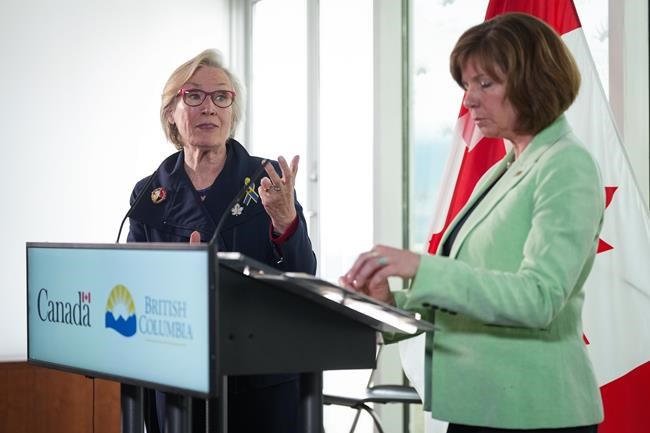
Carolyn Bennett, minister of mental health and addictions, told MPs on the parliamentary health committee last week that the government cannot scale up decriminalization beyond B.C. until it can ensure there aren’t “unintended consequences in public safety” in doing so, like gangs and organized crime.
“The government has said, ‘We have to be really careful about this.’ And that is true,” said Hopkins.

“We have to be careful about the way we structure drug policy in Canada, but while we’re being careful, we can’t afford to let fear dominate.”
This report by The Canadian Press was first published June 21, 2022.
—
This story was produced with the financial assistance of the Meta and Canadian Press News Fellowship.
Note to readers: This is a corrected story. An earlier version erroneously reported that Conservative MP Brad Vis said drug decriminalization overall is part of a “soft-on-crime” approach of the federal Liberal government.