Mental-health, addictions needs not being met, says study of five provinces

Advertisement

Advertise with us

A new study makes clear that Canada has a lot of work left to do when it comes to making sure that young people struggling with mental-health illnesses and addictions are getting adequate care.

Read this article for free:


or

Already have an account? Log in here »

To continue reading, please subscribe:

Subscribe and receive a limited-edition Free Press branded hat or tote.

Digital Subscription

One year of digital access for only $205*

  • Enjoy unlimited reading on winnipegfreepress.com
  • Read the E-Edition, our digital replica newspaper
  • Access News Break, our award-winning app
  • Play interactive puzzles

*First annual payment billed as $205.00 + GST for one year. This annual subscription will automatically renew at $233.00 + GST every 52 weeks (10% off the regular annual price of $259.35). Offer available to new and qualified returning subscribers only. Cancel any time.

To continue reading, please subscribe:

Add Free Press access to your Brandon Sun subscription for only an additional

$1 for the first 4 weeks*

  • Enjoy unlimited reading on winnipegfreepress.com
  • Read the E-Edition, our digital replica newspaper
  • Access News Break, our award-winning app
  • Play interactive puzzles
Start now

*Your next Brandon Sun subscription payment will increase by $1.00 and you will be charged $17.95 plus GST for four weeks. After four weeks, your payment will increase to $24.95 plus GST every four weeks.

Hey there, time traveller!
This article was published 30/08/2017 (3309 days ago), so information in it may no longer be current.

A new study makes clear that Canada has a lot of work left to do when it comes to making sure that young people struggling with mental-health illnesses and addictions are getting adequate care.

Manitoba, in particular, needs to take steps to address high number of attempted suicides. The province has the disturbing distinction of having the highest rate out of the five provinces that participated in the study, despite having the smallest population.

“Youth with mental-health (issues) and addictions are really struggling to get the care they need and to have that care sustained,” said James Bolton, director of research in the University of Manitoba’s psychiatry department.
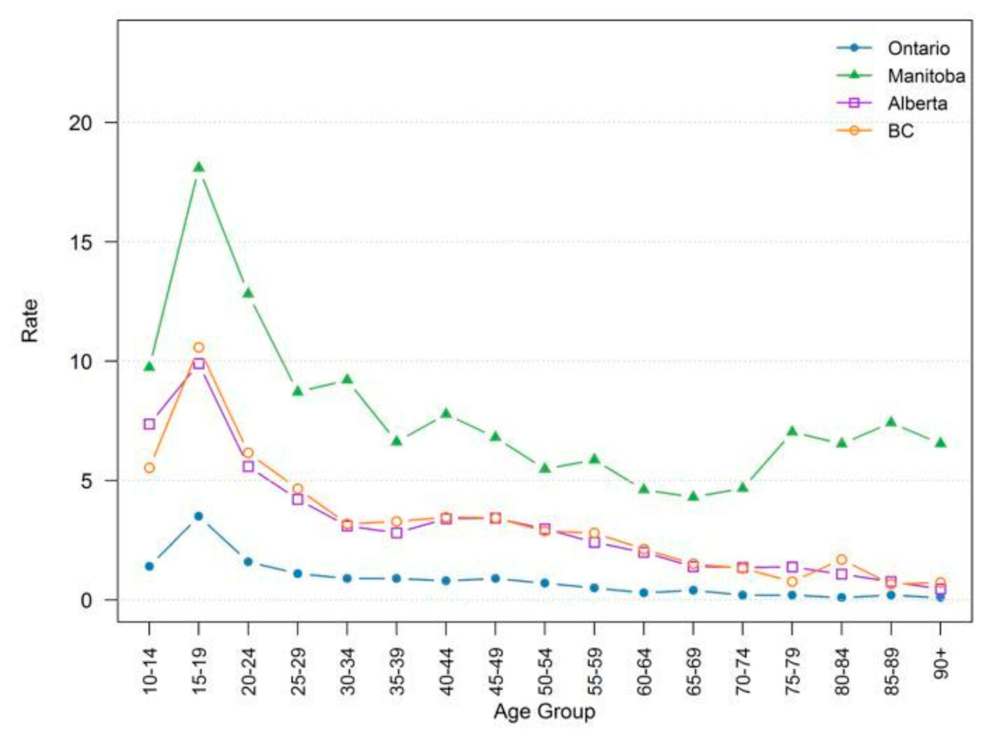
Manitoba had the highest rate of suicide among all age groups in the provinces studied. The study suggests this may be due to Manitoba having the highest proportion of Indigenous peoples in the population among the participating provinces, noting that suicide rates are known to be higher in that group.

Bolton headed up the Manitoba section of the study, which was years in the making and looked at care and outcomes in Manitoba, Alberta, British Columbia, Ontario and Quebec. It was published online Wednesday by the Centre for Applied Research in Mental Health and Addiction at Simon Fraser University.

While there have been previous mental-health reports national in scope, Bolton said this study is the first to really drill down into the issues and offer comparisons between provinces. Only five provinces were included, he said, because administrative health data varies province to province and the others weren’t able to provide it.

“It’s the first time we’ve really been able to examine the quality of mental-health services and the outcomes,” he said, “it provides much more detail about how many people are able to see a family doctor on a regular basis or whether they get their care in an emergency department or not.”

In some positive news for Manitoba, it has the smallest percentage of patients with mental-health disorders or addictions for whom their first point of contact — the first time in at least two years they’re receiving treatment for mental-health reasons — is not the emergency room.

That’s encouraging, the study notes, because in most cases “a crisis presentation indicates a failure of early symptom identification and treatment, which is best for longer-term positive outcomes.”

Emergency room as first point of contact was one of six performance indicators that researchers settled on to be able to compare mental-health and addictions care delivery across the country. The others were: access to the same family physician; doctor followup after discharge from hospital; rates of suicides; rates of suicide attempts; and mortality of those with diagnosed disorders.

By using those indicators to cut through regional differences in health-care delivery, Bolton said the researchers have created a jumping-off point for more standardized reporting processes — and that’s important.

“It’s vital to know what’s going on at the ground level within each province so we can know how to improve things at the local level,” he said.

In Manitoba, the study makes it clear the province needs a better understanding of what drives suicide attempts.

“We need to be mobilizing resources for the youth in our province,” Bolton said.

Health Minister Kelvin Goertzen called the report “concerning and troubling.”

The province is expecting a consulting report back by the end of the year about the development of a provincial mental-health and addictions strategy, which Goertzen said he expects will help ensure “access to the system in a more efficient way.”

He said its likely that “a significant part, if not all of that report” will be made public.

jane.gerster@freepress.mb.ca

CARMHA%20REPORT_29%20Aug_Final

History

Updated on Wednesday, August 30, 2017 4:59 PM CDT: Updated with comments.

Updated on Wednesday, August 30, 2017 5:27 PM CDT: Adds performance indicators box

Report Error Submit a Tip

More Stories

Desperate Poilievre wants Canadians to believe the sky is falling when it’s just cloudy outside

Tom Brodbeck 5 minute read Preview

Desperate Poilievre wants Canadians to believe the sky is falling when it’s just cloudy outside

Tom Brodbeck 5 minute read Friday, Sep. 18, 2026

Pierre Poilievre has a problem.

Canadians just don’t seem to be paying much attention to him anymore.

So, naturally, the Conservative Opposition leader has decided to turn up the volume.

At a recent party caucus retreat in Penticton, B.C., Poilievre delivered the familiar message: Canada is in trouble, Canadians are hurting and the Liberal government is making everything worse.

Read
Friday, Sep. 18, 2026

A life’s story: activist, educator, organizer knew the true meaning of community

Janine LeGal 7 minute read Preview

A life’s story: activist, educator, organizer knew the true meaning of community

Janine LeGal 7 minute read Yesterday at 3:00 AM CDT

Somewhere between a love for sharing stories and a love of community connections, Michael (Mike) Maunder lived his life. Giving voice to people and neighbourhoods was a passion for the natural-born community organizer.

An author, teacher and principal, Maunder lived in a one-bedroom apartment in West Broadway and devoted himself to community development, education and neighbourhood renewal.

He maintained a connection with Augustine United Church, whose commitment to social justice he appreciated, volunteered at the Sandy-Saulteaux Spiritual Centre, and found comfort in a Buddhist prayer community.

Maunder died on July 15 at the age of 80.

Read
Yesterday at 3:00 AM CDT

National Black Canadians Summit celebrates culture, combats racism

Gabrielle Piché 4 minute read Preview

National Black Canadians Summit celebrates culture, combats racism

Gabrielle Piché 4 minute read Yesterday at 6:06 PM CDT

Despite the event’s name — the National Black Canadians Summit — Bruce Miller felt he should attend.

He booked a ticket. And so, this weekend, the Indigenous Manitoban joined roughly 1,500 people flocking to the RBC Convention Centre.

It’s a full schedule — addresses from a former Canadian governor general, sessions on Black mental health and anti-Black racism.

The annual event draws politicians, artists and other professionals from across the country.

Read
Yesterday at 6:06 PM CDT

Hellebuyck standoff caused by… Nathan MacKinnon?

Mike McIntyre 6 minute read Preview

Hellebuyck standoff caused by… Nathan MacKinnon?

Mike McIntyre 6 minute read Friday, Sep. 18, 2026

Looking for someone to blame in the Connor Hellebuyck fiasco and cast as public enemy No. 1? How about long-time Winnipeg Jets nemesis Nathan MacKinnon?

Allow us to explain as we fire up the time machine and head back to February in Italy.

Oh, what could have been if MacKinnon had been able to score on what appeared to be an open net late in the third period of the men’s gold medal game with Hellebuyck down and seemingly out of position.

Instead, the star forward fired wide, keeping the score deadlocked at 1-1 as the clock ticked down on regulation.

Read
Friday, Sep. 18, 2026

American Hostage stars recall warmth of Winnipeggers during brutal winter

Randall King 7 minute read Preview

American Hostage stars recall warmth of Winnipeggers during brutal winter

Randall King 7 minute read Friday, Sep. 18, 2026

TORONTO — When you stream the eight-part series American Hostage, a sense of familiarity may strike.

That’s because the show was shot in Winnipeg — especially in the Exchange District — from November of last year to the beginning of February, with Winnipeg portraying Indianapolis circa 1977.

The whole world seemed to be watching that midwest American city that year as a hostage crisis unfolded involving one Tony Kiritsis, an angry man who goes ballistic when a mortgage brokerage was poised to foreclose on property he had dreamed of developing into a shopping centre.

Kiritsis kidnapped his mortgage broker, Richard Hall, wiring a shotgun to the back of his head, and demanded a public airing of his grievances, with the reluctant help of popular radio broadcaster Fred Heckman.

Read
Friday, Sep. 18, 2026

Cabernet Sauvignon star of wine festival

Ben Sigurdson 5 minute read Preview

Cabernet Sauvignon star of wine festival

Ben Sigurdson 5 minute read Yesterday at 3:00 AM CDT

The Winnipeg Wine Festival will celebrate the king of red wine grapes next weekend — the theme of this year’s festival, which takes place Sept. 25 and 26 at the RBC Convention Centre, is Cabernet Sauvignon.

Cab Sauv, as it’s also known, is the world’s most widely planted wine grape of any colour, first coming to prominence in the 1800s in France’s Bordeaux region, where the grape is still popular. Rather than single-variety wines, Bordeaux reds tend to be blends, with those coming from the left bank of the Gironde estuary being Cabernet-dominant, while right-bank wines are Merlot-dominant, with Cabernet Sauvignon playing a supporting role. Cabernet and Merlot work well together and many other countries have followed suit in blending the two.

A team at University of California Davis put Cabernet Sauvignon through a DNA test in 1996 and discovered its parent grapes are Cabernet Franc and Sauvignon Blanc — it’s likely that at some point the two varieties, planted next to each other in some vineyard, crossed and mutated and became the grape we know today. (Someone growing grapes in the 19th century must have had an inkling of what was up, as the grape has been called Cabernet Sauvignon since long before the DNA test.)

Flavour-wise, most Cabernet Sauvignon wines are big and bold, with a core of deep dark berry flavours, some graphite and spice notes and relatively bright acidity. It’s a grape that is well-suited to barrel aging, with most examples seeing at least some time in wood.

Read
Yesterday at 3:00 AM CDT