Old records shed new light on smallpox outbreaks in 1700s

Advertisement

Advertise with us

BOSTON (AP) — A highly contagious disease originating far from America's shores triggers deadly outbreaks that spread rapidly, infecting the masses. Shots are available, but a divided public agonizes over getting jabbed.

Read this article for free:


or

Already have an account? Log in here »

To continue reading, please subscribe:

Subscribe and receive a limited-edition Free Press branded hat or tote.

Digital Subscription

One year of digital access for only $205*

  • Enjoy unlimited reading on winnipegfreepress.com
  • Read the E-Edition, our digital replica newspaper
  • Access News Break, our award-winning app
  • Play interactive puzzles

*First annual payment billed as $205.00 + GST for one year. This annual subscription will automatically renew at $233.00 + GST every 52 weeks (10% off the regular annual price of $259.35). Offer available to new and qualified returning subscribers only. Cancel any time.

To continue reading, please subscribe:

Add Free Press access to your Brandon Sun subscription for only an additional

$1 for the first 4 weeks*

  • Enjoy unlimited reading on winnipegfreepress.com
  • Read the E-Edition, our digital replica newspaper
  • Access News Break, our award-winning app
  • Play interactive puzzles
Start now

*Your next Brandon Sun subscription payment will increase by $1.00 and you will be charged $17.95 plus GST for four weeks. After four weeks, your payment will increase to $24.95 plus GST every four weeks.

Hey there, time traveller!
This article was published 21/05/2021 (1965 days ago), so information in it may no longer be current.

BOSTON (AP) — A highly contagious disease originating far from America’s shores triggers deadly outbreaks that spread rapidly, infecting the masses. Shots are available, but a divided public agonizes over getting jabbed.

Sound familiar?

Newly digitized records — including a minister’s diary scanned and posted online by Boston’s Congregational Library and Archives — are shedding fresh light on devastating outbreaks of smallpox that hit the city in the 1700s.
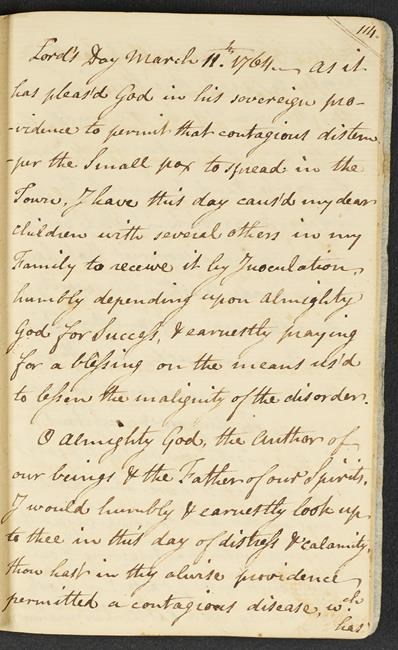
In this image provided by the American Ancestors & New England Historic Genealogical Society, a digitized copy of a page from a handwritten 18th century diary by the Rev. Ebenezer Storer, during a period of smallpox, in Boston, shows a March 1764 entry that includes a prayer Storer wrote after arranging to have his own children inoculated. In the prayer, Storer praises the discovery of means used in the late 18th century to treat the disease. (American Ancestors & New England Historic Genealogical Society via AP)

And three centuries later, the parallels with the coronavirus pandemic are uncanny.

“How little we’ve changed,” said CLA archivist Zachary Bodnar, who led the digitization effort, working closely with the New England Historic Genealogical Society.

“The fact that we’re finding these similarities in the records of our past is a very interesting parallel,” Bodnar said in an interview. “Sometimes the more we learn, the more we’re still the same, I guess.”

Smallpox was eradicated, but not before it sickened and killed millions worldwide. The U.S. Centers for Disease Control and Prevention say the last natural outbreak of smallpox in the United States occurred in 1949. In 1980, the World Health Organization’s decision-making arm declared it eradicated, and no cases of naturally occurring smallpox have been reported since.

But in April 1721, after an English ship, the HMS Seahorse, brought it to Boston, it was a clear and present danger. By winter of 1722, it would infect more than half of the city’s population of 11,000 and kill 850.

Much earlier outbreaks, also imported from Europe, killed Native Americans indiscriminately in the 1600s. Now, digitized church records are helping to round out the picture of how the colonists coped when it was their turn to endure pestilence.

The world’s first proper vaccination didn’t occur until the end of that century, when an English country doctor named Edward Jenner inoculated an 8-year-old boy against smallpox in 1796.

Before then, doctors used inoculation, or variolation as it was often called, introducing a trace amount of the smallpox virus into the skin. The procedure, or variations of it, had been practiced since ancient times in Asia. Jenner’s pioneering of vaccination, using instead a less lethal strain of the virus that infected cows, was a huge scientific advance.

Yet just as with COVID-19 vaccines in 2021, some took a skeptical view of smallpox inoculations in the 18th century, digitized documents show. To be sure, there was ample reason to worry: Early smallpox treatments, while effective in many who were inoculated, sickened or even killed others.

The Rev. Cotton Mather, one of the era’s most influential ministers, had actively promoted inoculation. In a sign of how resistant some colonists were to the new technology, someone tossed an explosive device through his window in November 1721.

Fortunately, it didn’t explode, but researchers at Harvard say this menacing message was attached: “Cotton Mather, you dog, damn you! I’ll inoculate you with this; with a pox to you.’’

Among the recently digitized Congregational Church records are handwritten diary entries scrawled by the Rev. Ebenezer Storer, a pastor in Cambridge, Massachusetts. On March 11, 1764, as smallpox once again raged through Boston, Storer penned a prayer in his journal after arranging to have his own children inoculated.

The deeply devout Storer, his diary shows, had faith in science.

“Blessed be thy name for any discoveries that have been made to soften the severity of the distemper. Grant thy blessing on the means used,” he wrote.

Three weeks later, Storer gave thanks to God “for his great mercy to me in recovering my dear children and the others in my family from the smallpox.”

For Bodnar, the archivist, it’s a testament to the insights church records can contain.

“They’re fascinating,” he said. “They’re essentially town records — they not only tell the story of the daily accounting of the church, but also the story of what people were doing at that time and what was going on.”

___

Follow AP New England editor Bill Kole on Twitter at http://twitter.com/billkole.

Report Error Submit a Tip

The Free Press acknowledges the financial support it receives from members of the city’s faith community, which makes our coverage of religion possible.


More Stories

The election of our discontent: City at a crumbling crossroads, grumbling residents say in poll

Matthew Frank 7 minute read Preview

The election of our discontent: City at a crumbling crossroads, grumbling residents say in poll

Matthew Frank 7 minute read Monday, Oct. 5, 2026

There’s an undercurrent of unhappiness running through the Winnipeg electorate as the municipal election day approaches.

One-half of Winnipeggers believe the city is heading in the wrong direction, according to a new Abacus Data poll, with nearly one-third unsure if Winnipeg is regressing or progressing.

Only 21 per cent of residents believe the city is on the right track, the Free Press-commissioned poll found.

That discontentment extends to how the city spends its tax dollars, with four in 10 Winnipeggers believing they receive poor value for what they pay in property taxes.

Read
Monday, Oct. 5, 2026

Jets trending in right direction after picking up points in first three games

Ken Wiebe 7 minute read Preview

Jets trending in right direction after picking up points in first three games

Ken Wiebe 7 minute read Yesterday at 5:06 PM CDT

Welcome to a small sample size season, when sweeping observations and hot takes can quickly become outdated and — occasionally — out of touch.

With that as a cautionary backdrop, the Winnipeg Jets are off to a 2-0-1 start that has them temporarily occupying top spot in the Central Division.

“We were optimistic that we’re a better team than we showed last year,” said Jets captain Adam Lowry. “We want to play fast. We want to compete hard, and we want to give ourselves a chance to win every night, so I think we’ve done that.”

As the Jets welcome the Colorado Avalanche on Wednesday to open a three-game homestand, they’ve gotten off to a fast start in a season that required one.

Read
Yesterday at 5:06 PM CDT

Estate of woman who died from local anesthetic injected into blood vessel sues Morden dentist, his business, clinic

Erik Pindera 4 minute read Preview

Estate of woman who died from local anesthetic injected into blood vessel sues Morden dentist, his business, clinic

Erik Pindera 4 minute read Monday, Oct. 5, 2026

The estate of a 23-year-old woman who died after receiving a local anesthetic during a wisdom tooth extraction at a Morden dental clinic has filed a lawsuit over her death.

Virginia Blatz never returned home after she went to Boundary Trails Dental Centre to have her wisdom teeth removed on Nov. 27, 2024. An autopsy later confirmed she died from local anesthetic systemic toxicity caused by an inadvertent injection into a blood vessel, her family has previously said.

Her father, Dulaney Blatz, filed a lawsuit in the Court of King’s Bench on behalf of her estate late last month, naming Ronald David Janz — the dentist who performed the procedure — his dental corporation and the dental corporation that operates the clinic as defendants.

None of the defendants have filed statements of defence in response to the claim, which has not yet been heard in court.

Read
Monday, Oct. 5, 2026

’Disgusting’ posters being investigated by police

Morgan Modjeski 4 minute read Monday, Oct. 5, 2026

The Winnipeg Police Service major crimes unit is investigating what some have labelled offensive and hateful posters on full-display at a Winnipeg home.

Three Manitoba nurses censured for inappropriate behaviour

Morgan Modjeski 3 minute read Monday, Oct. 5, 2026

A Manitoba nurse has been disciplined for inappropriate behaviour towards students including what is being described as unwanted touching.

Former host/VJ Rick Campanelli revisits his gambling addiction in new memoir

Jen Zoratti 7 minute read Preview

Former host/VJ Rick Campanelli revisits his gambling addiction in new memoir

Jen Zoratti 7 minute read Monday, Oct. 5, 2026

To many Canadians, veteran media personality Rick Campanelli is better known as Rick the Temp, the energetic, baby-faced intern-turned-VJ on MuchMusic in the 1990s and early 2000s.

But behind that winning smile was a much darker reality.

In his new memoir, Tempted: My Story, released last month via HarperCollins Canada and co-written with John Meyer, Campanelli, 56, opens up for the first time about his struggles with a serious — and secret — gambling addiction, which reached its nadir in 2008 when the then-host of Entertainment Tonight Canada was detained by U.S. Homeland Security for unpaid casino debts on a flight back from Las Vegas.

The Free Press caught up with Campanelli in advance of his Winnipeg launch Monday evening at McNally Robinson Grant Park. This interview has been lightly edited for length and clarity.

Read
Monday, Oct. 5, 2026