Poll suggests 40 per cent of Canadians know unvaccinated people, don’t discuss issue

Advertisement

Advertise with us

OTTAWA - About 40 per cent of Canadians know a family member or friend who is not vaccinated against COVID-19, and most don’t raise the issue with them, a poll carried out this month suggests.

Read this article for free:


or

Already have an account? Log in here »

To continue reading, please subscribe:

Subscribe and receive a limited-edition Free Press branded hat or tote.

Digital Subscription

One year of digital access for only $205*

  • Enjoy unlimited reading on winnipegfreepress.com
  • Read the E-Edition, our digital replica newspaper
  • Access News Break, our award-winning app
  • Play interactive puzzles

*First annual payment billed as $205.00 + GST for one year. This annual subscription will automatically renew at $233.00 + GST every 52 weeks (10% off the regular annual price of $259.35). Offer available to new and qualified returning subscribers only. Cancel any time.

To continue reading, please subscribe:

Add Free Press access to your Brandon Sun subscription for only an additional

$1 for the first 4 weeks*

  • Enjoy unlimited reading on winnipegfreepress.com
  • Read the E-Edition, our digital replica newspaper
  • Access News Break, our award-winning app
  • Play interactive puzzles
Start now

*Your next Brandon Sun subscription payment will increase by $1.00 and you will be charged $17.95 plus GST for four weeks. After four weeks, your payment will increase to $24.95 plus GST every four weeks.

Hey there, time traveller!
This article was published 13/12/2021 (1710 days ago), so information in it may no longer be current.

OTTAWA – About 40 per cent of Canadians know a family member or friend who is not vaccinated against COVID-19, and most don’t raise the issue with them, a poll carried out this month suggests.

The survey conducted by Leger and commissioned by the Association for Canadian Studies suggests four in ten Canadians have a friend or family member who is not vaccinated. Seventy per cent of these don’t discuss the matter with them, with half of those saying they have given up trying to persuade them to get protective shots.

The Leger-ACS survey shows that for 35 per cent of those polled, “it is not an issue” and they don’t talk about it, adding they get along well with unvaccinated family and friends. A similar percentage have given up trying to convince people they know to get immunized.
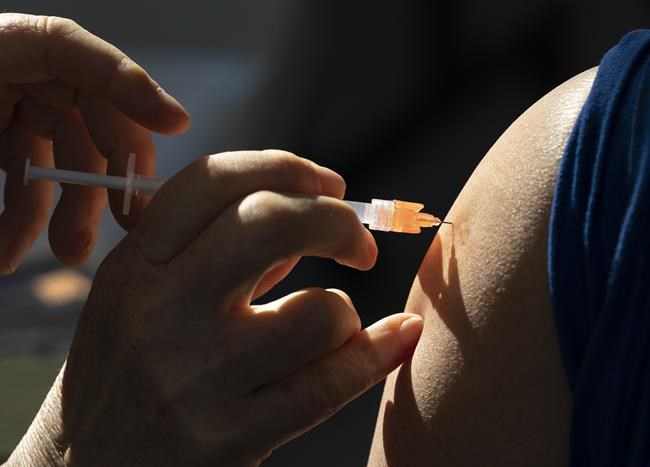
A dose of the Pfizer-BioNTech vaccine is given to a recipient at a vaccination site in Vancouver Thursday, March 11, 2021.  THE CANADIAN PRESS/Jonathan Hayward
A dose of the Pfizer-BioNTech vaccine is given to a recipient at a vaccination site in Vancouver Thursday, March 11, 2021. THE CANADIAN PRESS/Jonathan Hayward

About one in eight of of those surveyed said they argue with the unvaccinated about getting COVID-19 inoculations. Around one in ten no longer speak with unvaccinated people or avoid them, while another six per cent said they respect and support the personal choice of those who are unvaccinated.

The findings follow a poll conducted by Leger last month that suggested roughly 57 per cent of the vaccinated population would not invite an unvaccinated person into their homes.

Jack Jedwab, president and CEO of the Association for Canadian Studies, said some research shows taking a “hardline” stance with people who are not vaccinated does not tend to work, and a gentler persuasive approach is more effective.

“It’s better to take a softer approach. There’s not tremendous value in taking a hardline approach,” he said.

The poll of 1,500 people, conducted between Dec. 3 and 5, found respondents from Saskatchewan and Manitoba were most likely to have unvaccinated family and friends, followed by British Columbia. Respondents in rural areas were most likely to know someone who is unvaccinated than in towns or suburban areas.

Atlantic Canadian respondents were most likely to “defriend” unvaccinated family and friends, while Quebecers who answered the survey were most likely to try to convince others to get shots.

Respondents on the Prairies were most inclined to drop the subject and “say it’s fine”, according to the poll findings.

This report by The Canadian Press was first published Dec. 13, 2021.
Report Error Submit a Tip

More Stories

Working together in a trade war

Norman Brandson 5 minute read Preview

Working together in a trade war

Norman Brandson 5 minute read 2:00 AM CDT

In the Second World War, a grand coalition, held together politically by U.S. President Franklin D. Roosevelt, succeeded in defeating Nazi Germany, after many bumps in the road. The rich history of this period reinforces the truism that coalitions — bringing together parties of divergent strength and interests to face together a common challenge — are fraught with many points of potential fracture.

Canada was not only a partner in the great international war effort but also fashioned a national coalition — presided over by Prime Minister Mackenzie King — necessitated by the federalist nature of our government. It worked after a fashion — conscription notwithstanding — and we emerged as a trusted friend and ally of our southern neighbour.

Oh, how times have changed. We are again faced with an existential threat; not to be compared to a world war, but serious enough given it’s posed not by a distant foe on another continent, but by the most powerful country in the world, with whom we share 8,800 kilometres of heretofore undefended border.

The unprovoked attack on Canada has been economic; tariffs, threats of tariffs, scrapped trade agreements and so forth — measures that have already had significant impact and promise to escalate. How does a country of 10 quasi-independent provinces with a national government constitutionally pre-eminent in international relations respond?

Read
2:00 AM CDT

New Bannatyne eatery brings feast of Asian flavours

Eva Wasney 4 minute read Preview

New Bannatyne eatery brings feast of Asian flavours

Eva Wasney 4 minute read Yesterday at 4:29 PM CDT

Matriarchal influences run deep at House of Ma Kitchen and Bar.

Executive chef Dom Merano took inspiration from his mom’s home cooking while developing the menu for the new Exchange District restaurant — specifically Cynthia Merano’s recipes for lumpia (Filipino spring rolls) and kare-kare (braised beef and peanut stew).

“It tastes like home,” Merano says of the dishes, adding that his mom “felt honoured to be able to share her cooking with people. She was actually here prior to opening helping me roll lumpia.”

Cynthia’s photo is hung among the “Wall of Mas” at the back of the restaurant, where the mothers and grandmothers of True Hospitality staff are given pride of place.

Read
Yesterday at 4:29 PM CDT

Brandon’s gas plant: a health decision

Riley De Blonde and Scott Blyth 5 minute read 2:00 AM CDT

Imagine a Manitoba in which our lives are powered by clean, affordable electricity that Manitobans own and which doesn’t pollute the air and water we depend on.

That future is within reach and, as doctors, we know it would protect people’s health now and for many generations.

Instead, Manitoba Hydro wants to spend $3 billion on three new gas-fired turbines in Brandon.The Public Utilities Board is now considering this proposal, before our provincial leaders make a final decision that could lock us into burning harmful fossil fuels for decades.

Every day doctors witness the toll of air pollution, hotter summers and smokier skies on our patients — the child struggling through an asthma attack in the emergency room, the senior dangerously overheating during a heat wave. These health crises are not inevitable. They are the consequence of decisions, by governments and corporations, to keep burning fossil fuels.

First week at supervised drug consumption site issue-free: premier

Free Press staff 2 minute read Preview

First week at supervised drug consumption site issue-free: premier

Free Press staff 2 minute read Yesterday at 7:17 PM CDT

There were no issues to report after the first week of operations for Manitoba’s first supervised drug consumption site, Premier Wab Kinew said Tuesday.

The Winnipeg space, operating temporarily out of the fenced-off parking lot at 366 Henry Ave. while the adjacent building, which is to become the permanent site, undergoes renovations, opened Aug. 11.

Opening the long-awaited supervised consumption facility was a 2023 NDP election promise to keep people alive in the midst of a toxic street-drug crisis.

Kinew said the facility, which is being run by the Aboriginal Health and Wellness Centre for the province, had quietly served at least 125 clients as of earlier in the week.

Read
Yesterday at 7:17 PM CDT

Rural Manitoba homeowner charged with shooting at accused thieves

Nicole Buffie 4 minute read Preview

Rural Manitoba homeowner charged with shooting at accused thieves

Nicole Buffie 4 minute read Yesterday at 5:51 PM CDT

A homeowner in southern Manitoba has been charged after he fired shots at a group of people accused of stealing from his property, police say.

Officers were sent to the Rural Municipality of Dufferin Saturday after a report of a theft in progress. RCMP said four people went to the property, located about 95 kilometres southwest of Winnipeg, and returned later the same day driving two vehicles stolen from Watrous, Sask.

The owner of the property, a 66-year-old man, saw the suspects on a motion-activated camera and saw someone transferring fuel from a portable container into one of the stolen vehicles. The man confronted the group and fired shots towards the vehicles, police said.

Three people stayed at the scene until officers arrived and took them into custody, RCMP said. Various items believed to have been stolen from the property were found in the back of a truck. A fourth suspect fled in the other vehicle.

Read
Yesterday at 5:51 PM CDT

Two in five Canadians know unvaxed people: poll

Marie Woolf, The Canadian Press 3 minute read Preview

Two in five Canadians know unvaxed people: poll

Marie Woolf, The Canadian Press 3 minute read Monday, Dec. 13, 2021

OTTAWA - About 40 per cent of Canadians know a family member or friend who is not vaccinated against COVID-19, and most don’t raise the issue with them, a poll carried out this month suggests.

The survey conducted by Leger and commissioned by the Association for Canadian Studies suggests four in ten Canadians have a friend or family member who is not vaccinated. Seventy per cent of these don’t discuss the matter with them, with half of those saying they have given up trying to persuade them to get protective shots.

The Leger-ACS survey shows that for 35 per cent of those polled, “it is not an issue” and they don’t talk about it, adding they get along well with unvaccinated family and friends. A similar percentage have given up trying to convince people they know to get immunized.

About one in eight of of those surveyed said they argue with the unvaccinated about getting COVID-19 inoculations. Around one in ten no longer speak with unvaccinated people or avoid them, while another six per cent said they respect and support the personal choice of those who are unvaccinated.

Read
Monday, Dec. 13, 2021