Survey shows 52% of Canadians feel anxious about return to ‘normal’ after COVID-19
Advertisement
Read this article for free:
or
Already have an account? Log in here »
To continue reading, please subscribe:

Digital Subscription
One year of digital access for only $205*
- Enjoy unlimited reading on winnipegfreepress.com
- Read the E-Edition, our digital replica newspaper
- Access News Break, our award-winning app
- Play interactive puzzles
*First annual payment billed as $205.00 + GST for one year. This annual subscription will automatically renew at $233.00 + GST every 52 weeks (10% off the regular annual price of $259.35). Offer available to new and qualified returning subscribers only. Cancel any time.
To continue reading, please subscribe:
Add Free Press access to your Brandon Sun subscription for only an additional
$1 for the first 4 weeks*
- Enjoy unlimited reading on winnipegfreepress.com
- Read the E-Edition, our digital replica newspaper
- Access News Break, our award-winning app
- Play interactive puzzles
*Your next Brandon Sun subscription payment will increase by $1.00 and you will be charged $17.95 plus GST for four weeks. After four weeks, your payment will increase to $24.95 plus GST every four weeks.
Read unlimited articles for free today:
or
Already have an account? Log in here »
Hey there, time traveller!
This article was published 26/05/2021 (1959 days ago), so information in it may no longer be current.
OTTAWA – More than half of Canadians feel somewhat anxious about going back to the way life was before it was turned upside down by the COVID-19 pandemic, a new survey shows.
Leger asked the question for a study done in collaboration with the Association for Canadian Studies.
Data shows 1,647 Canadians responded to a web survey from May 21 to 23, which cannot be assigned a margin of error because it was done online.
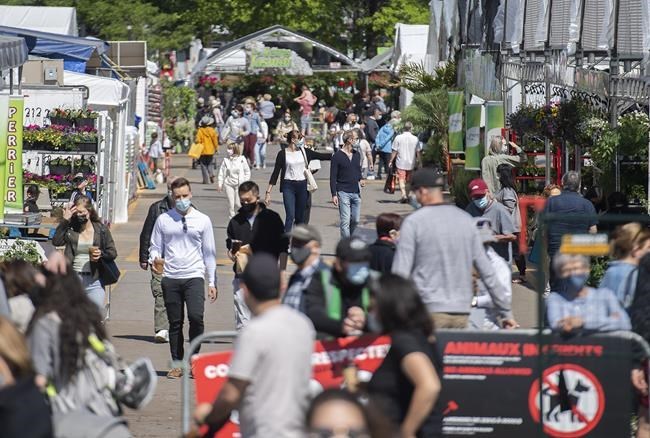
Respondents were asked whether returning to what life was like before the novel coronavirus was a source of anxiety for them, given how governments are announcing plans to reopen after more than a year of telling people to stay home.
The results show 52 per cent of those who responded reported feeling some level of anxiety, with those aged 18 to 24 showing the highest levels of unease at 68 per cent.
“Maybe some of it is related to work, maybe some of it is related to, ‘When we actually go back to normal, will it be safe? Will I feel comfortable around somebody not wearing a mask anymore?'” said Christian Bourque, executive vice-president of the polling and marketing research firm Leger.
For others, he said, it could come down to thinking like, “Oh God, I have to invite the in-laws again.”
“There’s something about this new life during the pandemic that people actually sort of grew into, and potentially, sort of, maybe like,” Bourque said.
The findings come as vaccines that protect against COVID-19 go into the arms of more Canadians, thanks to a steadier flow of federal shipments arriving than seen early in the year.
With more inoculations comes planning from provinces and federal advice about when daily activities, like playing sports outside and eating at a restaurant, can be allowed again, along with kids going back to the classroom.
Ontario, Quebec and Saskatchewan have each outlined plans to ease health restrictions through spring and summer in stages, according to how many people are vaccinated against COVID-19.
Prime Minister Justin Trudeau and federal officials are also fielding questions about how much longer the Canada-U. S. border will remain closed and what documentation Canadians might need to travel abroad, as well as vice versa for those entering the country.
Bourque suggested Leger’s research shows those in power would be wise to take a slower approach to reopening society, even as a post-COVID Canada seems to grow closer on the horizon.
“I would be extremely careful as to not sound over-joyous because that’s not the sentiment right now among Canadians.”
As for why young adults report feeling more anxious than other age groups about a return to normal, Bourque said it could be related to them being “the anxiety generation.”

Close to half of younger Canadians generally feel they suffer from some form of anxiety, he said, and so have more awareness of it and a greater willingness to name it than older residents.
Plus, for some in their 20s, their social life could be what makes them anxious.
“Potentially for younger Canadians who maybe have felt some form of isolation during the pandemic are probably weary about how will it be, how do I go back to the way things were,” said Bourque.
“‘I was not that popular before the pandemic, what will happen to me now?’ There might be a lot of that.”
This report by The Canadian Press was first published May 26, 2021.