Texas bans most abortions, with high court mum on appeal

Advertisement

Advertise with us

The nation's most far-reaching curb on abortions since they were legalized a half-century ago took effect Wednesday in Texas, with the Supreme Court silent on an emergency appeal to put the law on hold.

Read this article for free:


or

Already have an account? Log in here »

To continue reading, please subscribe:

Subscribe and receive a limited-edition Free Press branded hat or tote.

Digital Subscription

One year of digital access for only $205*

  • Enjoy unlimited reading on winnipegfreepress.com
  • Read the E-Edition, our digital replica newspaper
  • Access News Break, our award-winning app
  • Play interactive puzzles

*First annual payment billed as $205.00 + GST for one year. This annual subscription will automatically renew at $233.00 + GST every 52 weeks (10% off the regular annual price of $259.35). Offer available to new and qualified returning subscribers only. Cancel any time.

To continue reading, please subscribe:

Add Free Press access to your Brandon Sun subscription for only an additional

$1 for the first 4 weeks*

  • Enjoy unlimited reading on winnipegfreepress.com
  • Read the E-Edition, our digital replica newspaper
  • Access News Break, our award-winning app
  • Play interactive puzzles
Start now

*Your next Brandon Sun subscription payment will increase by $1.00 and you will be charged $17.95 plus GST for four weeks. After four weeks, your payment will increase to $24.95 plus GST every four weeks.

Hey there, time traveller!
This article was published 01/09/2021 (1841 days ago), so information in it may no longer be current.

The nation’s most far-reaching curb on abortions since they were legalized a half-century ago took effect Wednesday in Texas, with the Supreme Court silent on an emergency appeal to put the law on hold.

If allowed to remain in force, the law, which bans most abortions, would be the strictest against abortion rights in the United States since the high court’s landmark Roe v. Wade decision in 1973.

The Texas law, signed by Republican Gov. Greg Abbott in May, prohibits abortions once medical professionals can detect cardiac activity, usually around six weeks and before most women know they’re pregnant.
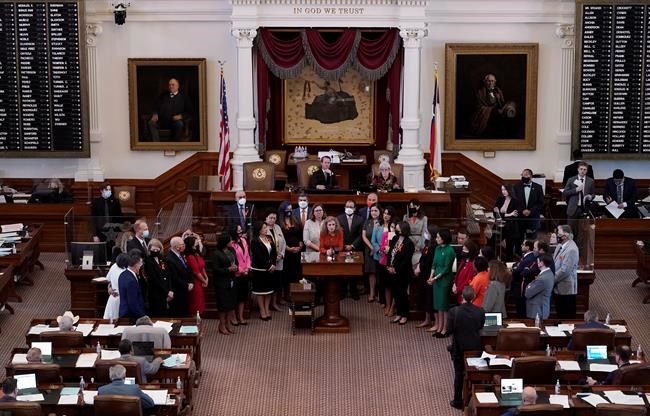
FILE - In this May 5, 2021, file photo, Texas state Rep. Donna Howard, D-Austin, center at lectern, stands with fellow lawmakers in the House Chamber in Austin, Texas, as she opposes a bill introduced that would ban abortions as early as six weeks and allow private citizens to enforce it through civil lawsuits, under a measure given preliminary approval by the Republican-dominated House. Abortion providers in Texas are asking the Supreme Court to prevent enforcement of a state law that would allow private citizens to sue anyone for helping a woman get an abortion after about six weeks of pregnancy. (AP Photo/Eric Gay, File)

It’s part of a broader push by Republicans across the country to impose new restrictions on abortion. At least 12 other states have enacted bans early in pregnancy, but all have been blocked from going into effect.

What makes the Texas law different is its unusual enforcement scheme. Rather than have officials responsible for enforcing the law, private citizens are authorized to sue abortion providers and anyone involved in facilitating abortions. Among other situations, that would include anyone who drives a woman to a clinic to get an abortion. Under the law, anyone who successfully sues another person would be entitled to at least $10,000.

“Starting today, every unborn child with a heartbeat will be protected from the ravages of abortion,” Abbott said in a statement posted on Twitter. “Texas will always defend the right to life.”

But protests were quick.

President Joe Biden said in a statement that the law “blatantly violates the constitutional right established under Roe v. Wade and upheld as precedent for nearly half a century.” He said the law “outrageously” gives private citizens the power “to bring lawsuits against anyone who they believe has helped another person get an abortion.”

Likewise, the American Medical Association said it was deeply disturbed by “this egregious law” and disappointed by the Supreme Court’s inaction.

The law “not only bans virtually all abortions in the state, but it interferes in the patient-physician relationship and places bounties on physicians and health care workers simply for delivering care,” said a statement from Dr. Gerald E. Harmon, the AMA president.

In a phone call with reporters, Marc Hearron, a lawyer for the Center for Reproductive Rights, said the abortion providers his group represents were still hoping to hear from the Supreme Court but “as of now, most abortion is banned in Texas.”

Clinics have said the law would rule out 85% of abortions in Texas and force many clinics to close. Planned Parenthood is among the abortion providers that have stopped scheduling abortions beyond six weeks from conception.
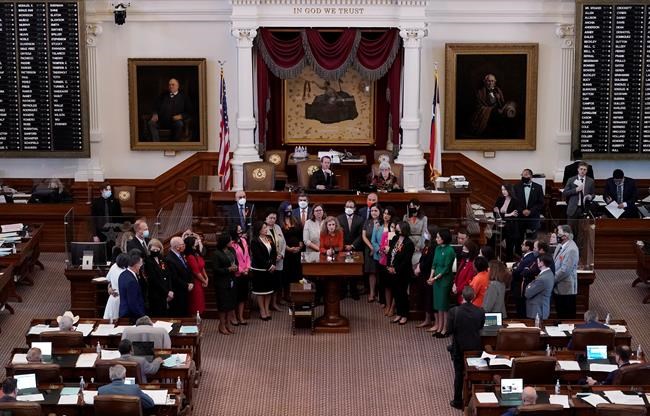
FILE - In this May 5, 2021, file photo, Texas state Rep. Donna Howard, D-Austin, center at lectern, stands with fellow lawmakers in the House Chamber in Austin, Texas, as she opposes a bill introduced that would ban abortions as early as six weeks and allow private citizens to enforce it through civil lawsuits, under a measure given preliminary approval by the Republican-dominated House. A Texas law banning most abortions in the state took effect at midnight on Sept. 1 but the Supreme Court has yet to act on an emergency appeal to put the law on hold. If allowed to remain in force, the law would be the most dramatic restriction on abortion rights in the United States since the high court’s landmark Roe v. Wade decision legalized abortion across the country in 1973. (AP Photo/Eric Gay, File)

Abortion opponents who wrote the law also made it difficult to challenge in court, in part because it’s hard to know whom to sue.

Abortion rights advocates say it will force many women to travel out of state for abortions, if they can afford to do so and also navigate issues including childcare and taking time off work. The Guttmacher Institute, a research organization that supports abortion rights, says if legal abortion care in Texas shuts down, the average one-way driving distance to an abortion clinic for Texans would increase from 12 miles to 248 miles.

Already, abortion clinics beyond the Texas border are feeling the impact. At the Trust Women clinic in Oklahoma City, there had been 80 appointments scheduled over the past two days, more than double the typical number of patients, said Rebecca Tong, co-executive director of the clinic. Two-thirds of those patients were from Texas, another sharp increase, and the earliest opening was now three weeks out.

“Oklahoma has just barely enough clinics for the amount of people here,” Tong said. “If anyone is thinking, ‘Oh, they can just go out of state, it’ll be so easy,’ a lot of clinics in the Midwest and South, we don’t do abortion care five days a week.”

Late into the night Tuesday before the ban took effect clinics in Texas were filled with patients, said Amy Hagstrom Miller, CEO of Whole Women’s Health, which has four abortion clinics in Texas.

Twenty-seven women were still in the waiting room after 10 p.m. at one clinic, leaving doctors crying and scrambling over whether they would see all of them in time, she said. The last abortion at one of her clinics finished at 11:56 p.m. in Fort Worth, where Hagstrom Miller said anti-abortion activists outside shined bright lights in the parking lot after dark looking for wrongdoing, and twice called police.

“This morning I woke up feeling deep sadness. I’m worried. I’m numb,” she said.

The law is part of a hard-right agenda that Texas Republicans muscled through the statehouse this year ahead of the 2022 midterm elections, when Abbott is up for a third term as governor.

Another law taking effect Wednesday ended required firearm training and background checks to carry handguns in public in Texas, and GOP lawmakers on Tuesday approved election changes that will further tighten what are already some of the strictest voting laws in the nation.
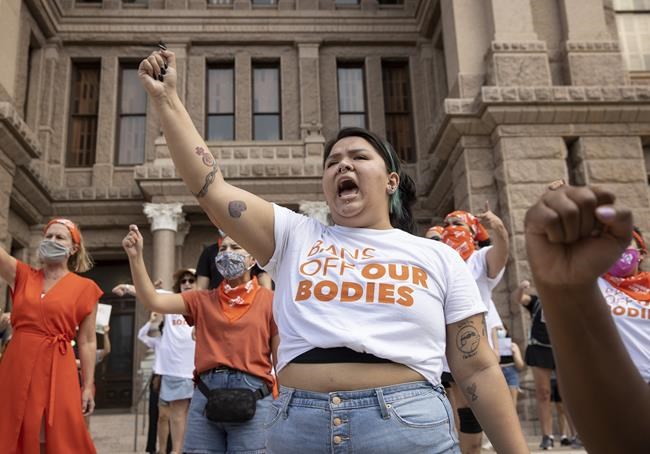
Leen Garza participates in a protest against the six-week abortion ban at the Capitol in Austin, Texas, on Wednesday, Sept. 1, 2021. Dozens of people protested the abortion restriction law that went into effect Wednesday. (Jay Janner/Austin American-Statesman via AP)

Texas has long had some of the nation’s toughest abortion restrictions, including a sweeping law passed in 2013. The Supreme Court eventually struck down that law, but not before more than half of the state’s 40-plus clinics closed.

Lawmakers also are moving forward in an ongoing special session in Texas with proposed new restrictions on medication abortion, a method using pills that accounts for roughly 40% of abortions in the U.S.

Even before the Texas case arrived at the high court the justices had planned to tackle the issue of abortion rights in a major case that will be heard after the court begins hearing arguments again in the fall. That case involves the state of Mississippi, which is asking to be allowed to enforce an abortion ban after 15 weeks of pregnancy.

___

AP writer Paul J. Weber reported from Austin, Texas.

Report Error Submit a Tip

More Stories

Teenage e-scooter driver in critical condition after crash

Chris Kitching 2 minute read 11:10 AM CDT

An electric scooter rider in their late teens suffered life-threatening injuries when they were hit by an SUV in southwest Winnipeg on Monday night.

Police said the collision happened at Waverley Street at Lake Crest Road at about 9:30 p.m.

The e-scooter rider was crossing Waverley when they were hit by a southbound 2010 Honda CR-V driven by a person who was also in their late teens.

The injured youth was in critical condition after the collision. They remained in hospital Wednesday. The driver remained on scene and was interviewed by investigators, police said.

Seven years sought for serial harasser

Dean Pritchard 5 minute read Preview

Seven years sought for serial harasser

Dean Pritchard 5 minute read Yesterday at 2:01 AM CDT

Alexander Beaton finished serving a two-year jail sentence for criminally harassing six women and didn’t last two days in the community before he was back at it, sending unwanted obscene messages and videos to a dozen women.

Now prosecutors are seeking a seven-year prison sentence for the 30-year-old Winnipeg man, whose latest string of victims includes a police officer who investigated his earlier crimes.

“He essentially continued (offending) unabated,” Crown attorney Brett Rach told provincial court Judge Malcolm McDonald at a sentencing hearing Friday. “It caused more than a nuisance to these victims — it caused them to fear for their safety.”

Beaton pleaded guilty to 14 charges of criminal harassment, sending indecent communications and breaching court orders for a campaign of harassment waged between 2015 and 2025.

Read
Yesterday at 2:01 AM CDT

Federal Court awards OCN $27M, 62 years after construction of hydro dam

Nicole Buffie 5 minute read Preview

Federal Court awards OCN $27M, 62 years after construction of hydro dam

Nicole Buffie 5 minute read Updated: 12:02 PM CDT

The Federal Court has ordered Ottawa pay Opaskwayak Cree Nation $27 million over damages suffered due to the construction of the Grand Rapids hydro dam in the 1960s.

In a decision dated Sept. 3, Federal Court Justice Sébastien Grammond says the federal government had a fiduciary duty to protect the community from the impacts of the dam.

“When the Crown exercises a discretionary power over an Indigenous interest, it has a fiduciary duty and it must exercise the discretion in the best interests of the Indigenous group,” the ruling said. “Canada breached its fiduciary duty to OCN because it approved the (project) without ensuring that the impacts of the Grand Rapids dam on OCN’s traditional way of life were mitigated or compensated.”

The First Nation took the federal government to court in February over impacts on the community after the dam, located about 145 kilometres southeast of Opaskwayak Cree Nation, was installed on the Saskatchewan River in 1964. The case was heard over 14 days in a judge-alone trial in Winnipeg.

Read
Updated: 12:02 PM CDT

Letters, Sept. 16

7 minute read Preview

Letters, Sept. 16

7 minute read Updated: 8:06 AM CDT

Decades ago, we were told mining and other economic development in the North could be “balanced” with protecting caribou habitat. We’ve seen how that worked out. Fortunes were made. Caribou herds declined, and now some populations are teetering on the brink of extinction.

Read
Updated: 8:06 AM CDT

BRANDON — A 29-year-old man has been sentenced to 18 years in prison for sexually abusing and impregnating a 14-year-old girl in 2024.

“Sexual abuse of a child is inherently a grave violation of the child’s bodily integrity, dignity, and security, and in this case, the consequences were compounded by the victim’s pregnancy and the need to undergo a termination,” Brandon provincial court Judge Patrick Sullivan said on Tuesday.

The accused had pleaded guilty to two counts of sexual interference and two counts of breaching a court order banning him from contacting anyone under 18.

A publication ban prohibits the publication of information that could identify the 14-year-old, who is from a western Manitoba First Nation, and two other minors with whom he communicated.

Rogers, Telus deny blame for June twister alert barrage

Malak Abas 3 minute read Preview

Rogers, Telus deny blame for June twister alert barrage

Malak Abas 3 minute read Updated: Yesterday at 7:21 AM CDT

Telecom companies say they aren’t to blame for the barrage of tornado alerts Manitobans received during severe thunderstorms in early June.

The Canadian Radio-television and Telecommunications Commission announced in August it would investigate the unusually high number of alerts, and called on the Pelmorex Corp., which operates the national Alert Ready system, along with telecom companies Bell, Rogers and Telus to respond to a number of questions.

They were given until last Friday to describe their possible roles in the creation, receipt, processing or distribution of alerts issued from Environment and Climate Change Canada in the midst of the June 9 storm.

Telus said in its response that it received 133 alert requests targeted to Manitoba created by Environment Canada and forwarded by Pelmorex between 2:35 p.m. June 9 and 3:29 a.m. the following day. While the majority of those messages contained identical information and were automatically suppressed, 17 were ultimately sent out as alerts in Winnipeg.

Read
Updated: Yesterday at 7:21 AM CDT