WEATHER ALERT

How birdwatchers can help threatened bird populations

Advertisement

Advertise with us

The types of birds coming through your neighbourhood are probably changing, and so is the timing of their migrations. Birdwatchers noticing these differences are on the front line in figuring out how climate change and more severe weather events are putting stress on bird populations.

Read this article for free:

or

Already have an account? Log in here »

To continue reading, please subscribe:

Subscribe and receive a limited-edition Free Press branded hat or tote.

Digital Subscription

One year of digital access for only $205*

  • Enjoy unlimited reading on winnipegfreepress.com
  • Read the E-Edition, our digital replica newspaper
  • Access News Break, our award-winning app
  • Play interactive puzzles

*First annual payment billed as $205.00 + GST for one year. This annual subscription will automatically renew at $233.00 + GST every 52 weeks (10% off the regular annual price of $259.35). Offer available to new and qualified returning subscribers only. Cancel any time.

To continue reading, please subscribe:

Add Free Press access to your Brandon Sun subscription for only an additional

$1 for the first 4 weeks*

  • Enjoy unlimited reading on winnipegfreepress.com
  • Read the E-Edition, our digital replica newspaper
  • Access News Break, our award-winning app
  • Play interactive puzzles
Start now

*Your next Brandon Sun subscription payment will increase by $1.00 and you will be charged $17.95 plus GST for four weeks. After four weeks, your payment will increase to $24.95 plus GST every four weeks.

Hey there, time traveller!
This article was published 07/05/2019 (2641 days ago), so information in it may no longer be current.

The types of birds coming through your neighbourhood are probably changing, and so is the timing of their migrations. Birdwatchers noticing these differences are on the front line in figuring out how climate change and more severe weather events are putting stress on bird populations.

“Birders have to be much more alert to when birds are coming through than they used to be, since birds may be coming through much earlier or later than they used to,” says John Rowden, director of community conservation at the National Audubon Society.

Birdwatchers are increasingly noticing unfamiliar birds normally found elsewhere, he says, and are seeing fewer of the birds they’d taken for granted.
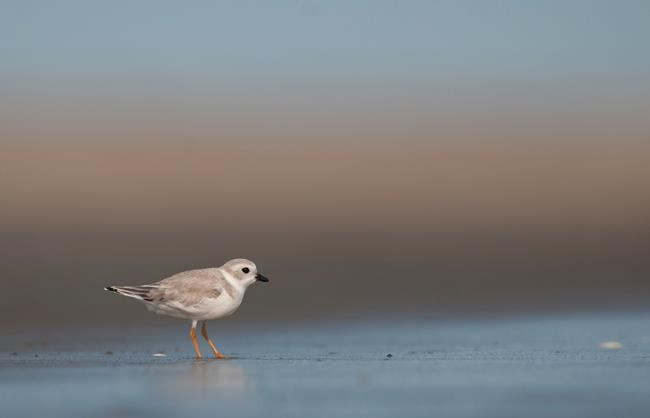
This 2012 photo provided by Audubon shows a Piping Plover on the coast of Maine. (Walker Golder/Augubon via AP)

“People are shocked when I say it. But just because we’ve seen these birds (year after year) doesn’t mean they’ll always be there. They are declining in numbers because we’re throwing so many things at them, so we need to do what we can to help them,” says Rowden.

At least 314 species of American birds are expected to lose 50 per cent or more of their range by the end of the century, and have been listed by the Audubon Society as climate-threatened or endangered, Rowden says.

A United Nations science report issued Monday says 1 million species of plants and animals are at risk of going extinct. Scientists issuing the report in Paris blamed development that has led to loss of habitat, climate change, overfishing, pollution and invasive species.

Conservationists say there are a few easy steps people can take to help struggling bird populations, like planting native species, even in window boxes or patio containers, to encourage the native insects upon which birds depend, particularly for feeding their young.

The Audubon Society’s Plants for Birds program encourages people to plant native plants; there’s a website where you can type in your zip code to find out which plants will help birds in your area, and where to find those native plants and seeds locally.

During spring and fall migration seasons, people are encouraged to help migrating birds by minimizing outdoor lighting and covering reflective surfaces like large windows. Make indoor plants less visible to passing birds.

Birdwatchers can also help efforts to save the birds by tracking what they see on ebird.org, a national online data base run by The Cornell Lab of Ornithology.

“We also have a community science program called Climate Watch , which tries to collect data on how bird ranges are changing. It asks people to go out and do point counts of certain species, and runs from May 15 to June 15. That’s something very helpful that birders can participate in,” says Rowden.

“Birders love to see the same birds year after year, and keep track of when they are they going to come back each year during migration. Now, the timing may change and the windows may shift. You’ve got to be on the ball to spot them,” he says.

“It’s helpful if communities can pitch in to help,” he adds.

Geoff LeBaron, director of the Christmas Bird Count at the National Audubon Society, says he has seen the effects of climate change firsthand.

“I’ve been a birder since I was a little kid,” he says. “It’s clear that climate change is affecting and will continue to affect birds on a global scale, and it’s a question of whether or not they can adapt to what the climate is throwing at them.”

Record droughts, floods, hurricanes and more are having a dramatic impact, he says.

“Hurricanes tend to happen during migration season and they happen initially over water, so they have a big effect on sea birds and can send them thousands of miles off track. Birdwatchers spot them when they get displaced over land.”

Most at risk from climate catastrophes are sea birds and grasslands birds, experts say. Birds known as aerial insectivores, like swifts and nighthawks, are also at risk because the insects they depend on are getting harder to find.

One bird, the rufous hummingbird, is expected to lose all of its range in the United States within this century. And the yellow warbler, which is found across the country and is considered one of the more common birds, has declined by 25 per cent since the 1960s, Rowden says.

Report Error Submit a Tip

More Stories

Decision on corridor for Trans-Canada twinning near Ontario border expected this fall, province says

Chris Kitching 4 minute read Preview

Decision on corridor for Trans-Canada twinning near Ontario border expected this fall, province says

Chris Kitching 4 minute read Updated: Yesterday at 5:24 PM CDT

The Manitoba government is taking more time to evaluate and select a preferred corridor for the twinning of a 16-kilometre section of the Trans-Canada Highway near the Ontario boundary.

An earlier timeline indicated Manitoba Transportation and Infrastructure expected to choose an alignment by the fall of 2025. A provincial spokesperson told the Free Press on Monday a decision is expected this winter, but a different spokesperson said Wednesday a decision is expected this fall.

“The department continues to evaluate corridor alternatives and will undertake additional geotechnical, environmental and design work as part of the (functional design study) to support the selection of a preferred corridor,” the spokesperson said in a statement.

The study, which will include Crown-Indigenous and public consultation, is expected to be completed in late 2027, with a detailed design to follow.

Read
Updated: Yesterday at 5:24 PM CDT

Critical analysis of Manitoba Hydro plans may be frustrating, but it’s necessary

Editorial 4 minute read Preview

Critical analysis of Manitoba Hydro plans may be frustrating, but it’s necessary

Editorial 4 minute read Yesterday at 2:00 AM CDT

Many of this country’s public utilities are virtual monopolies, and because of that, their ability to set rates and their long-term capital plans need review in order to protect their ratepayers.

Read
Yesterday at 2:00 AM CDT

Drop bravado and cease silly summer spat

Maureen Scurfield 4 minute read 2:01 AM CDT

DEAR MISS LONELYHEARTS: My neighbour mowed the words “dumb ass” into my lawn, which had grown way too long while I was staying at the lake in my new cabin — for four weeks.

I agree my long front lawn got annoying to look at on our residential street. So, I got home and got out of my car, and took pictures of what he did to my lawn — in front of some neighbours for witnesses.

Then I unpacked my stuff, and that night just before bed I finally mowed the lawn with my loud mower. I did it in my own sweet time and went to bed, still mad. I honestly thought my neighbour was mostly just jealous because he doesn’t have a cabin himself!

I’d finally cooled off by noon the next day, so I went out and bought the guy a 12-pack, and left the beer on his back steps, with a card saying, “You can relax now!”

Use it twice: a data centre we could support

Hersh Seth 5 minute read Preview

Use it twice: a data centre we could support

Hersh Seth 5 minute read 2:00 AM CDT

In June, Premier Wab Kinew rejected a massive AI data centre planned near Île-des-Chênes. The project would have used 500 megawatts of power, which is about the same as the Grand Rapids generating station, and would have run on six natural gas turbines. Kinew said the environmental cost was too high and the long-term benefit for Manitobans was too low.

He made the right call. But simply saying no to data centres is not enough.

Winnipeg is a cold city. Data centres are basically huge electric heaters with computers inside. Almost every watt they use turns into heat, and most facilities pay to release it into the air. In a city that spends half the year paying to stay warm, that’s not just waste; it’s an opportunity. The idea is simple: use the energy twice. First for computing, then for heating our buildings.

The stakes are real. Manitoba Hydro’s new resource plan says peak demand will exceed our capacity as early as 2029 or 2030, and that the province will need about 1,760 additional megawatts of dependable capacity by 2035.

Read
2:00 AM CDT

Downtown Winnipeg comedy club Yuk Yuk’s closes

Gabrielle Piché 4 minute read Preview

Downtown Winnipeg comedy club Yuk Yuk’s closes

Gabrielle Piché 4 minute read Yesterday at 8:04 PM CDT

A downtown Winnipeg comedy club, Yuk Yuk’s, closed after being one of the company’s worst performing locations across Canada.

“We’ve opened many clubs,” said Mark Breslin, Yuk Yuk’s founder. “They’re like oil wells — some of them gush, some of them trickle and some of them are just dry.

“You never absolutely know which is going to be which.”

The franchise counts at least 10 locations nationally.

Read
Yesterday at 8:04 PM CDT

Report draws link between missing Indigenous women and trafficking across Canada

Marsha McLeod 6 minute read Preview

Report draws link between missing Indigenous women and trafficking across Canada

Marsha McLeod 6 minute read Tuesday, Jul. 28, 2026

A new analysis of online sex advertisements featuring Indigenous women has identified cross-country corridors that are highly indicative of sex trafficking, while revealing insight into how women and girls are exploited in Winnipeg.

Read
Tuesday, Jul. 28, 2026