WEATHER ALERT

Memory centre takes visitors through 4 decades of Afghan war

Advertisement

Advertise with us

KABUL - A teary-eyed Hameed Rafi said he'll never forget the day he joined a panel of civilian war victims and family members and spoke about the suicide bombing in Kabul that killed his sister last August.

Read this article for free:

or

Already have an account? Log in here »

To continue reading, please subscribe:

Subscribe and receive a limited-edition Free Press branded hat or tote.

Digital Subscription

One year of digital access for only $205*

  • Enjoy unlimited reading on winnipegfreepress.com
  • Read the E-Edition, our digital replica newspaper
  • Access News Break, our award-winning app
  • Play interactive puzzles

*First annual payment billed as $205.00 + GST for one year. This annual subscription will automatically renew at $233.00 + GST every 52 weeks (10% off the regular annual price of $259.35). Offer available to new and qualified returning subscribers only. Cancel any time.

To continue reading, please subscribe:

Add Free Press access to your Brandon Sun subscription for only an additional

$1 for the first 4 weeks*

  • Enjoy unlimited reading on winnipegfreepress.com
  • Read the E-Edition, our digital replica newspaper
  • Access News Break, our award-winning app
  • Play interactive puzzles
Start now

*Your next Brandon Sun subscription payment will increase by $1.00 and you will be charged $17.95 plus GST for four weeks. After four weeks, your payment will increase to $24.95 plus GST every four weeks.

Hey there, time traveller!
This article was published 30/04/2019 (2648 days ago), so information in it may no longer be current.

KABUL – A teary-eyed Hameed Rafi said he’ll never forget the day he joined a panel of civilian war victims and family members and spoke about the suicide bombing in Kabul that killed his sister last August.

Sharing his story with them in March at the Afghanistan Center for Memory and Dialogue, Rafi recalled how all of the wounded in the attack had been taken to hospitals, so he began searching lists of wounded hanging on hospital walls. But he couldn’t find the name of his sister, 18-year-old Rahila, who had been studying in an education centre for her college entrance exam when the attack happened.

Then, a doctor suggested Rafi also search lists of those killed.
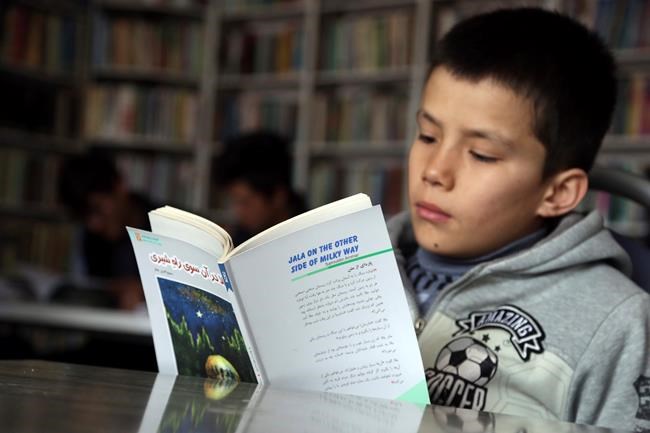
In this Tuesday, March 19, 2019, an Afghan boy studies at the Rahila library, in Kabul, Afghanistan. Launched in February by the Afghanistan Human Rights and Democracy Organization, the center seeks to salvage, protect and share memories and stories of civilian victims of the country's four decades of war. (AP Photo/Rahmat Gul)

“That shocked me, I had never considered that my sister wouldn’t be alive anymore,” he said. But as he learned later, Rahila had perished, he told those who attended the panel discussion.

Rafi’s chance to share his story is at the heart of the memory centre’s mission. Launched in February by the Afghanistan Human Rights and Democracy Organization, it seeks to salvage, protect and share memories and stories of civilian victims of the country’s four decades of war.

The centre, located in a small basement of a rental house in west Kabul, contains exhibits reminding visitors of the years of carnage and loss, including drawings, garments, photos and toys with accompanying personal information such as names, places and causes of death or injury.

But the centre is also a safe space for family and friends of civilian victims like Rafi to share their stories and preserve the memories of their loved ones. Each family has its own story, but when they listen to the narratives of others they realize they’re not alone in their pain.

Afghanistan has experienced some 40 years of continuous wars and the centre has divided them into periods, starting with the former communist regime from 1978-1992, which led to the 1979 invasion by the former Soviet Union to support the government and Afghanistan’s subsequent spiral into war.

That period was followed by the civil war in the Islamic State of Afghanistan, from 1992-1996. During these years, many of the warlords, who were later returned to power by the international community in 2001, waged a brutal war against each other for power, killing 50,000 people in Kabul alone.

The Taliban regime, the Islamic Emirate of Afghanistan, ruled the country from 1996-2001. The years 2002-present represent the current period that followed the collapse of Taliban rule.

More than 2 million civilians are estimated to have been killed in the fighting in Afghanistan between 1978 and 2001, with thousands more killed and wounded in the past 17 years, since the U.S.-led NATO intervention.

The centre grew out of the concept of the “memory box,” in which survivors or family members would bring favourite items of victims and put them in boxes of different sizes and materials, many of them ornately decorated. As they met other victims’ family and friends, they began to exchange stories.

Later, the centre asked survivors to write letters to their lost loved ones and to the larger Afghan community to let them know about their pain. This took place over about eight years, during which hundreds of memory boxes were constructed with more than 4,000 personal objects and stories.

Strolling through the memory centre, visitors see in one exhibit a Barbie doll and accompanying make-up table that belonged to a young girl named Saima, who was killed in a suicide car bomb attack near the former parliament building in April 2015.

In another exhibit, a wristwatch still shows the time for visitors, but not its owner, who is unidentified. The watch belonged to the victim of suicide bombing attack in Kabul that killed and wounded dozens. Center organizers were unsure of the date of the attack.

In yet another exhibit, a small piece of paper has a handwritten note from a prisoner to his family, who has not seen or heard from him in decades. Family and friends still hope he will return home one day.

“Unfortunately, in Afghanistan there was not a policy of remembrance for thousands of war victims that we have in this country,” said Hadi Marifat, the human rights organization’s director.

The memory centre is “a tribute to the war victims and it is for them (and survivors) to come here and share their stories and to, of course, at the same time get acknowledgement, which is very, very important in a context like Afghanistan,” Marifat said.

Rafi, whose sister was one of 50 students killed in the Islamic State group’s suicide attack on the Mawood Educational Center in western Kabul, understands the need to pay tribute to the lost.

Upon returning home a day after Rahila’s burial, he went through her diary and discovered her love for books and education. In a short note, she writes that education is the only way out of the crisis in Afghanistan.

The note inspired Rafi to establish a library on Oct. 25 in Dasht-e Barchi neighbourhood in west Kabul, not far from where Rahila lost her life, to encourage a culture of reading and studying among youths. The Rahila Library has more than 7,000 books with a separate reading space for visitors. So far, more than 4,000 people have visited the library since it opened.

“We lost Rahila, but we hope Rahila’s name and kindness will be remembered by people through this library,” he said.
Report Error Submit a Tip

More Stories

Gaps in homecare leave Winnipeg man in perilous situation

Nicole Buffie 4 minute read Preview

Gaps in homecare leave Winnipeg man in perilous situation

Nicole Buffie 4 minute read Yesterday at 6:00 AM CDT

Tom Landy fears he won’t live long enough to receive adequate homecare.

The 49-year-old Winnipegger has spinal muscular atrophy, a degenerative disease, and requires 24-7 homecare, but gaps in his care leave him sitting in one spot for hours and lately he’s developed bed sores.

Landy was approved for around-the-clock care in June 2025, but staffing issues and an investigation into a homecare worker’s workplace injury have left him without help for periods of time throughout the day and forced his 76-year-old father to fill in.

“This is what they’re here for, to take care of me, and now it feels like I’m a burden,” he said from his home in the Maples.

Read
Yesterday at 6:00 AM CDT

Girl pleads guilty to assaulting fellow student

Tessa Adamski 3 minute read Preview

Girl pleads guilty to assaulting fellow student

Tessa Adamski 3 minute read 2:01 AM CDT

BRANDON — A high school student who admitted to attacking another girl in the hallway says she is taking responsibility for her wrongdoing.

The 15-year-old, who can’t be named under the Youth Criminal Justice Act, pleaded guilty to assault in Brandon provincial court on Tuesday.

“I do feel terrible about what I did. I should not have done it. She’s a good person and she never deserved that,” the teen said.

On Feb. 9, the accused came up behind the girl near her locker at Vincent Massey school, pulled her hair and punched her in the head, according to an agreed statement of facts.

Read
2:01 AM CDT

Memory centre takes visitors through 4 decades of Afghan war

Rahim Faiez, The Associated Press 5 minute read Preview

Memory centre takes visitors through 4 decades of Afghan war

Rahim Faiez, The Associated Press 5 minute read Tuesday, Apr. 30, 2019

KABUL - A teary-eyed Hameed Rafi said he'll never forget the day he joined a panel of civilian war victims and family members and spoke about the suicide bombing in Kabul that killed his sister last August.

Sharing his story with them in March at the Afghanistan Center for Memory and Dialogue, Rafi recalled how all of the wounded in the attack had been taken to hospitals, so he began searching lists of wounded hanging on hospital walls. But he couldn't find the name of his sister, 18-year-old Rahila, who had been studying in an education centre for her college entrance exam when the attack happened.

Then, a doctor suggested Rafi also search lists of those killed.

"That shocked me, I had never considered that my sister wouldn't be alive anymore," he said. But as he learned later, Rahila had perished, he told those who attended the panel discussion.

Read
Tuesday, Apr. 30, 2019

Leave lonely lake life and get back to busy

Maureen Scurfield 5 minute read Yesterday at 2:00 AM CDT

DEAR MISS LONELYHEARTS: I’m going crazy! My husband and I are living up at a lake for the first summer after buying a beautiful new cabin. I thought it was going to be heaven, but it’s been hell for me.

I’m not retired, but I’m able to work at my office job remotely for the summer. The problem is, I’m already lonely and bored while my husband is out fishing. My man goes off in the boat with his buddies in the early morning, often for the whole day and the early evening, too. Now he says he’s “in fisherman’s heaven” with his retired buddies who go explore the many great angling lakes around us.

If it goes on all summer and into early fall, and I’ll be out of my mind by then. Most of the other guys’ wives stay back in the city now. They learned early on it’s a drag to be a fisherman’s “widow.”

I called my boss this morning after my husband left to go fishing. My manager says they’re really busy right now, and could use me there ASAP. Yay! I can come back to the office as soon as I want, but I feel guilty about leaving my husband alone. What should I do?

Bracket creep: A stealthy tax increase

Gage Haubrich 4 minute read Yesterday at 2:00 AM CDT

About $2,100. That’s how much Premier Wab Kinew’s bracket creep tax hike could cost your family by 2030, depending on how much you make.

Bracket creep is an income tax hike that happens when the government stops indexing tax brackets to inflation. That means that after getting a cost-of-living raise, taxpayers can be bumped into a new tax bracket and have their tax bill increased even though they can’t afford to buy more.

Think about it this way: A raise that only covers higher grocery prices isn’t a real raise. You’re not richer. Your cart costs the same. But the bigger number on your paycheque bumps you into a higher bracket. That means higher taxes on a paycheque that buys the exact same number of groceries as last year.

That’s why most provincial governments and the federal government adjust income tax brackets with inflation.

Decision on corridor for Trans-Canada twinning near Ontario border expected this fall, province says

Chris Kitching 4 minute read Preview

Decision on corridor for Trans-Canada twinning near Ontario border expected this fall, province says

Chris Kitching 4 minute read Updated: Yesterday at 5:24 PM CDT

The Manitoba government is taking more time to evaluate and select a preferred corridor for the twinning of a 16-kilometre section of the Trans-Canada Highway near the Ontario boundary.

An earlier timeline indicated Manitoba Transportation and Infrastructure expected to choose an alignment by the fall of 2025. A provincial spokesperson told the Free Press on Monday a decision is expected this winter, but a different spokesperson said Wednesday a decision is expected this fall.

“The department continues to evaluate corridor alternatives and will undertake additional geotechnical, environmental and design work as part of the (functional design study) to support the selection of a preferred corridor,” the spokesperson said in a statement.

The study, which will include Crown-Indigenous and public consultation, is expected to be completed in late 2027, with a detailed design to follow.

Read
Updated: Yesterday at 5:24 PM CDT