More sleep in Seattle: Later school start helps kids get zzz
Advertisement
Read this article for free:
or
Already have an account? Log in here »
To continue reading, please subscribe:

Digital Subscription
One year of digital access for only $205*
- Enjoy unlimited reading on winnipegfreepress.com
- Read the E-Edition, our digital replica newspaper
- Access News Break, our award-winning app
- Play interactive puzzles
*First annual payment billed as $205.00 + GST for one year. This annual subscription will automatically renew at $233.00 + GST every 52 weeks (10% off the regular annual price of $259.35). Offer available to new and qualified returning subscribers only. Cancel any time.
To continue reading, please subscribe:
Add Free Press access to your Brandon Sun subscription for only an additional
$1 for the first 4 weeks*
- Enjoy unlimited reading on winnipegfreepress.com
- Read the E-Edition, our digital replica newspaper
- Access News Break, our award-winning app
- Play interactive puzzles
*Your next Brandon Sun subscription payment will increase by $1.00 and you will be charged $17.95 plus GST for four weeks. After four weeks, your payment will increase to $24.95 plus GST every four weeks.
Read unlimited articles for free today:
or
Already have an account? Log in here »
Hey there, time traveller!
This article was published 12/12/2018 (2790 days ago), so information in it may no longer be current.
SEATTLE – High school students are getting more sleep in Seattle, say scientists studying later school start times.
Teenagers wore activity monitors to find out whether a later start to the school day would help them get more sleep. It did, adding 34 minutes of slumber a night. They also reported less daytime sleepiness, and grades improved.
The Seattle School District changed from a 7:50 a.m. start time to 8:45 a.m. in the fall of 2016 for high schools and most middle schools, joining dozens of other U.S. school districts adopting later starts to help sleep-deprived teens.
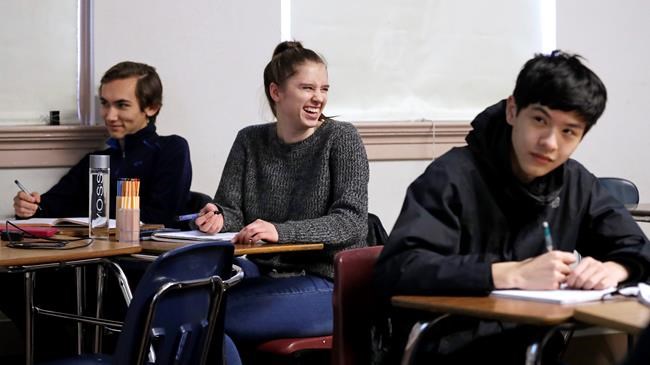
Teenagers’ nightly sleep has decreased and most adolescents don’t get the recommended nine hours. One culprit: Light from devices that many teens use to chat, post and scroll long after dark.
Franklin High School senior Hazel Ostrowski, who took part in the study, said sleeping later makes it easier to pay attention during class but she still struggles sometimes.
“I’ll wake up so tired I wish I could go back to sleep. At night, I’ll be on my phone and I just want to stay up,” she said.
Researchers worked with science teachers at two high schools to find out if students got more sleep after the change or simply stayed up later. Over two years, they recruited 178 sophomores to wear wristwatch-like monitors for two weeks to track activity and light exposure. Results were published Wednesday in the journal Science Advances.
The scientists compared sleep habits of sophomores in spring 2016, before the change, to sleep habits of sophomores from spring 2017, after later start times went into effect.
Some measures held steady. Naps and weekend sleep schedules didn’t change. On school nights, only a few students stayed up later, not enough to greatly budge the average.
What changed was wakeup time, with morning activity starting about 45 minutes later on school days. Combined with a slight shift to later bedtimes for a few, the average sleep duration increased by 34 minutes.
Put another way, morning wakeup time shifted from 6:24 a.m. to 7:08 a.m. Falling asleep shifted only a tad, from 11:27 p.m. to 11:38 p.m.
“Given all the pressures keeping our teenagers awake in the evening — screen time, social media — this is a great thing to see,” said Horacio de la Iglesia, a University of Washington biology professor who led the study.
Digging deeper, researchers analyzed schoolwide data on first-period punctuality and attendance. Of the two high schools, the one in a more affluent area showed no difference year to year. But the school in a poorer area had less tardiness and fewer absences after the change, a hint that later start times could help with socioeconomic learning gaps, the researchers said.
Exam scores and other grades in the science classes increased year to year by a small margin, but the authors acknowledge that teachers’ views on the later start time could have unconsciously boosted the grades they gave.
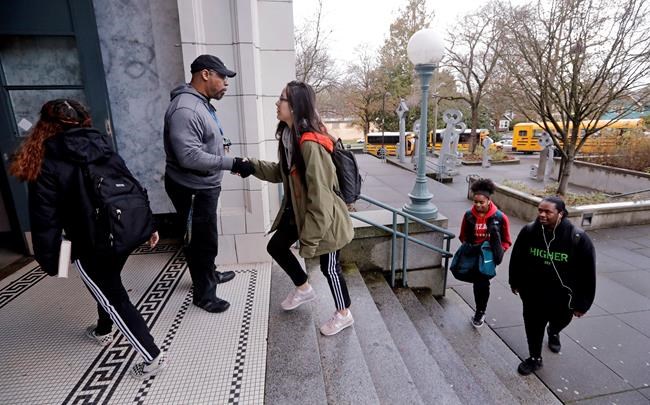
Most U.S. middle and high schools start before 8:30 a.m., contrary to an American Academy of Pediatrics recommendation, said University of Minnesota researcher Kyla Wahlstrom, who studies the issue.
School districts resist, she said, because later start times disrupt bus schedules and sports practices, and rob parents of afternoon teenage baby sitters to watch younger kids.
Prior studies relied on students recalling how much they slept. This was the largest to use a stronger measure, the wearable monitor, she said.
Bringing the research into classrooms made it a learning experience for students, Wahlstrom said, “a brilliant way to do it.”
___
Follow AP Medical Writer Carla K. Johnson on Twitter: @CarlaKJohnson
___
The Associated Press Health & Science Department receives support from the Howard Hughes Medical Institute’s Department of Science Education. The AP is solely responsible for all content.