Heated debate over high drug costs returns to Capitol Hill

Advertisement

Advertise with us

Patient bills, competition and secrecy shared the spotlight Tuesday as pharmacy benefit managers testified before Congress about prescription drug prices.

Read this article for free:


or

Already have an account? Log in here »

To continue reading, please subscribe:

Subscribe and receive a limited-edition Free Press branded hat or tote.

Digital Subscription

One year of digital access for only $205*

  • Enjoy unlimited reading on winnipegfreepress.com
  • Read the E-Edition, our digital replica newspaper
  • Access News Break, our award-winning app
  • Play interactive puzzles

*First annual payment billed as $205.00 + GST for one year. This annual subscription will automatically renew at $233.00 + GST every 52 weeks (10% off the regular annual price of $259.35). Offer available to new and qualified returning subscribers only. Cancel any time.

To continue reading, please subscribe:

Add Free Press access to your Brandon Sun subscription for only an additional

$1 for the first 4 weeks*

  • Enjoy unlimited reading on winnipegfreepress.com
  • Read the E-Edition, our digital replica newspaper
  • Access News Break, our award-winning app
  • Play interactive puzzles
Start now

*Your next Brandon Sun subscription payment will increase by $1.00 and you will be charged $17.95 plus GST for four weeks. After four weeks, your payment will increase to $24.95 plus GST every four weeks.

Hey there, time traveller!
This article was published 09/04/2019 (2678 days ago), so information in it may no longer be current.

Patient bills, competition and secrecy shared the spotlight Tuesday as pharmacy benefit managers testified before Congress about prescription drug prices.

Members of a Senate Finance Committee investigating drug costs pushed the benefit managers to explain why they can’t do more to control prices and to reveal the details behind the contracts they negotiate. The hearing was the committee’s third so far this year focused on the high cost of prescriptions.

Executives from CVS Health, UnitedHealth Group’s OptumRx and Cigna testified. Here are some key points about the issue:
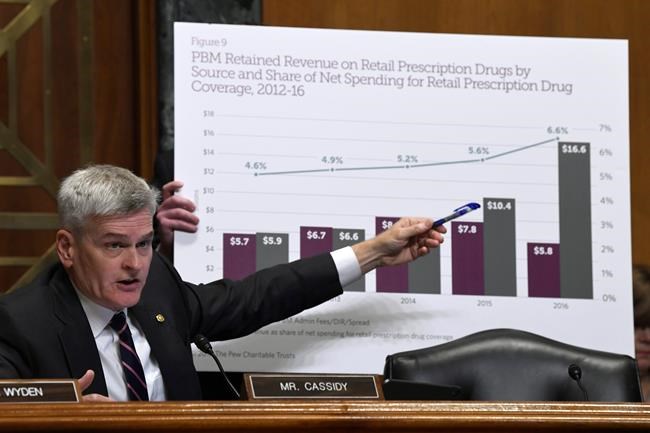
Sen. Bill Cassidy, R-La., shows a chart during a Senate Finance Committee hearing with pharmacy benefit managers on Capitol Hill in Washington, Tuesday, April 9, 2019, exploring the high cost of prescription drugs. (AP Photo/Susan Walsh)

WHO THEY ARE

Pharmacy benefit managers, or PBMs, run prescription drug coverage for employers, insurers, unions and other clients. They set up lists of covered drugs that are often broken into tiers with different pricing levels for the patient. They negotiate rebates for some drugs to help offset high initial or list prices.

Three PBMs dominate the U.S. market. CVS Health’s Caremark business, UnitedHealth’s OptumRx and Cigna’s recently acquired Express Scripts each process over a billion prescriptions annually.

The trio controlled about 76 per cent of the market last year, according to the research firm Drug Channels Institute.

THE DEBATE

Critics see PBMs as middlemen who add costs to an already expensive system for prescription drugs.

Drugmakers point to the rebates as part of the problem.

They say they have to offer them to land some of their products on a PBM’s list of covered drugs or a less-expensive tier, and this contributes to higher list prices. High list prices hurt patients who have to pay a big deductible when they fill a prescription.

Sen. Ron Wyden, D-Ore., criticized the companies for “gouging” their customers by charging them higher drug prices than what they negotiated with drugmakers. He also said the companies guard their operations “with greater secrecy than HBO is guarding the ending of ‘Game of Thrones.'”

“Whether pharmacy benefit managers bring any real value to taxpayers is a mystery,” Wyden said.
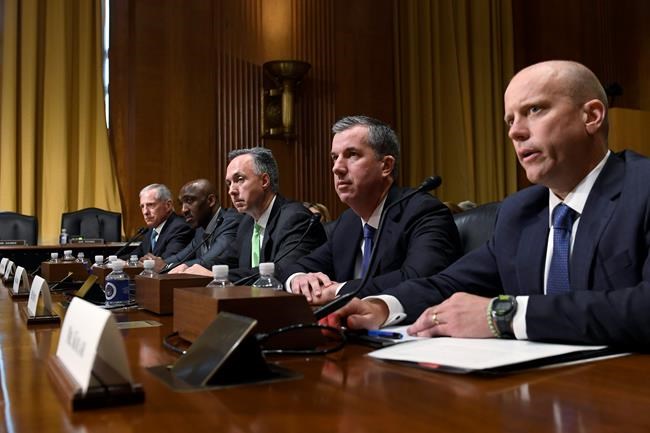
Prime Therapeutics Senior Vice President, General Counsel, and Interim President and Chief Executive Officer Mike Kolar, right, testifies before the Senate Finance Committee on Capitol Hill in Washington, Tuesday, April 9, 2019, during a hearing to explore the high cost of prescription drugs. He is joined at the table by, from left, Cigna Corporation Executive Vice President and Chief Clinical Officer Steve Miller, CVS Caremark President and CVS Health Executive Vice President Derica Rice, Humana Healthcare Services Segment President William Fleming and OptumRx Chief Executive Officer John Prince. (AP Photo/Susan Walsh)

Committee Chairman Chuck Grassley, R-Iowa, questioned whether PBMs prefer high-cost drugs that come with big rebates over cheaper drugs.

PBM TAKE

PBMs say they do several things to help control costs, but drugmakers are the only ones responsible for setting their initial prices.

When drugmakers produce competing products to treat the same condition — like with hepatitis C drugs — PBMs use that competition to wrangle price breaks in exchange for coverage.

They use the leverage that comes from all the prescriptions they process to negotiate rebates, and they urged lawmakers to make it easier for patients to get access to lower cost drugs like generic medications.

“When we have competition, we can bring down drug prices,” said CVS Health’s Derica Rice, a former executive with the drugmaker Eli Lilly and Co.

PBMs say they only offer rebates on around 8% of the prescriptions they process, and they pass along most of those discounts to payers like insurers or large employers. They said they want to offer more of those rebates directly to patients when they buy the drugs, an upfront approach to the discounts favoured by President Donald Trump’s administration.

PBM executives also said they can’t make the details of their negotiations with drugmakers public because that would hurt their leverage for getting future discounts.

WHAT’S NEXT

Senators have already grilled pharmaceutical leaders about prescription drug prices and heard testimony from people affected by the soaring cost of insulin for patients with diabetes. Members of the House of Representatives also are looking into drug costs.
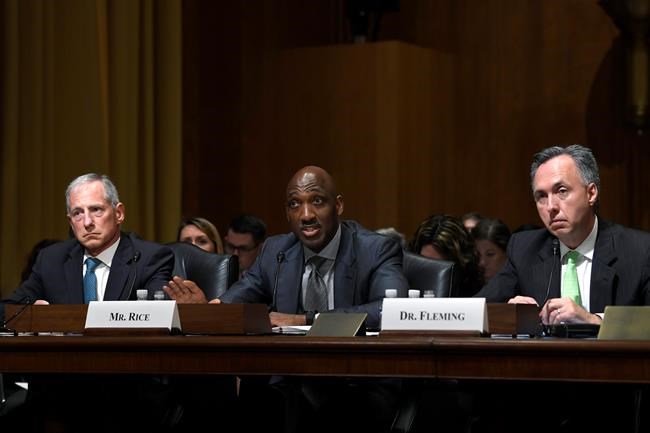
CVS Caremark President and CVS Health Executive Vice President Derica Rice, center, flanked by Cigna Corporation Executive Vice President and Chief Clinical Officer Steve Miller, left, and Humana Healthcare Services Segment President William Fleming, right, testifies before the Senate Finance Committee on Capitol Hill in Washington, Tuesday, April 9, 2019, during a hearing to explore the high cost of prescription drugs. (AP Photo/Susan Walsh)

Grassley and Wyden have said they are working to look for ways to bring down high prescription drug costs

Democrats want Medicare to leverage its purchasing power and directly negotiate prices with the industry, a step most Republicans oppose. Grassley has called for a greater public accounting of how drug prices are set.

___

Follow Tom Murphy on Twitter: @thpmurphy

___

The Associated Press Health and Science Department receives support from the Howard Hughes Medical Institute’s Department of Science Education. The AP is solely responsible for all content.

Report Error Submit a Tip

More Stories

Lac du Bonnet slowly healing from devastating fire

Nicole Buffie 6 minute read Preview

Lac du Bonnet slowly healing from devastating fire

Nicole Buffie 6 minute read Yesterday at 6:32 PM CDT

LAC DU BONNET — Fifteen months after devastating wildfires ripped through Lac du Bonnet, claiming two lives and destroying more than a dozen homes, residents are trying their best to build back better.

Along the winding gravel path that is Wendigo Road outside Lac du Bonnet, new timber peeks through patches of charred forest. Homes and cottages are beginning to take shape after fire raced through the neighbourhood at record speed and levelled at least 18 homes on the road.

Table saws and nail guns ring in the distance while Brian Curtis plots out where his new cottage will go. Curtis bought his previous cottage 19 years ago and had recently levelled the foundation.

He and his wife, Pam, had been thinking about long-term renovations when the May 13, 2025 fire swept away all their work and memories.

Read
Yesterday at 6:32 PM CDT

Mayoral race lineup grows to 10 candidates

Joyanne Pursaga 2 minute read Preview

Mayoral race lineup grows to 10 candidates

Joyanne Pursaga 2 minute read Thursday, Aug. 6, 2026

An electrical contractor has become the 10th candidate to register for the race to become Winnipeg’s next mayor.

Zac Uminski has thrown his name into the competition, after Scott Gillingham signed up to seek re-election as mayor and eight other candidates previously registered.

The father of four said concern about homelessness and addictions sparked his interest in politics.

“My campaign will focus on practical solutions to improve public safety, support families and strengthen the city services,” Uminski said. “We need safer communities.”

Read
Thursday, Aug. 6, 2026

Asian supermarket T&T to open at Polo Park

Gabrielle Piché 5 minute read Preview

Asian supermarket T&T to open at Polo Park

Gabrielle Piché 5 minute read Thursday, Aug. 6, 2026

Live seafood, more than 150 varieties of baked bread and rows of Asian produce are being promised for CF Polo Park — in two years time.

Read
Thursday, Aug. 6, 2026

Watching while we work

Tory McNally 7 minute read Preview

Watching while we work

Tory McNally 7 minute read 2:01 AM CDT

For many employees, the idea that their employer might be tracking how long they spend at their keyboard, how often they move their mouse, or whether they are actively working throughout the day feels unsettling. For many employers, however, workplace surveillance is increasingly viewed as another management tool, particularly as hybrid and remote work become more common. The recent news that TD plans to monitor certain employees’ activity during the workday has reignited a conversation that has been quietly growing for several years: where is the line between legitimate oversight and excessive monitoring?

The reality is that workplace surveillance is nothing new. Employers have long monitored attendance, reviewed security camera footage, tracked company vehicles using GPS, audited expense reports, and reviewed internet usage on company-owned devices. What has changed is the sophistication of the technology. Today’s software can record login times, monitor application usage, track keystrokes, capture screenshots, analyze email activity, and even generate reports ranking employees based on their perceived productivity.

This naturally raises an important question. Does increased surveillance actually make people work harder?

The answer is not nearly as straightforward as many organizations hope.

Read
2:01 AM CDT

Mayoral race grows to 11 candidates

Joyanne Pursaga 2 minute read Yesterday at 3:21 PM CDT

Realtor Brad Gross is the 11th candidate to register for the race to become Winnipeg’s next mayor.

Gross, 60, said improving public safety and renewing roads will be key goals in his campaign.

“I just don’t like the direction the city’s going and it doesn’t seem to be getting better…. A lot of seniors, a lot of people are worried about crime. (And) the streets are just horrible again,” he said.

He said the city should not invest in bike lanes until Winnipeg’s roads are in better condition. He also hopes to provide free bus fares for seniors and gradually add security cameras at all bus shacks with known safety concerns, if elected.

Puzzles Palace

1 minute read Monday, Jul. 27, 2026

To solve our puzzles, please subscribe with this special offer: |