WEATHER ALERT

Prosecco’s bubble shows no sign of bursting

Advertisement

Advertise with us

ASOLO, Italy - Prosecco, the fruity sparkling wine made in the northeastern hills of Italy is gaining in global popularity — and producers of Champagne, for so long the dominant bubbly wine, are taking note.

Read this article for free:

or

Already have an account? Log in here »

To continue reading, please subscribe:

Subscribe and receive a limited-edition Free Press branded hat or tote.

Digital Subscription

One year of digital access for only $205*

  • Enjoy unlimited reading on winnipegfreepress.com
  • Read the E-Edition, our digital replica newspaper
  • Access News Break, our award-winning app
  • Play interactive puzzles

*First annual payment billed as $205.00 + GST for one year. This annual subscription will automatically renew at $233.00 + GST every 52 weeks (10% off the regular annual price of $259.35). Offer available to new and qualified returning subscribers only. Cancel any time.

To continue reading, please subscribe:

Add Free Press access to your Brandon Sun subscription for only an additional

$1 for the first 4 weeks*

  • Enjoy unlimited reading on winnipegfreepress.com
  • Read the E-Edition, our digital replica newspaper
  • Access News Break, our award-winning app
  • Play interactive puzzles
Start now

*Your next Brandon Sun subscription payment will increase by $1.00 and you will be charged $17.95 plus GST for four weeks. After four weeks, your payment will increase to $24.95 plus GST every four weeks.

Hey there, time traveller!
This article was published 17/12/2018 (2780 days ago), so information in it may no longer be current.

ASOLO, Italy – Prosecco, the fruity sparkling wine made in the northeastern hills of Italy is gaining in global popularity — and producers of Champagne, for so long the dominant bubbly wine, are taking note.

Prosecco has become the bestselling sparkling wine in the world by volume, and experts say it is eroding the market share of Champagne, the French wine that is synonymous with celebration but also comes with a heftier price tag. The Italian wine’s production eclipsed Champagne’s five years ago and is now 75 per cent higher at 544 million bottles.

Champagne still claims the revenues crown, cashing in a record 4.9 billion euros ($5.6 billion) last year on 307 million bottles, 2.8 billion euros of that in exports. But Prosecco’s bubble shows no sign of bursting: exports this year are trending up 16 per cent over last year’s 804 million-euro ($913 million) high. Adding insult to injury, sales are surging 40 per cent in Champagne’s home country, France, according to one estimate. And those figures don’t reflect the seasonal Christmas sales bump of 20 per cent.
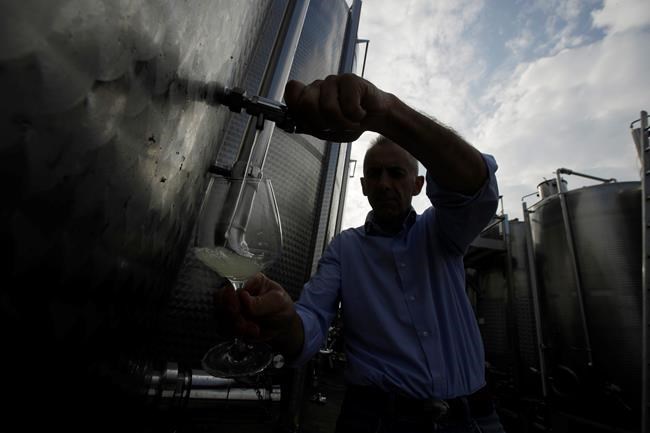
In this image taken on Monday, Oct. 15, 2018, wine grower Adelino Pizzobon spills Prosecco from a silos, at the Case Paolin farm, in Volpago del Montello, Italy. Prosecco has become the best-selling sparkling wine in the world, and experts say it is eroding the more casual corner of champagne's market while aiming higher. Its production eclipsed champagne's five years ago and is now 75 percent higher at 544,000 bottles three-quarters of which for export. (AP Photo/Luca Bruno)

Michael Edwards, an expert who has been a wine judge for Decanter magazine and wrote the book “The Finest Wines of Champagne,” says consumers are increasingly interested in sparkling wines.

“Prosecco capitalizes on the desire to drink sparkling wine, not necessarily Champagne,” he says.

The Italian bubbly’s success is attributed to its lower price and its profile as an anytime libation, making it popular in Great Britain, the United States and Germany, markets where Champagne has long flourished.

Jowin Lepper Carberry, a consultant for a medical devices company in Baltimore, Maryland, tried Prosecco at the beach four years ago, and liked it so much she started making frozen smoothies with it for friends at her pool. She moved on to making cocktails for dinner parties and has used Prosecco instead of Champagne for the past four New Year’s Eves.

“My initial reason for trying it at the beach is because it was less expensive than Champagne. Now I use it because I prefer it to Champagne,” she said.

With an average production cost of 3.70 euros ($4.20) per bottle, a fraction of Champagne’s average 10.24 euros ($11.63), Prosecco can be purchased at a price that makes it easier to buy as an after-work drink or for a casual gathering, without pomp and circumstance.

The lower price is in part made possible by a simpler production method. It has two processes of fermentation, both in large tanks, whereas Champagne’s second fermentation period is done while the wine is bottled. That requires storing the Champagne bottles at an angle and turning them slightly every day by hand to help the fermentation — expensive manual labour when done over thousands of bottles.

Prosecco producers themselves are taken aback by their wine’s success, and mindful not to squander it. They are up against not only imitators, but also other sparkling wines, like Spain’s Cava, which still does not rival Prosecco in terms of global sales, and Germany’s Sekt, which experts say has improved in quality.

“As the old innkeepers used to say, even the fountain outside the bar is competition,” said Armando Serena the head of the Asolo Consortium of Prosecco makers. “But it is certainly not a phenomenon that we expected. It is cause for reflection for (Champagne producers) perhaps.”

Prosecco’s growing popularity, and the proliferation of sparkling wines in general fueled by younger drinkers, is forcing Champagne makers to up their game.

“The quality of Champagne at the moment has never been higher because it has to be. The danger is the competition, so it has to be better,” said Edwards.

At the same time, the three consortiums that make Prosecco have taken some hints from the Champagne playbook.

They successfully lobbied to have Prosecco as a brand with protected status switched from the grape once known as Prosecco, and now Glera, to a hilly territory in northeastern Italy. It is based around the city of Treviso and encompasses five provinces in the wider Veneto region and four in neighbouring Friuli Venezia Giulia, right up to the Slovenian border. That change, made in 2009, has helped producers better control quality and fight against counterfeiters.

The most renowned of the three consortiums, Conegliano Valdobbiadene, is trying to get the territory recognized by UNESCO as a world heritage site, a label that experience in other regions shows boosts both tourism and the value of the product. Champagne received its UNESCO status in 2015.

Prosecco makers are betting future success on higher quality, and higher-priced vintages. The best Valdobbiadene can cost up to 30 euros ($34).

Sebastiano Bonomo, export manager at the Giusti Dal Col winery near Treviso, said he can imagine one day high-end restaurants keeping a Prosecco list, like they do for Champagne, based on geographic denominations and zones.

“That is the plan we should go for, being able to bring knowledge about our territory, just like the knowledge off Champagne was spread to the entire world,” Bonomo said.

Asolo is the smallest of the three consortia making Prosecco, but it has expanded its vineyards by 86 per cent from 2011 to 2017. That has given much needed economic stimulus to a region that suffered a blow with the failure of two regional banks that devoured billions in savings.

“We see many young people who are remaining to work in family companies … because they have prospects of a good life,” Serena said. “Prosecco has a fruitiness and a perfume that gives hope for the future.”

Report Error Submit a Tip

More Stories

Automation reaches new heights on farm

Laura Rance-Unger 4 minute read Preview

Automation reaches new heights on farm

Laura Rance-Unger 4 minute read Saturday, Jul. 25, 2026

LANGHAM, Sask. — The thousands of farmers from across the Prairies who flock to the annual Ag in Motion show every July seem oblivious to the possibility the technology on display could one day replace many of them.

Families with children in tow, Hutterite colony workers, grandparents and young couples just starting out roamed through the 600 or more exhibitor displays, amazed at how everything about farming just keeps getting bigger, more efficient and increasingly more automated.

It’s now possible to seed using a 100-foot-wide drill — a 12-foot jump over the widest available a few years ago — provided the farmer can afford a tractor with enough horsepower to pull it. Those sell for around $850,000 and up.

Granted, the number of farms with enough acres to justify that kind of width and drawing power is still relatively small, but farms continue to grow. And it’s no secret the number of people who have the interest, skills and financial wherewithal to run them continues to shrink.

Read
Saturday, Jul. 25, 2026

Daycare grapples with five-year-old’s outbursts, choking incidents

Maggie Macintosh 4 minute read Preview

Daycare grapples with five-year-old’s outbursts, choking incidents

Maggie Macintosh 4 minute read Friday, Jul. 24, 2026

A Windsor Park child-care facility is weighing a five-year-old’s right to care versus the safety of other children who have been choked.

Little People’s Place expelled a pre-schooler in the spring in response to his aggressive behaviour toward other children and staff.

The child’s family has appealed to the province for him to be reinstated.

The case is raising concerns about inclusion support resources and measures to protect everyone at the Cottonwood Road daycare.

Read
Friday, Jul. 24, 2026

Manitoba Hydro’s energy plan set to be scrutinized

Chris Kitching 6 minute read Preview

Manitoba Hydro’s energy plan set to be scrutinized

Chris Kitching 6 minute read 6:00 AM CDT

Manitoba Hydro is set to face questions and concerns over its plan for the province’s future energy needs, which includes proposed natural gas-powered turbines in Brandon and Indigenous-owned wind farms.

The Public Utilities Board, an arm’s-length regulator, will begin six weeks of hearings Monday into the 10-year blueprint and potential ways to satisfy electricity demand, while Hydro grapples with a projected energy shortfall, debt of $25 billion and aging infrastructure.

“The development plan reflects the best available information and analysis of how Manitoba Hydro can meet growing energy demand, while balancing factors we know are important to our customers, including cost, reliability and the environment,” Peter Chura, a spokesman for the Crown corporation, told the Free Press.

“We are confident in our analysis and that we’ve appropriately balanced reliability, affordability, safety and risk.”

Read
6:00 AM CDT

Qualico celebrating 75 years of growth, success since its first development of 13 bungalows in River Heights

Aaron Epp 6 minute read Preview

Qualico celebrating 75 years of growth, success since its first development of 13 bungalows in River Heights

Aaron Epp 6 minute read 6:00 AM CDT

The first things staff and visitors see after ascending to the third floor of Qualico’s head office in Winnipeg are two statues — one each for company founders David and Katherine Friesen.

Flanking the doors to the integrated real estate company’s C-suite offices, the bronze sculptures are monuments to the couple and the vision, strength and integrity (as the plaques attached to the wooden pedestals attest) it took to start Qualico in 1951.

But imagine for a moment what it would be like if the sculptures were less reverent and more whimsical. Picture them outfitted with the kind of pull-string voice boxes one finds in a child’s toy. What might they say?

It’s possible one of David Friesen’s phrases would be: “No margin, no mission.”

Read
6:00 AM CDT

City has plenty of frozen dessert oases to discover

AV Kitching 6 minute read Preview

City has plenty of frozen dessert oases to discover

AV Kitching 6 minute read Updated: 11:23 AM CDT

No matter the weather, ice cream is always a welcome addition to the day.

It’s a rite of passage as, at the slightest hint of a thaw, Winnipeggers descend in droves, heeding the siren call of institutions such as Sargent Sundae (2053 Portage Ave.) and Bridge Drive-In (766 Jubilee Ave. and 1680 Main St.) that slide open their shutters any time from late March to early April, ready to welcome dedicated connoisseurs seeking their first taste of the season.

We’re blessed with an abundance of ice-cream joints in this city, ranging from brick-and-mortar storefronts to mobile carts and pop-up stalls, all serving generous scoops of childhood faves alongside rather more innovative flavours.

With so many dairy bars and frozen dessert parlours dotted around, there’s no need to choose just one spot to satisfy your sweet tooth.

Read
Updated: 11:23 AM CDT

Bombers search for an offensive identity after Week 8 tailspin

Ken Wiebe 7 minute read Preview

Bombers search for an offensive identity after Week 8 tailspin

Ken Wiebe 7 minute read 6:30 PM CDT

Tommy Condell has been around long enough to know that criticism is part of the job, so you can understand why there were moments when the Winnipeg Blue Bombers offensive co-ordinator sounded a tad defensive when speaking to the media on Monday afternoon.

The Bombers were coming off a disappointing 52-30 loss to the Calgary Stampeders that dropped them to 4-3 on the season.

In many instances, a 30-point outburst would have been cause for celebration. But when you look under the hood of Friday’s outing — which included four interceptions for Bombers pivot Dru Brown — the picture wasn’t quite as rosy.

Compounding matters, star tailback Brady Oliveira went from making the longest touchdown run of his CFL career — a 45-yard scamper late in the third quarter — to being a mostly forgotten player in the fourth as the club mostly abandoned the run in an effort to rally from nine and eventually 12-point deficits.

Read
6:30 PM CDT