Ramadan in Mideast is for fasting and Facebook, data shows

Advertisement

Advertise with us

DUBAI, United Arab Emirates - The Muslim holy month of Ramadan, with its long days of fasting and prayer meant to draw worshippers closer to God and away from worldly distractions, is being reshaped by technology.

Read this article for free:

or

Already have an account? Log in here »

To continue reading, please subscribe:

Subscribe and receive a limited-edition Free Press branded hat or tote.

Digital Subscription

One year of digital access for only $205*

  • Enjoy unlimited reading on winnipegfreepress.com
  • Read the E-Edition, our digital replica newspaper
  • Access News Break, our award-winning app
  • Play interactive puzzles

*First annual payment billed as $205.00 + GST for one year. This annual subscription will automatically renew at $233.00 + GST every 52 weeks (10% off the regular annual price of $259.35). Offer available to new and qualified returning subscribers only. Cancel any time.

To continue reading, please subscribe:

Add Free Press access to your Brandon Sun subscription for only an additional

$1 for the first 4 weeks*

  • Enjoy unlimited reading on winnipegfreepress.com
  • Read the E-Edition, our digital replica newspaper
  • Access News Break, our award-winning app
  • Play interactive puzzles
Start now

*Your next Brandon Sun subscription payment will increase by $1.00 and you will be charged $17.95 plus GST for four weeks. After four weeks, your payment will increase to $24.95 plus GST every four weeks.

Hey there, time traveller!
This article was published 28/05/2019 (2621 days ago), so information in it may no longer be current.

DUBAI, United Arab Emirates – The Muslim holy month of Ramadan, with its long days of fasting and prayer meant to draw worshippers closer to God and away from worldly distractions, is being reshaped by technology.

People in the Middle East spend close to 58 million more hours on Facebook during Ramadan and watch more YouTube videos — everything from beauty tips and recipes to sports and TV dramas — than any other time of the year, making the holy month not only the most important one for Muslims, but also the prime time of the year for advertisers.

For Facebook, which also owns Instagram, and Google, which owns YouTube, Ramadan brings a welcome boost of business in the region.
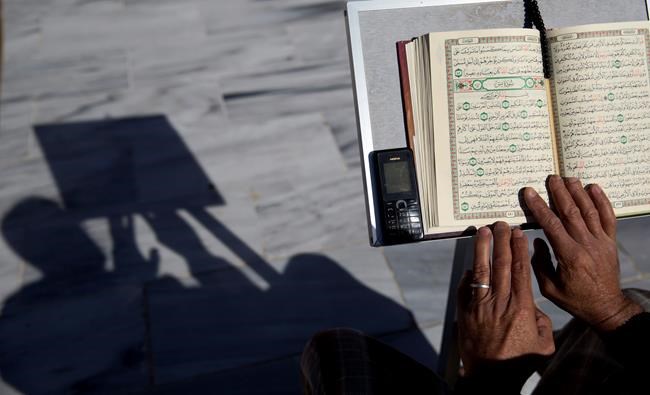
FILE - In this May 8, 2019 file photo, a Palestinian reads verses of the Quran, Islam's holy book, during the month of Ramadan at Al Emari Mosque in Gaza City. The Muslim holy month of Ramadan, with its long days of fasting and prayer meant to draw worshippers closer to God and away from worldly distractions, is being reshaped by technology. People in the Middle East are spending close to 58 million more hours on Facebook and watching more YouTube videos than at any other time of the year, making Ramadan the biggest moment of the year for advertisers. (AP Photo/Hatem Moussa, File)

“Consumption and time spent on our platforms does indeed increase,” said Ramez Shehadi, Facebook’s managing director for Mideast and North Africa.

People stay up a lot more at night during Ramadan and have more downtime — especially before iftar, the evening meal that breaks the daylong fast, and the “suhoor,” when people gather to eat before another day of fasting. Many also work shorter hours during the day.

All that translates to 5% more time spent on Facebook’s platforms, or what is nearly 58 million more hours, Shehadi said. Put another way, there are almost 2 million hours of additional time spent daily on Facebook in the Mideast during Ramadan.

Ramadan is also the peak season for advertising in the region, as TV dramas and soap operas get a 151% increase in viewership on YouTube during the holy month, according to Google.

“Our revenue is a function of people’s engagement,” Shehadi said. “The more that they engage on our platforms, the more that advertisers want to be able to reach those that are engaging. That’s what drives our revenue.”

So much ad revenue is spent during Ramadan that Google launched “The Lantern Award” to celebrate the most creative and engaging ads of the month.

Yet Ramadan is not just about abstaining from food and drink, including water, during the day. It’s also about disconnecting from vacuous distractions and focusing on contemplation, introspection, acts of good, charity and connecting with God. It can appear then as a contradiction that this is also when companies ramp up their efforts to get people to buy more, view more and engage in excess consumerism.

Google does not disclose total watch time for YouTube during Ramadan, but says that in Egypt, Saudi Arabia and the United Arab Emirates, for example, viewing of sports videos jumps by 22%, travel videos by 30%, and action games, simulation and video games by 10-20% during the holy month.

People also spend 27% more time watching religious content on YouTube in Ramadan.

“To us, YouTube brings people together. We see a lot of people wanting to watch things together,” said Joyce Baz, Google’s head of communications in Mideast and North Africa.

She added that Google products, like its search engine, are there “to simplify people’s lives so that they can focus on things that matter like being with their loved ones and family.” Google’s “Qibla Finder,” for example, helps Muslims find the direction of Mecca to pray toward, wherever they happen to be.

Google says this year’s top trending search queries during the first week of Ramadan in Egypt, Iraq and Saudi Arabia included a surprising mix of Game of Thrones, prayer times, Ramadan TV shows, movie timings and English Premier League results.

Meanwhile, some of the most popular downloaded apps in the Mideast on the Google Play store during Ramadan include games like Stack Ball, streaming apps like Vu and Shahid and online retailers Noon and Jolly Chic.

Iftar evening meals are a major social affair during Ramadan, ranging from lavish spreads at home to decadent five-star hotel buffets. This translates into a 16% spike in beauty product searches and an 18% spike in searches for beauty tips on YouTube, compared to the rest of the year. Also, according to Google maps, trips to the malls increase by more than 20% in the last weeks of Ramadan in preparation for the Eid al-Fitr holiday, which ends the holy month.

Fatima el-Barbar, an Egyptian mother living in Dubai, said she searches more for recipes and watches her favourite TV dramas online during Ramadan. But she said that between her job, taking care of the children, preparing iftar each night, her daily prayers and reading the Qur’an, the Muslim holy book, there’s little time for the internet.

“I actually have less time for the internet in Ramadan than in other days of the year,” she said.

To help companies better understand consumer habits in Ramadan, Google identified six categories of audiences: dedicated watchers, devoted fasters, foodies, groomers, travellers and shoppers.

“YouTube is a companion during Ramadan, a platform where viewers can watch what they want, whenever they want throughout the day,” Google says in its own pitch to advertisers.

To more authentically connect with roughly 180 million users in the Middle East, Facebook and Instagram launch special Ramadan icons to give people more customized ways of expressing themselves online. Instagram also has a campaign to promote acts of kindness during the month.

“We’re trying to be magnifiers and propagators of goodness as opposed to what might seem on the surface like an extension of consumerism,” Shehadi said. “It resonates with the ethos of Ramadan and certainly the ethos of Facebook, which is around bringing people together around things that matter to them.”

Haitham el-Ghoneim, a Jordanian resident in Dubai, the United Arab Emirates, said he uses Facebook to connect with friends during Ramadan, sharing traditional greetings for the holy month and checking on his family in Jordan.

Still, he doesn’t think the rest of it — all that time spent online, on games, scrolling and ads — is a good thing. “It’s not being spent in a useful way. It’s mostly fake news, or jokes and things that have no benefit,” he said.

___

Follow Aya Batrawy on Twitter at https://twitter.com/ayaelb

Report Error Submit a Tip

More Stories

Preserving past, pondering future of 142-year-old downtown church

Chris Kitching 6 minute read Preview

Preserving past, pondering future of 142-year-old downtown church

Chris Kitching 6 minute read Wednesday, Jul. 29, 2026

A 142-year-old church in downtown Winnipeg needs about $7.7 million for upgrades and related costs, while an ongoing heritage renewal project aims to create a blueprint for its future.

Potential options include selling Holy Trinity Anglican Church and leasing it back for a decades-long term, or building an apartment or office tower on an existing surface parking lot to generate revenue, officials said Wednesday.

“I think that is part of the negotiation and ensuring we have the right partners, but it is hard to put down on paper precisely every aspect of the future of a place of worship,” project manager Stephen Borys said of the potential duration of a sale and leaseback agreement to ensure the church still exists generations from now.

Similar agreements with 50- or 100-year leases exist elsewhere in Canada, he said, noting the option has been on the table for Holy Trinity for a year.

Read
Wednesday, Jul. 29, 2026

Wild weather uproots trees across city, leaves thousands in Manitoba without power

Chris Kitching 7 minute read Preview

Wild weather uproots trees across city, leaves thousands in Manitoba without power

Chris Kitching 7 minute read Updated: Yesterday at 5:06 PM CDT

This summer’s latest barrage of severe thunderstorms caused widespread property damage and power outages for more than 30,000 Manitoba Hydro customers, mostly in Winnipeg, as winds of up to 133 km/h wreaked havoc.

Charleswood resident Ian Glover’s house had minor damage compared with a neighbour’s home, where a large, uprooted poplar tree crashed through the roof while the storm pummelled Winnipeg late Wednesday night and early Thursday.

“I opened the window after I woke up (around 6 a.m.) and the tree — oh my God,” Glover said. “I got my wife up and she couldn’t believe it. I was totally blown away. (Our neighbour) said the branch went right through the house into their living room.”

Glover was thankful his neighbours were not injured. Some of the tree’s outer branches clipped the corner of his home.

Read
Updated: Yesterday at 5:06 PM CDT

Hydro scrambling to restore power to remaining 4,500 customers after storm; some outages will continue into Saturday

Chris Kitching 5 minute read Preview

Hydro scrambling to restore power to remaining 4,500 customers after storm; some outages will continue into Saturday

Chris Kitching 5 minute read Updated: 4:31 PM CDT

Power outages could stretch into a third day for some Manitobans — mainly in and around Winnipeg — while crews continued to repair widespread damage caused by powerful thunderstorms.

About 4,500 Manitoba Hydro customers were still without electricity at 2:30 p.m. Friday, after more than 30,000 lost power while powerful winds brought down trees and power lines Wednesday night and early Thursday.

The Crown corporation said it is aiming to have all outages with greater numbers of customers restored by Friday night, but some customers may remain without power into Saturday.

“The challenge is just the sheer scale of this thing — hundreds of different outages spread across a large part of the city,” Hydro spokesman Peter Chura said. “Just getting to all of them in a timely fashion is very difficult.”

Read
Updated: 4:31 PM CDT

The bountiful harvest: Thousands of visitors flock to St. Norbert Farmers’ Market every Saturday

Melissa Martin 17 minute read Preview

The bountiful harvest: Thousands of visitors flock to St. Norbert Farmers’ Market every Saturday

Melissa Martin 17 minute read 6:00 AM CDT

While most of Winnipeg is still sleeping, or perhaps just starting to think about making the morning coffee, a patch of shade and sun just south of the Perimeter Highway is already humming with life.

Read
6:00 AM CDT

Drop bravado and cease silly summer spat

Maureen Scurfield 4 minute read Yesterday at 2:01 AM CDT

DEAR MISS LONELYHEARTS: My neighbour mowed the words “dumb ass” into my lawn, which had grown way too long while I was staying at the lake in my new cabin — for four weeks.

I agree my long front lawn got annoying to look at on our residential street. So, I got home and got out of my car, and took pictures of what he did to my lawn — in front of some neighbours for witnesses.

Then I unpacked my stuff, and that night just before bed I finally mowed the lawn with my loud mower. I did it in my own sweet time and went to bed, still mad. I honestly thought my neighbour was mostly just jealous because he doesn’t have a cabin himself!

I’d finally cooled off by noon the next day, so I went out and bought the guy a 12-pack, and left the beer on his back steps, with a card saying, “You can relax now!”

Ramadan in Mideast is for fasting and Facebook, data shows

Aya Batrawy, The Associated Press 6 minute read Preview

Ramadan in Mideast is for fasting and Facebook, data shows

Aya Batrawy, The Associated Press 6 minute read Tuesday, May. 28, 2019

DUBAI, United Arab Emirates - The Muslim holy month of Ramadan, with its long days of fasting and prayer meant to draw worshippers closer to God and away from worldly distractions, is being reshaped by technology.

People in the Middle East spend close to 58 million more hours on Facebook during Ramadan and watch more YouTube videos — everything from beauty tips and recipes to sports and TV dramas — than any other time of the year, making the holy month not only the most important one for Muslims, but also the prime time of the year for advertisers.

For Facebook, which also owns Instagram, and Google, which owns YouTube, Ramadan brings a welcome boost of business in the region.

"Consumption and time spent on our platforms does indeed increase," said Ramez Shehadi, Facebook's managing director for Mideast and North Africa.

Read
Tuesday, May. 28, 2019