Saving the Earth and having a gas
I hate to toot my own horn, but my emission-reduction strategy is brilliant
Advertisement
Read this article for free:
or
Already have an account? Log in here »
To continue reading, please subscribe:

Digital Subscription
One year of digital access for only $205*
- Enjoy unlimited reading on winnipegfreepress.com
- Read the E-Edition, our digital replica newspaper
- Access News Break, our award-winning app
- Play interactive puzzles
*First annual payment billed as $205.00 + GST for one year. This annual subscription will automatically renew at $233.00 + GST every 52 weeks (10% off the regular annual price of $259.35). Offer available to new and qualified returning subscribers only. Cancel any time.
To continue reading, please subscribe:
Add Free Press access to your Brandon Sun subscription for only an additional
$1 for the first 4 weeks*
- Enjoy unlimited reading on winnipegfreepress.com
- Read the E-Edition, our digital replica newspaper
- Access News Break, our award-winning app
- Play interactive puzzles
*Your next Brandon Sun subscription payment will increase by $1.00 and you will be charged $17.95 plus GST for four weeks. After four weeks, your payment will increase to $24.95 plus GST every four weeks.
Read unlimited articles for free today:
or
Already have an account? Log in here »
Hey there, time traveller!
This article was published 25/09/2017 (3217 days ago), so information in it may no longer be current.
I had some spare time on my hands last week, so I came up with a plan for saving the planet.
This plan depends largely on my wife’s participation, and I will get to that in a minute, but first we need to spend some time talking about the huge threat posed by cows.
So I came up with my planet-saving concept last week after reading a deeply moving story on the National Public Radio (NPR) website about the methane that cows pump into the atmosphere via their flatulence and, especially, their belches.
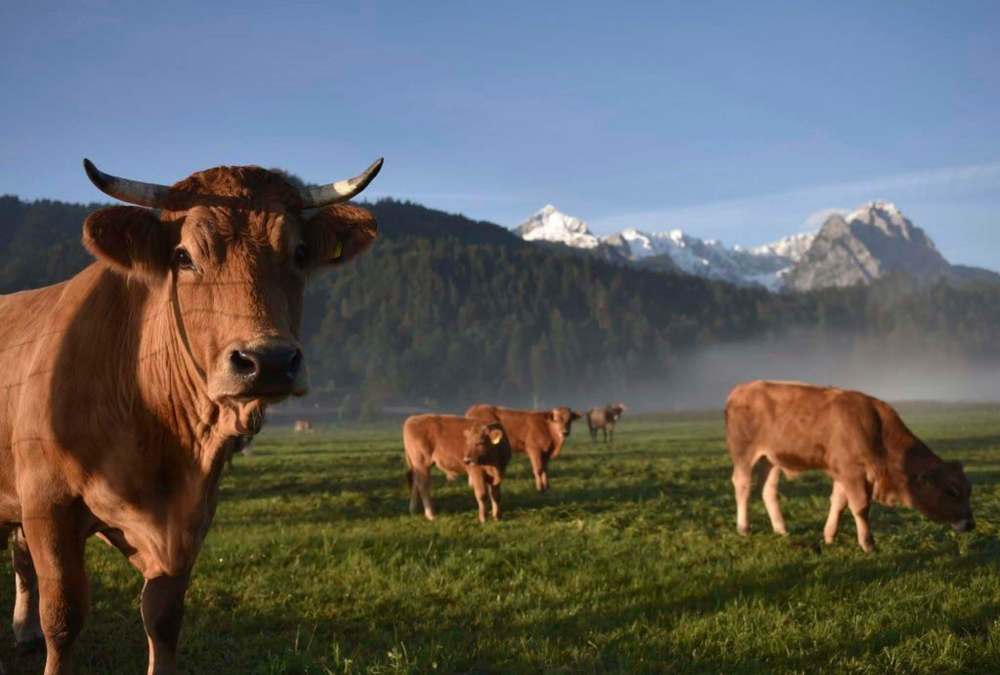
It turns out that when they are not doing commercials for dairy products, cows spend most of their time standing around in little bovine clots, farting and belching.
Seriously, if we could get cows to wear hollowed-out watermelons on their heads, they would be indistinguishable from Saskatchewan Roughriders fans, although that is not today’s scientific point.
No, today’s scientific point is that cows are a bit on the gassy side. The stinky truth is that livestock accounts for 14.5 per cent of all greenhouse-gas emissions, with over half of that coming from cattle, according to a 2013 report from the United Nations’ Food and Agriculture Organization.
Anyway, the NPR story I read and partially understood focused on a group of scientists who have dedicated their lives to studying cattle emissions. Before you laugh your cruel little laugh, you should know that these scientists recently won the Public Library of Science Genetics Research Prize, which will go a long way toward improving their social lives.
Random woman in bar: “Hello, handsome, so what do you do for a living?”
Cattle scientist: “Well, I spend most of my time studying cow farts and belches.”
Random woman in bar: “Ooh, let’s go back to your place. Also, I really dig your pocket protector.”
Based on what I read online, these scientists determined a cow’s genetic makeup plays a huge role in determining what microbes are found in its gut and, therefore, the amount of methane it releases into the air.
This is important because methane from cattle is a greenhouse gas, which leads to global warming, which causes the polar ice caps to melt, which causes former U.S. vice-president Al Gore to make long documentaries, which current U.S. President Donald Trump refuses to watch.
The really exciting thing is, these award-winning geneticists have determined that, theoretically speaking, it might be possible through selective breeding to produce cattle that do not emit large quantities of methane. Yes, it is entirely possible that, during our lifetimes, we might be able to live in a world populated by gas-free cows.
But first, it helps to identify which type of cows produce the most methane, and which ones give off the least gas, so to speak. It turns out that is easier said than done.
Q: How do you determine how much gas a standard cow is giving off from either end of its anatomy?
A: You have to put the cows into high-tech airtight chambers that analyze their “outgassing.”
Q: Airtight chambers for cows? Are you making that up?
A: No.
The big problem is that it is quite expensive to put cows into special sealed chambers. “To measure methane emissions, it can cost $700 to $1,000 per cow,” Filippo Miglior, a geneticist at Canadian Dairy Network and the University of Guelph, told NPR.
That’s a lot of money just for testing whether a cow has the natural ability to clear a crowded elevator, if you catch our subtle scientific drift. So, I told myself, there must be a better way to handle this sensitive yet odiferous task.
Which is where my wife, She Who Must Not Be Named, enters the picture. It dawned on me that my wife has the unique ability to detect methane particles at the molecular level, a skill she is not reluctant to put on display when we are enjoying time together at home.

We will be sitting in our den watching a gripping movie, or lying in bed reading before we go to sleep, when, suddenly and without warning, my wife will take a big sniff, scrunch her face into a look of disgust, fix me with a laser-like stare and growl: “Yuck! You are such a pig!”
Which is when I will adopt a look of righteous indignation and defiantly stomp out into the kitchen, where I will enjoy another helping of taco chips and bean dip.
The point I am making is that, for a reasonable fee, I am pretty sure I could talk my wife into donating her super-sensitive sniffer to the cause of science and the prospect of a world that will not be destroyed because of potentially lethal cattle burps and farts.
I don’t want to get ahead of myself, but I think I can already detect the sweet smell of success … although it’s entirely possible that is just the aroma of leftover bean dip.
doug.speirs@freepress.mb.ca
History
Updated on Monday, September 25, 2017 8:00 AM CDT: Adds photo