Despite the rough ride, e-scooter companies are bullish on Canada
Advertisement
Read this article for free:
or
Already have an account? Log in here »
To continue reading, please subscribe:

Digital Subscription
One year of digital access for only $205*
- Enjoy unlimited reading on winnipegfreepress.com
- Read the E-Edition, our digital replica newspaper
- Access News Break, our award-winning app
- Play interactive puzzles
*First annual payment billed as $205.00 + GST for one year. This annual subscription will automatically renew at $233.00 + GST every 52 weeks (10% off the regular annual price of $259.35). Offer available to new and qualified returning subscribers only. Cancel any time.
To continue reading, please subscribe:
Add Free Press access to your Brandon Sun subscription for only an additional
$1 for the first 4 weeks*
- Enjoy unlimited reading on winnipegfreepress.com
- Read the E-Edition, our digital replica newspaper
- Access News Break, our award-winning app
- Play interactive puzzles
*Your next Brandon Sun subscription payment will increase by $1.00 and you will be charged $17.95 plus GST for four weeks. After four weeks, your payment will increase to $24.95 plus GST every four weeks.
Read unlimited articles for free today:
or
Already have an account? Log in here »
Hey there, time traveller!
This article was published 21/06/2021 (1888 days ago), so information in it may no longer be current.
TORONTO – When shared e-scooter companies rolled into Canada in 2018, they hoped a few small pilots would quickly result in a country full of people zipping around on two wheels.
Since then, the companies which allow people to rent scooters through an app and park them along city streets have been banned from Montreal and Toronto and have barely made a dent in Atlantic Canada.
But recent winsin Western Canada and impending decisions in several Ontario municipalities could soon provide e-scooter companies the opportunities they need to establish themselves in the market.
“The wave is going to continue,” said Jonathan Hopkins, director of strategic development and government relations in Canada for e-scooter company Lime.
“We’ll see how big it is and how far it goes and how fast it spread, but there’s not going to be a retrenchment against this. E-scooters are here to stay in Canada.”
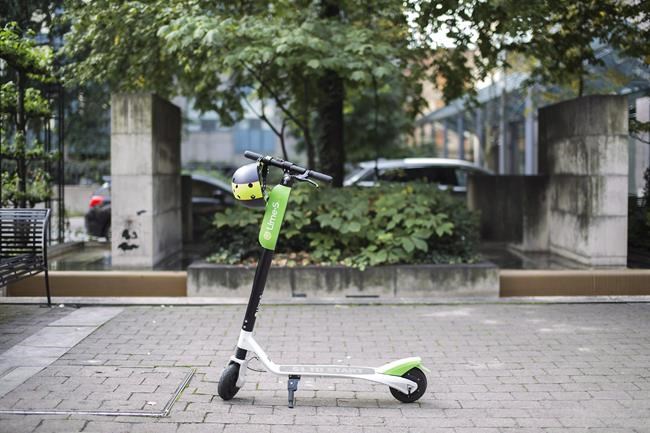
Lime, which currently operates in Edmonton, Victoria and Ottawa and held a 2020 pilot in Calgary, was among the first to attempt a shared model in 2018, where consumers locate and unlock e-scooters with an app and pick up or drop off on Canadian streets.
The San Francisco company entered the market with a pilot limited to Waterloo, Ont.’s private trails and university campuses.
Users had to be at least 18 years old with a driver’s licence and were charged a $1 unlocking fee and 30 cents per minute. The pilot ended in 2019 and Lime did not seek a renewal, but Hopkins said the company wants to return whenever Waterloo allows e-scooters region-wide.
During that trial period, Lime competitors Bird, Jump, Spin and Roll were expanding in Canada and Montreal decided to give Lime and Bird a shot with a summer 2019 pilot.
A city report found e-scooters in the Montreal pilot were only parked in designated zones 20 per cent of the time and police issued 333 tickets to riders, including 324 for not wearing a helmet.
Then, there was the Lime e-scooter spotted in the Lachine Canal — reminiscent of viral incidents in the U.S. and Asia, where scooters were lit on fire, tossed off buildings, snapped in half and even defecated on.
Montreal banned shared e-scooters in 2020, but Bird thinks the pilot would have gone differently with a greater number of parking zones in more convenient locations and a system locking e-scooters to permitted municipal infrastructure.
“There’s a use case for scooters in Montreal and I’m optimistic that the shared e-scooter program will be back (but) differently constituted,” saidChris Schafer, Bird Canada’s vice-president of government affairs.
Hopkins agreed.
“It’s definitely not a lost cause,” he said. “It’s only a matter of time. I think (e-scooters) will be back soon.”
Raktim Mitra, an associate professor with Ryerson University’s school of urban and regional planning, doesn’t think Montreal’s experience will keep e-scooter brands with deep pockets out of the rest of the country, but he said they have their work cut out for them.
While many debuted in the U.S. by flooding the market and then seeking municipal partners, Canada’s transportation ministry has tighter controls, he said.
That means provinces have to permit e-scooter pilots and then individual municipalities must study and vote on whether to allow companies to operate there.
Provincial approval doesn’t always spur municipalities to move ahead. Toronto, for example, decided in May to opt out of a provincial pilot permitting e-scooter trials because of safety concerns.
Schafer, however, still thinks there’s “positive momentum,” especially when people try e-scooters elsewhere.
“There’s always that question of when are they coming here?” said Schafer. “I hear that in Toronto and in other cities where they may not exist yet.”
But Mitra said Canada’s e-scooter market is a question mark. While the devices have become more popular than bikes in some U.S. cities, Canadians may use them because they’re “a cool new thing” or when they’re travelling, but not adopt them regularly.
“We don’t have a clear idea of what gap in the transportation landscape these e-scooters would fill,” Mitra said.
Several provinces are on their way to determining that. Bird has permits in Kelowna, B.C., Calgary, Edmonton, Ottawa and Windsor, Ont.and Schafer saidHamilton, Brampton and Mississauga, Ont. are considering e-scooters.
Calgary, which ran a pilot between 2019 and 2020, recently decided to let e-scooters stay and Edmonton is entering its third trial season.
B.C. said earlier this year that it will soon welcome the devices to Kelowna, Vernon, West Vancouver and North Vancouver and Ottawa will launch e-scooters this summer with Bird, Lime and Neuron Mobility.
Singapore’s Neuron Mobility wasn’t dissuaded by the rough ride e-scooters experienced elsewhere because chief executive Zachary Wang thinks it’s common with emerging technology.
“It does take some time, some effort to try to make this new type of infrastructure be well integrated in the city,” he said, after calling the Montreal ban “unfortunate.”
He hopes Neuron will avoid quibbles because its e-scooters come with helmets, a button to call emergency services and topple detection capabilities that alert the company if they fall over.
Mitra will be watching how the pilot and others go, hoping they give him clues about the future.
“There’s a lot of demand and I can see there’s a lot of potential for it to become an important transportation option,” he said.
“But at the same time, it’s hard to really understand if it’s here to stay or just a fad that will slowly disappear from the market in the next five to 10 years.”
This report by The Canadian Press was first published June 21, 2021.
Note to readers: This is a corrected story. A previous version erroneously included Calgary as a current location for Lime e-scooters.