Wild horse roundups ramping up as drought grips the US West
Advertisement
Read this article for free:
or
Already have an account? Log in here »
To continue reading, please subscribe:

Digital Subscription
One year of digital access for only $205*
- Enjoy unlimited reading on winnipegfreepress.com
- Read the E-Edition, our digital replica newspaper
- Access News Break, our award-winning app
- Play interactive puzzles
*First annual payment billed as $205.00 + GST for one year. This annual subscription will automatically renew at $233.00 + GST every 52 weeks (10% off the regular annual price of $259.35). Offer available to new and qualified returning subscribers only. Cancel any time.
To continue reading, please subscribe:
Add Free Press access to your Brandon Sun subscription for only an additional
$1 for the first 4 weeks*
- Enjoy unlimited reading on winnipegfreepress.com
- Read the E-Edition, our digital replica newspaper
- Access News Break, our award-winning app
- Play interactive puzzles
*Your next Brandon Sun subscription payment will increase by $1.00 and you will be charged $17.95 plus GST for four weeks. After four weeks, your payment will increase to $24.95 plus GST every four weeks.
Read unlimited articles for free today:
or
Already have an account? Log in here »
Hey there, time traveller!
This article was published 17/08/2021 (1819 days ago), so information in it may no longer be current.
TOOELE, Utah (AP) — The sound of the helicopter propeller thundered across the horizon as it dipped down toward mustangs dotting the golden brown plain. The horses burst into a gallop at the machine’s approach, their high-pitched whinnies rising into the dry air.
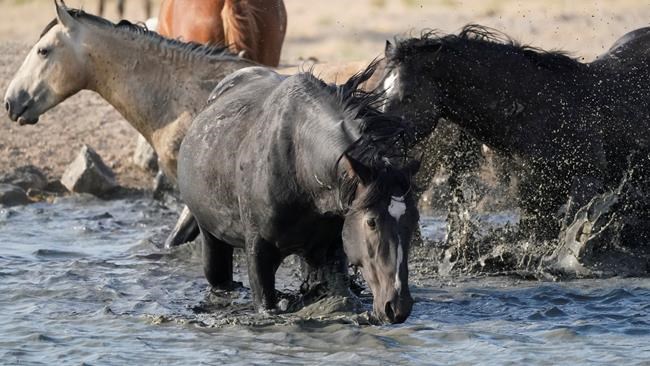
That helicopter roundup in the mountains of western Utah removed hundreds of free-roaming wild horses, shortly before the Biden administration announced it would sharply increase the number of mustangs removed across the region. It’s an emergency step land managers say is essential to preserving the ecosystem and the horses as a megadrought worsened by climate change grips the region.
“What were seeing here in the West gives some insight into a new norm,” Terry Messmer, a professor at Utah State University who studies wild horse management.
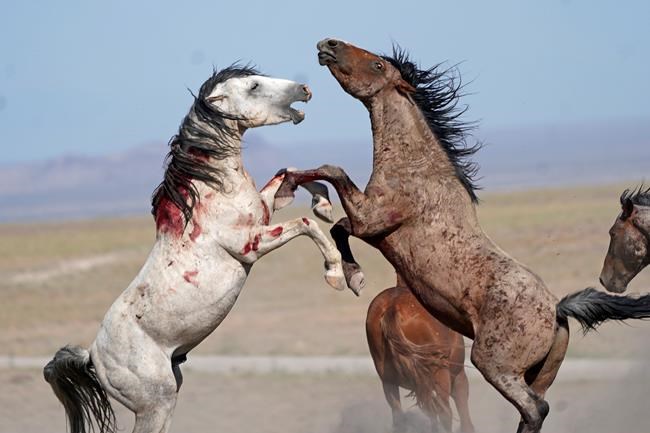
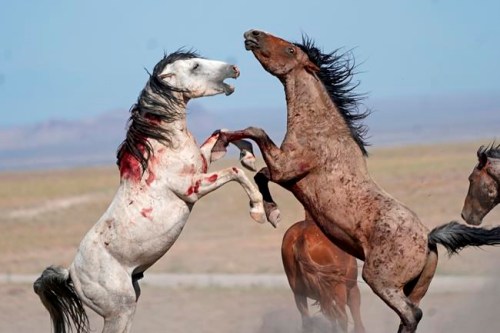
The removals are adding fuel to longstanding conflicts with activists for the animals whose beauty and power make them an enduring emblem of the American West. They say the U.S. government is using the drought as an excuse to take out horses in favor of cattle grazing.
Horses that are captured are held in government corrals and pastures mostly in the West and Midwest before they are made available for public adoption. Some also end up being used by law enforcement entities such as the U.S. Border Patrol, or go to prison inmate programs where they are tamed for future use.
Advocates tried unsuccessfully to stop the roundup of Utah’s Onaqui herd, one that’s captured the imagination of Hollywood celebrities and Girl Scout troops alike. Horses in the picturesque and accessible herd are so well known that many have names, like the patriarch “Old Man.” He was left behind in the July roundup, but about 300 other horses were taken to be adopted or kept in captivity for the rest of their lives.
“It’s really unfortunate the Biden administration continues to scapegoat the horses while giving a pass to livestock that have a greater impact on public lands,” said Suzanne Roy, executive director of the American Wild Horse Campaign.
The Bureau of Land Management oversees almost a quarter-billion acres of public land, primarily in the West, and is tasked with managing the wild horse population. It’s planning to remove some 6,000 horses, mostly from Nevada, Oregon, Wyoming and Colorado, by October — a 50% increase from last year. Eventually land managers say they need to cut the number of wild horses by two-thirds to keep things in balance.
“In many places where wild horses and burros roam, virtually no vegetation was produced in the spring and early summer growing seasons,” said Jason Lutterman, spokesman for the National Wild Horse and Burro Program in Reno, Nevada. The Biden administration has announced reforms aimed at ensuring that captured horses put up for adoption do not eventually end up in slaughterhouses, but advocates worry problems could persist as long as the government offers a $1,000 adoption incentive.
Wild-horse advocates acknowledge that lack of forage and water can be an issue in some areas, but they argue removals from the herds like the Onaqui are unnecessary.
“The BLM has a drought trump card, and they use it sometimes when they want to take additional horses off the range,” Greg Hendricks, director of field operations.
Advocates want to leave the horses on the range and instead administer fertility treatments to limit the size of the herd without roundups that can be costly and tough on the animals. One horse died during the Onaqui roundup. Fertility treatments are used, but require new doses at least annually and can be difficult to administer because they require horses to be tracked down and darted one at a time, Messmer said.
Cattle ranchers, meanwhile, say they’ve made voluntary changes to reduce grazing on federal lands. By hauling water to drought-stricken areas for their livestock, they’ve even helped the horses who drink it too, said Hunter Ihrman, a spokesman for the National Cattlemen’s Beef Association.
The number of sheep and cattle that graze on leased public land is far larger than the number of wild horses, Messmer said. A key difference, though, is that livestock are part of the U.S. economy.
“Americans like their McDonald’s burgers. They like their Big Macs. They like all of those things, and all of those things have beef as part of it,” he said.
Eventually, land managers want to double the number of removals, a step they say is essential across 10 Western states in the coming years. Wild horses are federally protected, so the plan, if approved by Congress, would increase costs to an annual high of about $360 million.
Without those changes, horses could die of thirst or starvation, they say. Dozens of horses were found dead near a dried-up watering hole in northern Arizona in 2018.
The wild horses now on the plains are largely descended from those brought by Europeans hundreds of years ago. Herds can double in size every four to five years, and when populations grow too high they destroy topsoil, disturb water supplies and eat grass essential to native species like the increasingly rare sage grouse, Messmer said.
In recent weeks, federal land managers have conducted the largest helicopter roundup in Colorado in years, near the border with Utah. Meanwhile, volunteers trying to protect another herd nearby are working with the agency to get water to the horses using tanks, wells and water trucks, said Kathy DeGonia, president of Piceance Mustangs.
The rugged range of the Piceance-East Douglas herd is dotted with oil and gas production, so packed dirt roads make it easier to make water deliveries during the drought. Deliveries could run into November.
DeGonia’s group also collaborates with federal officials on programs like sterilization and horse auctions.
“In a perfect world we’d let all of these mustangs stay out there until they die,” she said. “But there’s just not enough food and water to maintain all the horses on the range.”
___
Follow AP’s complete drought coverage: https://apnews.com/hub/droughts.