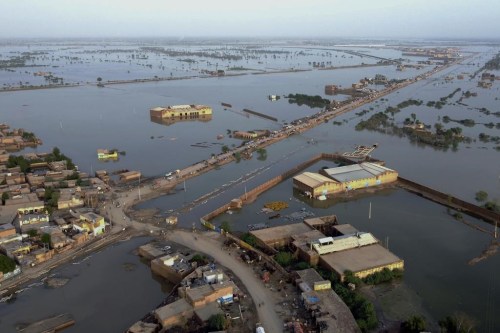
Warming, other factors worsened Pakistan floods, study finds

Advertisement

Advertise with us

Climate change likely juiced rainfall by up to 50% late last month in two southern Pakistan provinces, but global warming wasn’t the biggest cause of the country’s catastrophic flooding that has killed more than 1,500 people, a new scientific analysis finds.

Read this article for free:


or

Already have an account? Log in here »

To continue reading, please subscribe:

Subscribe and receive a limited-edition Free Press branded hat or tote.

Digital Subscription

One year of digital access for only $205*

  • Enjoy unlimited reading on winnipegfreepress.com
  • Read the E-Edition, our digital replica newspaper
  • Access News Break, our award-winning app
  • Play interactive puzzles

*First annual payment billed as $205.00 + GST for one year. This annual subscription will automatically renew at $233.00 + GST every 52 weeks (10% off the regular annual price of $259.35). Offer available to new and qualified returning subscribers only. Cancel any time.

To continue reading, please subscribe:

Add Free Press access to your Brandon Sun subscription for only an additional

$1 for the first 4 weeks*

  • Enjoy unlimited reading on winnipegfreepress.com
  • Read the E-Edition, our digital replica newspaper
  • Access News Break, our award-winning app
  • Play interactive puzzles
Start now

*Your next Brandon Sun subscription payment will increase by $1.00 and you will be charged $17.95 plus GST for four weeks. After four weeks, your payment will increase to $24.95 plus GST every four weeks.

Hey there, time traveller!
This article was published 15/09/2022 (1432 days ago), so information in it may no longer be current.

Climate change likely juiced rainfall by up to 50% late last month in two southern Pakistan provinces, but global warming wasn’t the biggest cause of the country’s catastrophic flooding that has killed more than 1,500 people, a new scientific analysis finds.

Pakistan’s overall vulnerability, including people living in harm’s way, is the chief factor in the disaster that at one point submerged one-third of the country under water, but human-caused “climate change also plays a really important role here,” said study senior author Friederike Otto, a climate scientist at Imperial College of London.

There are many ingredients to the still ongoing humanitarian crisis — some meteorological, some economic, some societal, some historic and construction oriented. Add to that weather records that don’t go back far enough in time.
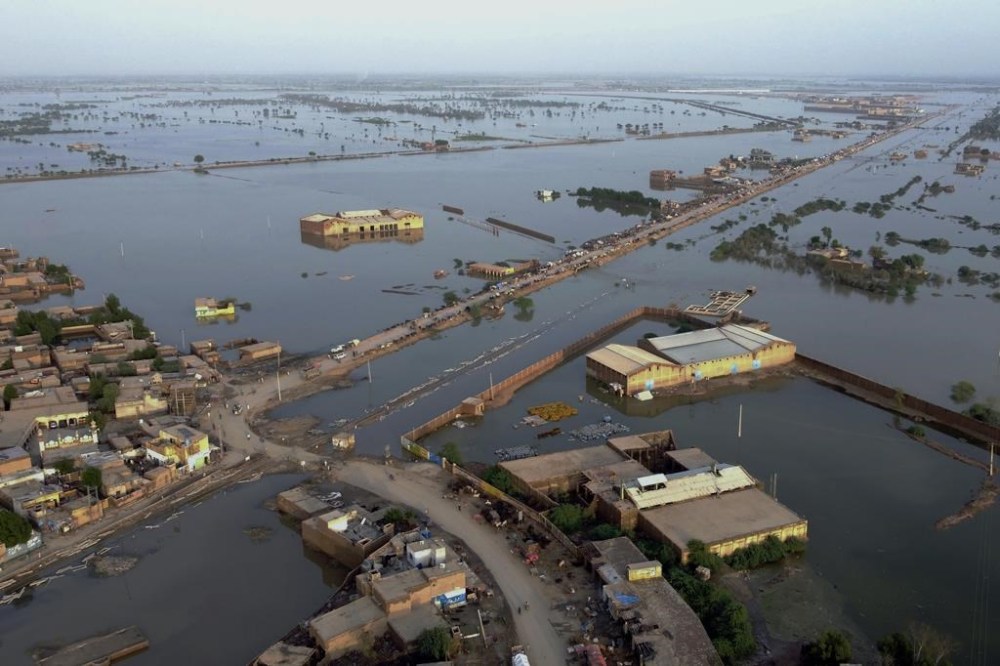
FILE - Homes are surrounded by floodwaters in Sohbat Pur city, a district of Pakistan's southwestern Baluchistan province, Aug. 29, 2022. A new study says human-caused climate change juiced the rainfall that triggered Pakistan's floods by up to 50%. But the authors of the Thursday, Sept. 15, study say other societal issues that make the country vulnerable and put people in harm's way are probably the biggest factor in the ongoing humanitarian disaster. (AP Photo/Zahid Hussain, File)

With such complications and limitations, the team of international scientists looking at the disaster couldn’t quantify how much climate change had increased the likelihood and frequency of the flooding, said authors of the study. It was released Thursday but not yet peer reviewed.

What happened “would have been a disastrously high rainfall event without climate change, but it’s worse because of climate change,” Otto said. “And especially in this highly vulnerable region, small changes matter a lot.”

But other human factors that put people in harm’s way and weren’t adequate to control the water were even bigger influences.

“This disaster was the result of vulnerability that was constructed over many, many years,” said study team member Ayesha Siddiqi of the University of Cambridge.

August rainfall in the Sindh and Balochistan provinces — together nearly the size of Spain — was eight and nearly seven times normal amounts, while the country as a whole had three-and-a-half times its normal rainfall, according to the report by World Weather Attribution, a collection of mostly volunteer scientists from around the world who do real-time studies of extreme weather to look for the fingerprints of climate change.

The team looked at just the two provinces over five days and saw an increase of up to 50% in the intensity of rainfall that was likely due to climate change. They also looked at the entire Indus region over two months and saw up to a 30% increase in rainfall there.

The scientists not only examined records of past rains, which only go back to 1961, but they used computer simulations to compare what happened last month to what would have happened in a world without heat-trapping gases from the burning of coal, oil and natural gas — and that difference is what they could attribute to climate change. This is a scientifically valid technique, according to the U.S. National Academy of Sciences.

Study co-author Fahad Saeed, a climate scientist at Climate Analytics and the Center for Climate Change and Sustainable Development in Islamabad, Pakistan, said numerous factors made this monsoon season much wetter than normal, including a La Nina, the natural cooling of part of the Pacific that alters weather worldwide.

But other factors had the signature of climate change, Saeed said. A nasty heat wave in the region earlier in the summer — which was made 30 times more likely because of climate change — increased the differential between land and water temperatures. That differential determines how much moisture goes from the ocean to the monsoon and means more of it drops.

And climate change seemed to slightly change the jet stream, storm tracks and where low pressure sits, bringing more rainfall for southern provinces than they usually get, Saeed said.

“Pakistan has not contributed much in terms of causing global climate change, but sure is having to deal with a massive amount of climate change consequences,” said University of Michigan environment dean Jonathan Overpeck, who wasn’t part of the study.
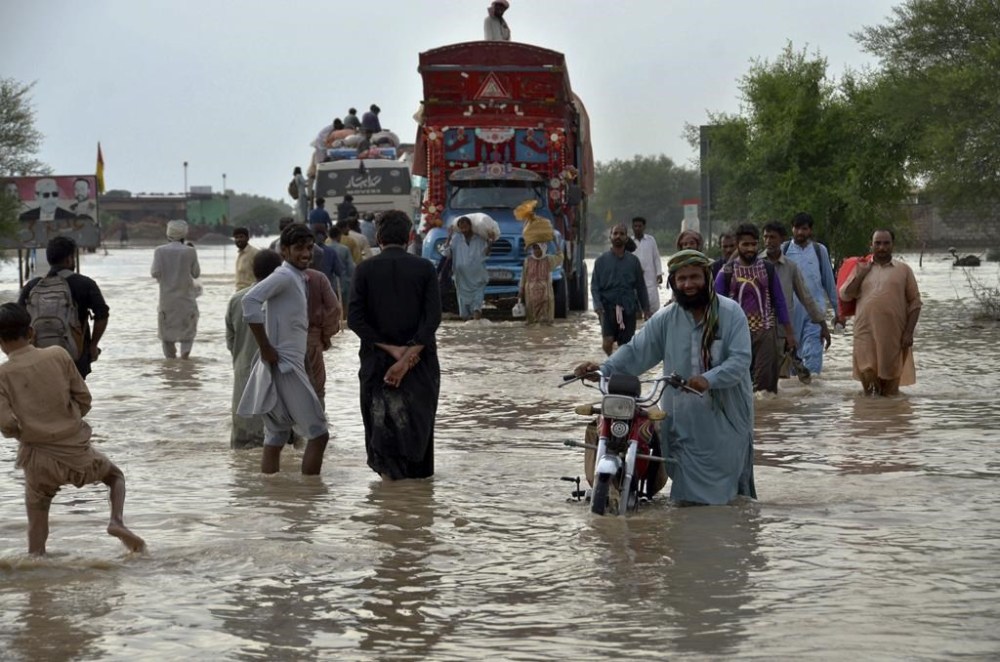
FILE - People navigate through a flooded road caused by heavy monsoon rains, in Nasirabad, a district of Pakistan's southwestern Baluchistan province, Aug. 22, 2022. A new study says human-caused climate change juiced the rainfall that triggered Pakistan's floods by up to 50%. But the authors of the Thursday, Sept. 15, study say other societal issues that make the country vulnerable and put people in harm's way are probably the biggest factor in the ongoing humanitarian disaster. (AP Photo/Zahid Hussain, File)

Overpeck and three other outside climate scientists said the study makes sense and is nuanced properly to bring in all risk factors.

The nuances help “avoid overinterpretation,’’ said Stanford University climate scientist Chris Field. “But we also want to avoid missing the main message — human-caused climate change is increasing the risks of extreme events around the world, including the devastating 2022 Pakistan flooding.”

___

Follow AP’s climate and environment coverage at https://apnews.com/hub/climate-and-environment

___

Follow Seth Borenstein on Twitter at @borenbears

___

Associated Press climate and environmental coverage receives support from several private foundations. See more about AP’s climate initiative here. The AP is solely responsible for all content.

Report Error Submit a Tip

More Stories

Oliveira shines in win over Redblacks, Collaros rocked again

Taylor Allen 5 minute read Preview

Oliveira shines in win over Redblacks, Collaros rocked again

Taylor Allen 5 minute read Saturday, Aug. 15, 2026

It wasn’t a stellar performance by any stretch.

But at this point, the Winnipeg Blue Bombers will take a win no matter what it looks like.

The Blue and Gold outlasted the winless Ottawa Redblacks 33-21 on a rainy Friday night at Princess Auto Stadium to improve to 5-4.

“It’s great to finally get a win at home for our fans and to go out and play a better game is very encouraging,” said right guard Patrick Neufeld.

Read
Saturday, Aug. 15, 2026

Murphy helps Goldeyes battle back to beat Explorers

Mike McIntyre 6 minute read Preview

Murphy helps Goldeyes battle back to beat Explorers

Mike McIntyre 6 minute read Yesterday at 5:55 PM CDT

Max Murphy didn’t hesitate when asked to describe his season so far.

“It’s been terrible,” the veteran Winnipeg Goldeyes outfielder told the Free Press.

Murphy is admittedly critical of himself, the product of a high standard he’s set during a pro baseball career that began in 2014 and has included the past six years with the Fish, where he’s established new franchise records for home runs and RBIs.

So you can imagine the relief felt on Sunday when he looked a lot more like the Murphy of old in leading his team to a 6-2 comeback victory over the Sioux City Explorers to close out a six-game homestand at Blue Cross Park in front of a season-high crowd of 6,825.

Read
Yesterday at 5:55 PM CDT

Firefighter’s death fuels cancer fight

Zoe Pierce 5 minute read Preview

Firefighter’s death fuels cancer fight

Zoe Pierce 5 minute read Saturday, Aug. 15, 2026

The United Fire Fighters of Winnipeg is mourning the loss of Winnipeg firefighter Darrel Maynard while continuing its work to raise awareness of occupational cancer and improve health protections for firefighters.

Maynard, a senior firefighter II and acting lieutenant with the Winnipeg Fire Paramedic Service, died Aug. 5 at age 41 after a three-year battle with occupational cancer.

He served Winnipeg for nearly two decades and leaves behind his wife Francine and sons Colin and Christian.

“Darrel was an incredible, incredible person, an incredible firefighter, and really, really special to all of us,” said Nick Kasper, president of UFFW.

Read
Saturday, Aug. 15, 2026

A better approach, but not yet enough

Editorial 4 minute read Preview

A better approach, but not yet enough

Editorial 4 minute read 2:00 AM CDT

In late June, when the Winnipeg Police Service launched a 10-day ‘crackdown’ on open drug use and illegal drug sales in areas in and around downtown, it did so without consulting or informing community outreach and social services agencies working in the targeted areas.

Inevitably, the WPS action drew criticism from several front-line agencies, which issued a collective statement just two days after the police operation began, pointing out that heavy-handed policing would drive vulnerable people away from the help they desperately need.

“Every day we work to build trust with people who have experienced trauma, discrimination, and barriers to care,” Kate Sjoberg, executive director of Resource Assistance for Youth, said at the time. “Actions that create fear around accessing services can undo months or years of relationship-building and place people at greater risk of preventable harm.”

At the time, WPS Chief Gene Bowers held up his hand and said, “That’s on me.”

Read
2:00 AM CDT

Opera group hits pub to stage shows for sophisticated palates

Conrad Sweatman 3 minute read Preview

Opera group hits pub to stage shows for sophisticated palates

Conrad Sweatman 3 minute read 2:00 AM CDT

Opera’s famous drinking songs — La Traviata’s Brindisi, Don Giovanni’s Fin ch’han dal vino, Carmen’s Votre Toast — tend to flow with references to women and wine, not beer.

But that hasn’t stopped Winnipeggers from sipping 1919s or Generics at local bar and brewery Little Brown Jug over the past few years to the strains of Verdi, Puccini and Mozart.

Currently in its eighth season, Opera by the Pint has its next LBJ event Wednesday at 7 p.m. (The artists also perform at the Public Brewhouse and Gallery in Steinbach at 7 p.m. on Thursday.)

This week’s program focuses on musical hits, while also featuring traditional Filipino ballads and Mexican art songs.

Read
2:00 AM CDT

Manitoba family finalist for cattle producers environmental award

Aaron Epp 4 minute read Preview

Manitoba family finalist for cattle producers environmental award

Aaron Epp 4 minute read Saturday, Aug. 15, 2026

A family in western Manitoba is one of seven finalists for a national environmental award honouring beef cattle producers.

Connor and Kyla English, alongside Connor’s parents, Brian and Leanne English, are nominated for the Canadian Cattle Association’s Environmental Stewardship Award. The 30-year-old award is presented to beef farmers and ranchers who explore innovative ways to protect, preserve and enhance their operations and the environment simultaneously.

This year’s recipient will be announced on Wednesday during a banquet at the Canadian Beef Industry Conference in Winnipeg.

The English family’s roots near Bradwardine — about 265 kilometres west of Winnipeg — date back to 1898. Today, Connor, Kyla, Brian and Leanne manage a herd of about 320 breeding cows on nearly 445 hectares (1,100 acres) of owned and rented pasture and forage land.

Read
Saturday, Aug. 15, 2026