Sperm whales’ clicking dialects are evidence of ‘non-human culture’, say scientists

Advertisement

Advertise with us

VANCOUVER - In the dark depths of the Pacific Ocean, there are a lot of conversations going on.

Read this article for free:


or

Already have an account? Log in here »

To continue reading, please subscribe:

Subscribe and receive a limited-edition Free Press branded hat or tote.

Digital Subscription

One year of digital access for only $205*

  • Enjoy unlimited reading on winnipegfreepress.com
  • Read the E-Edition, our digital replica newspaper
  • Access News Break, our award-winning app
  • Play interactive puzzles

*First annual payment billed as $205.00 + GST for one year. This annual subscription will automatically renew at $233.00 + GST every 52 weeks (10% off the regular annual price of $259.35). Offer available to new and qualified returning subscribers only. Cancel any time.

To continue reading, please subscribe:

Add Free Press access to your Brandon Sun subscription for only an additional

$1 for the first 4 weeks*

  • Enjoy unlimited reading on winnipegfreepress.com
  • Read the E-Edition, our digital replica newspaper
  • Access News Break, our award-winning app
  • Play interactive puzzles
Start now

*Your next Brandon Sun subscription payment will increase by $1.00 and you will be charged $17.95 plus GST for four weeks. After four weeks, your payment will increase to $24.95 plus GST every four weeks.

Hey there, time traveller!
This article was published 16/09/2022 (1489 days ago), so information in it may no longer be current.

VANCOUVER – In the dark depths of the Pacific Ocean, there are a lot of conversations going on.

Click-click-click-click-click. That’s the sound of a sperm whale.

Click-click-click-click, pause, click. That’s a sperm whale that lives in the same area but is from a different group.
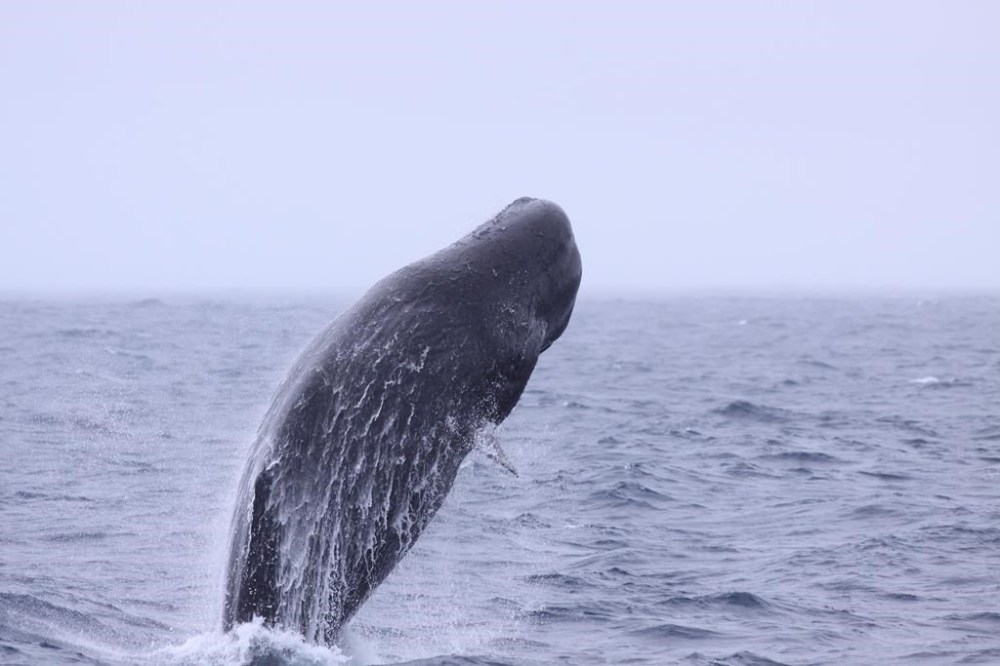
A female sperm whale is seen breaching the water off the Galapagos Islands, Ecuador, in a May 9, 2014, handout photo. As highly social animals, sperm whales live in small family groups called clans. These marine giants share similar codas or
A female sperm whale is seen breaching the water off the Galapagos Islands, Ecuador, in a May 9, 2014, handout photo. As highly social animals, sperm whales live in small family groups called clans. These marine giants share similar codas or "dialects" belonging to the same cultural groups, also known as vocal clans. THE CANADIAN PRESS/HO-Mauricio Cantor,

Sperm whales, the largest toothed animal in the world and easily recognized by their huge, rounded foreheads, use series of Morse-code-like clicks, known as “codas,” to communicate.

Scientists now say in a new study that variations in the whales’ clicking dialects are evidence of “non-human culture” and provide a way for whale groups to mark cultural identity when clans overlap, in a similar way to human ethnic groups.

The study published this month in the Proceedings of the National Academy of Sciences involved a team of 27 scientists from Halifax and Nijmegen in the Netherlands.

Dr. Taylor Hersh, the paper’s lead author and PhD graduate from Dalhousie University’s biology department, said in a news release the work “was the culmination of decades of research efforts by individuals working throughout the Pacific Ocean.”

“We decided to share data and work collaboratively, to learn something new about these enigmatic, charismatic and cultural animals,” said Hersh.

To determine if whales’ codas were comparable to dialects in humans, the researchers focused on “identity codas,” which are particular to each clan.

“Whales from different clans never interact with each other, even when they share the same waters,” Hersh said in an interview. “This suggests that the whales have some way of distinguishing ‘us’ versus ‘them,’ and we wanted to know if they do so using identity codas.”

After pooling acoustic data from 23 locations and extracting over 23,000 codas, the team identified seven sperm whale vocal clans across the Pacific, each having a unique dialect.

The research was part of the “Global Coda Dialect Project” led by Hersh, Canadian whale biologist Shane Gero, who is also a scientist-in-residence at Ottawa’s Carleton University, and marine scientist Chris Johnson.

Hersh said researchers have known for years that they could tell different sperm whale clans apart based on their vocal sounds.

But the new research provided “quantitative evidence” that the whales themselves are using those identity codas as a symbolic marker to indicate which cultural group they belong to. When clans overlapped, their dialects became more distinct, the scientists said.

“So, I think a nice analogy with humans is, if you see someone walking around with a necklace that has a cross on it or a Star of David,” said Hersh.

“Even without talking to them or hearing them speak or knowing anything about them, you know something about at least one cultural group that they see themselves belonging to.

“And so, we think it’s something similar with the sperm whales that they use these certain coda types.”

She said the study also revealed more about animal culture.

“It’s just for so long we thought we have the most complex culture, or we have the only culture. And I think it’s become clear over the past 10, 20 years that that’s not true. We find more and more examples of animals with culture. And I think that’s (true) with the sperm whales, ” said Hersh.

Gero, the scientist-in-residence at Carleton University, said in an interview that the work had been painstaking, with researchers spending thousands of hours on small, open boats.

He said some of the scientists had been “living on sailboats sailing across the Pacific,” dragging a hydrophone behind them to constantly record the sounds of the ocean.

For every minute of recording, it could take eight to 12 times as long to extract and label a whale’s coda.

Hersh said the next step is to conserve and protect whales in a way that accounts for their culture.

“Because if these whales are drawing boundaries around their own cultural groups, then I think that should be reflected in management too (and) we should also try and see them in that way and incorporate that into how we manage them,” said Hersh.

She joked that if, one day, a way was found for humans to communicate with sperm whales, she’d ask them if the researchers’ findings were relevant to them.

“It would be great to ask, ‘wait, is that true,'” she said with a laugh.

This report by The Canadian Press was first published Sept. 16, 2022.

This story was produced with the financial assistance of the Meta and Canadian Press News Fellowship.
Report Error Submit a Tip

More Stories

‘People count on this place’: Pembina Hwy. Giant Tiger latest location slated to close

By Matthew Frank 3 minute read Preview

‘People count on this place’: Pembina Hwy. Giant Tiger latest location slated to close

By Matthew Frank 3 minute read Monday, Oct. 12, 2026

Another Giant Tiger store in Winnipeg will shutter next year, leaving some area residents concerned about a lack of affordable groceries in the neighbourhood.

Red papers taped to the front doors of the Canadian retail chain’s location at Pembina Highway and Southpark Drive indicate it will close Feb. 27.

Doreen Yanchuk, a self-described bargain hunter, shook her head when she saw the signs Monday. The 67-year-old said she’s a regular customer at the location because it’s a five-minute drive from her home.

“They have very good sales here, which draws people to the shop because everything is expensive,” Yanchuk said.

Read
Monday, Oct. 12, 2026

Manitoba delegation to join trade mission to India

Free Press staff 2 minute read 2:01 AM CDT

A delegation from Manitoba will travel to India seeking to bolster economic ties with the South Asia nation.

Ottawa giving province $6M to hire up to 90 family doctors for rural, northern communities

Chris Kitching 3 minute read Preview

Ottawa giving province $6M to hire up to 90 family doctors for rural, northern communities

Chris Kitching 3 minute read 12:38 PM CDT

The federal government is giving Manitoba up to $6 million toward the goal of hiring as many as 90 more family doctors over the next three years.

The funds will be used to expand Manitoba’s practice-ready assessment program, which provides an accelerated licensing pathway for internationally trained physicians who are eligible, to add doctors in rural and northern communities.

“Every single Manitoban deserves to know that, no matter where they live, they have access to quality care,” provincial Health Minister Uzoma Asagwara said at a news conference in Winnipeg alongside federal Health Minister Marjorie Michel.

“We know that for rural and northern communities, that means having a doctor not only available, but it means having that doctor available at the right time.”

Read
12:38 PM CDT

White-supremacist highway sign casts pall on Steinbach city council campaign

Matthew Frank 4 minute read Preview

White-supremacist highway sign casts pall on Steinbach city council campaign

Matthew Frank 4 minute read Yesterday at 7:41 PM CDT

The RCMP is investigating a white-nationalist sign near Steinbach with racist messaging and alleged links to a known Canadian far-right group.

A sign hanging on a overpass at the intersection of Highways 1 and 12 read: “STEINBACH VOTES WHITE NOT BROWN,” according to photos posted on social media.

Also written was the name Nationalist-13, a men’s-only neo-Nazi group, also known as NS-13, primarily based in Hamilton, Ont. The Free Press couldn’t independently verify if the group is associated or who hung the sign.

“On Oct. 13, the Steinbach RCMP were made aware of this sign and have opened an investigation,” a spokesperson said in an email statement. They also said the sign has been removed.

Read
Yesterday at 7:41 PM CDT

Tenants battling landlords find help in short supply from province

Scott Billeck 14 minute read Preview

Tenants battling landlords find help in short supply from province

Scott Billeck 14 minute read Yesterday at 6:00 AM CDT

For nearly three years, Quincy Houdayer and Avery Helm repeatedly pressed their landlord to address plumbing failures, water damage and other maintenance problems at their West Broadway apartment, with records showing some issues persisted until the couple turned to the Residential Tenancies Branch.

Emails and text messages between the tenants, Clearwater Management and the RTB reviewed by the Free Press document recurring leaks and flooding, periods without heat or hot water, concerns about mould and basement conditions and repeated followups from the couple seeking repairs.

“Most of the experiences we’ve had with them can be boiled down to, like, they either are very dismissive about it, they act like it’s not their problem… or they will just fully, blatantly ignore you,” Helm said, adding that the only way to get Clearwater to respond was to threaten going to the RTB, a provincial government agency.

RTB data obtained by the Free Press also shows 13 orders involving the three-building complex at 193-197 Furby St. in 2026 alone. All but one favoured the tenant, while the remaining order ruled in favour of both the tenant and landlord on different items.

Read
Yesterday at 6:00 AM CDT

Sperm whales’ clicking dialects are evidence of ‘non-human culture’, say scientists

Nono Shen, The Canadian Press 4 minute read Preview

Sperm whales’ clicking dialects are evidence of ‘non-human culture’, say scientists

Nono Shen, The Canadian Press 4 minute read Friday, Sep. 16, 2022

VANCOUVER - In the dark depths of the Pacific Ocean, there are a lot of conversations going on.

Click-click-click-click-click. That's the sound of a sperm whale.

Click-click-click-click, pause, click. That's a sperm whale that lives in the same area but is from a different group.

Sperm whales, the largest toothed animal in the world and easily recognized by their huge, rounded foreheads, use series of Morse-code-like clicks, known as "codas," to communicate.

Read
Friday, Sep. 16, 2022