Satellite launched to map the world’s oceans, lakes, rivers

Advertisement

Advertise with us

A U.S.-French satellite that will map almost all of the world’s oceans, lakes and rivers rocketed into orbit Friday.

Read this article for free:


or

Already have an account? Log in here »

To continue reading, please subscribe:

Subscribe and receive a limited-edition Free Press branded hat or tote.

Digital Subscription

One year of digital access for only $205*

  • Enjoy unlimited reading on winnipegfreepress.com
  • Read the E-Edition, our digital replica newspaper
  • Access News Break, our award-winning app
  • Play interactive puzzles

*First annual payment billed as $205.00 + GST for one year. This annual subscription will automatically renew at $233.00 + GST every 52 weeks (10% off the regular annual price of $259.35). Offer available to new and qualified returning subscribers only. Cancel any time.

To continue reading, please subscribe:

Add Free Press access to your Brandon Sun subscription for only an additional

$1 for the first 4 weeks*

  • Enjoy unlimited reading on winnipegfreepress.com
  • Read the E-Edition, our digital replica newspaper
  • Access News Break, our award-winning app
  • Play interactive puzzles
Start now

*Your next Brandon Sun subscription payment will increase by $1.00 and you will be charged $17.95 plus GST for four weeks. After four weeks, your payment will increase to $24.95 plus GST every four weeks.

Hey there, time traveller!
This article was published 16/12/2022 (1355 days ago), so information in it may no longer be current.

A U.S.-French satellite that will map almost all of the world’s oceans, lakes and rivers rocketed into orbit Friday.

The predawn launch aboard a SpaceX rocket from Vandenberg Space Force Base in California capped a highly successful year for NASA.

Nicknamed SWOT — short for Surface Water and Ocean Topography — the satellite is needed more than ever as climate change worsens droughts, flooding and coastal erosion, according to scientists. Cheers erupted at control centers in California and France as the spacecraft started its mission.
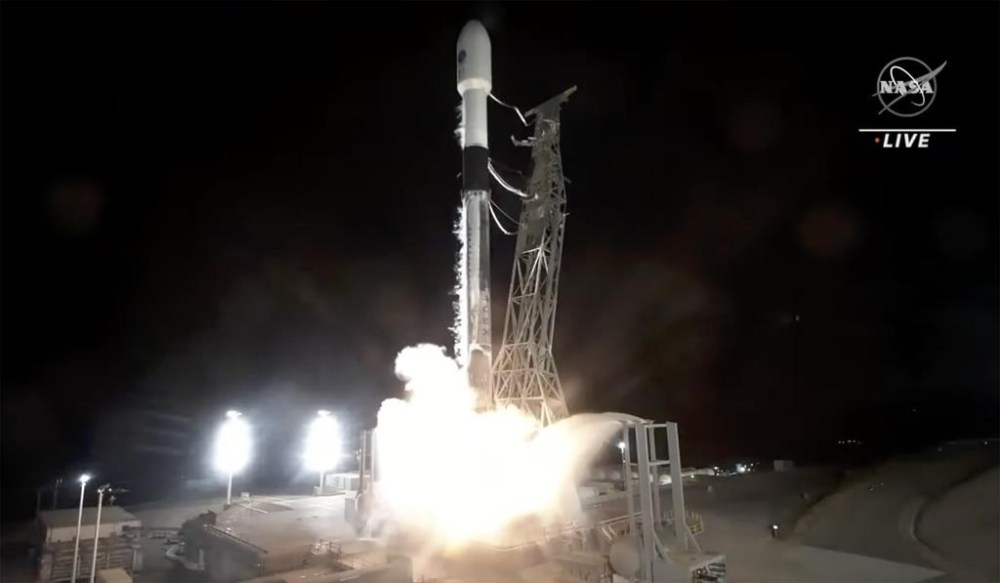
In this image made from video provided by NASA, a SpaceX rocket carrying the Surface Water and Ocean Topography satellite lifts off from Vandenberg Space Force Base in California, Friday, Dec. 16, 2022. (NASA via AP)

“It is a pivotal moment, and I’m very excited about it,” said NASA program manager Nadya Vinogradova-Shiffer. “We’re going to see Earth’s water like we’ve never before.”

About the size of a SUV, the satellite will measure the height of water on more than 90% of Earth’s surface, allowing scientists to track the flow and identify potential high-risk areas. It will also survey millions of lakes as well as 1.3 million miles (2.1 million kilometers) of rivers, from headwater to mouth.

The satellite will shoot radar pulses at Earth, with the signals bouncing back to be received by a pair of antennas, one on each end of a 33-foot (10-meter) boom.

It should be able to make out currents and eddies less than 13 miles (21 kilometers) across, as well as areas of the ocean where water masses of varying temperatures merge.

NASA’s current fleet of nearly 30 Earth-observing satellites cannot make out such slight features. And while these older satellites can map the extent of lakes and rivers, their measurements are not as detailed, said the University of North Carolina’s Tamlin Pavelsky, who is part of the mission.

Perhaps most importantly, the satellite will reveal the location and speed of rising sea levels and the shift of coastlines, key to saving lives and property. It will cover the globe between the Arctic and Antarctica at least once every three weeks, as it orbits more than 550 miles (890 kilometers) high. The mission is expected to last three years.

Laurie Leshin, the director of NASA’s Jet Propulsion Laboratory in Pasadena, California, noted that while the agency is known for its Mars rovers and space telescopes, “this is the planet we care most about.”

“We’ve got a lot of eyes on Earth,” with even more globe-surveying missions planned in the next few years, she added.
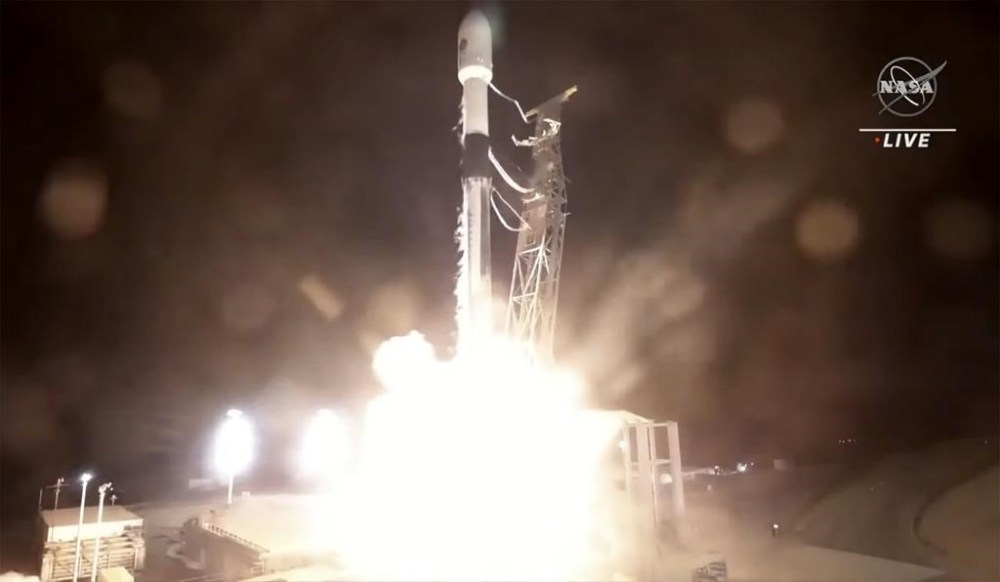
In this image made from video provided by NASA, a SpaceX rocket carrying the Surface Water and Ocean Topography satellite lifts off from Vandenberg Space Force Base in California, Friday, Dec. 16, 2022. (NASA via AP)

NASA and the French Space Agency collaborated on the $1.2 billion SWOT project — some 20 years in the making — with Britain and Canada chipping in.

Already recycled, the first-stage booster returned to Vandenberg eight minutes after liftoff to fly again one day. When the double sonic booms sounded, “Everybody jumped out of their skin, and it was exhilarating. What a morning,” said Taryn Tomlinson, an Earth science director at the Canadian Space Agency.

It’s the latest milestone this year for NASA. Among the other highlights: glamour shots of the universe from the new Webb Space Telescope; the Dart spacecraft’s dead-on slam into an asteroid in the first planetary defense test; and the Orion capsule’s recent return from the moon following a test flight.

___

The Associated Press Health and Science Department receives support from the Howard Hughes Medical Institute’s Science and Educational Media Group. The AP is solely responsible for all content.


Report Error Submit a Tip

More Stories

Carney’s defence of Lake Ontario carries enormous weight

Niigaan Sinclair 5 minute read Preview

Carney’s defence of Lake Ontario carries enormous weight

Niigaan Sinclair 5 minute read Friday, Aug. 28, 2026

For centuries on Turtle Island (North America), explorers, map makers, and political leaders have erased Indigenous place names and substituted them — more often than not — with political, ethnocentric, and self-aggrandizing names.

In recent years, a few places on the continent have had Indigenous names re-established, but as of today, few of the original names are “official.”

So, it was no surprise when U.S. President Donald Trump on Thursday signed an executive order directing the U.S. Department of the Interior and Board on Geographic Names to take steps within 30 days to officially rename Lake Ontario as “Lake America.”

The move may have been a result of the Canada-U.S. trade war and Trump’s pettiness and ego, but it also fits in perfectly with his career.

Read
Friday, Aug. 28, 2026

Recognizing the value of phys-ed for kids

Jerry Storie 6 minute read Preview

Recognizing the value of phys-ed for kids

Jerry Storie 6 minute read 2:00 AM CDT

The message from Premier Wab Kinew and Education Minister Tracy Schmidt last week about the importance of exercise for young people was timely and important — but it is not new.

Read
2:00 AM CDT

Winnipeg police ID deceased man, notify family

Free Press staff 3 minute read Preview

Winnipeg police ID deceased man, notify family

Free Press staff 3 minute read Sunday, Aug. 30, 2026

Winnipeg police have been able to notify next-of-kin about the death of a man found unresponsive on a city street in July.

The man was identified after police asked for the public’s help and issued a composite sketch and description of the unknown man on Friday.

On Sunday, police said his family has been notified and thanked the public. Additional details about the man were not released in order to respect the family’s privacy, police said.

The man died in hospital after being found unresponsive July 28 at the corner of Main Street and James Avenue in Winnipeg, and investigators’ previous efforts to identify him were unsuccessful.

Read
Sunday, Aug. 30, 2026

Dynacare strike could lead to lab test logjam

Carol Sanders 4 minute read Preview

Dynacare strike could lead to lab test logjam

Carol Sanders 4 minute read 2:00 AM CDT

DOCTORS and health-care advocates are raising concerns about patient care if a Sept. 8 strike goes ahead at the private company that provides nearly all medical lab services in Manitoba.

There is no essential services agreement in place with Dynacare, so if its lab techs are off the job, patients who need blood tests and urinalysis will be directed to hospitals and public clinics for those services.

“There’s only so many of those workers and I’m sure that the public folks are bracing for big crunch of additional patients if the strike really goes ahead,” Noah Schulz of the Manitoba Health Coalition said Monday.

Dynacare serves 1.2 million Manitoba patients a year at 23 community lab locations.

Read
2:00 AM CDT

Provencher Park eyed for new aquatic centre

Malak Abas 4 minute read Preview

Provencher Park eyed for new aquatic centre

Malak Abas 4 minute read Updated: 4:23 PM CDT

Provencher Park may be the next site for a new aquatic centre.

Read
Updated: 4:23 PM CDT

Rare and tough to notice, sarcomas may lurk in the body

Jen Zoratti 12 minute read Preview

Rare and tough to notice, sarcomas may lurk in the body

Jen Zoratti 12 minute read Yesterday at 6:00 AM CDT

Last summer, Michelle Finley was going about a normal day.

She had just dropped her car off at a garage and was walking back to her office building downtown when, suddenly, she was stopped in her tracks by a searing cramp on the bottom of her right foot.

“It was so painful it took my breath away,” says Finley, now 52. “I stopped and held on to the side of a building for a second — like, it was bringing tears to my eyes.”

Finley thought she had a really bad case of plantar fasciitis. Nine months later she would lose her foot to sarcoma.

Read
Yesterday at 6:00 AM CDT