Where’s the snow? Climate change affects ski racing season
Advertisement
Read this article for free:
or
Already have an account? Log in here »
To continue reading, please subscribe:

Digital Subscription
One year of digital access for only $205*
- Enjoy unlimited reading on winnipegfreepress.com
- Read the E-Edition, our digital replica newspaper
- Access News Break, our award-winning app
- Play interactive puzzles
*First annual payment billed as $205.00 + GST for one year. This annual subscription will automatically renew at $233.00 + GST every 52 weeks (10% off the regular annual price of $259.35). Offer available to new and qualified returning subscribers only. Cancel any time.
To continue reading, please subscribe:
Add Free Press access to your Brandon Sun subscription for only an additional
$1 for the first 4 weeks*
- Enjoy unlimited reading on winnipegfreepress.com
- Read the E-Edition, our digital replica newspaper
- Access News Break, our award-winning app
- Play interactive puzzles
*Your next Brandon Sun subscription payment will increase by $1.00 and you will be charged $17.95 plus GST for four weeks. After four weeks, your payment will increase to $24.95 plus GST every four weeks.
Read unlimited articles for free today:
or
Already have an account? Log in here »
Hey there, time traveller!
This article was published 10/02/2023 (1281 days ago), so information in it may no longer be current.
MERIBEL, France (AP) — Besides some minor dustings, it hasn’t snowed significantly in the French resorts hosting the skiing world championships since mid-January.
And there is no snow in the long-term forecast.
Instead, the weather has been perfectly clear, sunny and, yes — cold. But starting next week when a warm front is slated to move in over the posh towns of Courchevel and Meribel, temperatures are expected to soar well above freezing and start melting the perfectly shaped racing surfaces that organizers have prepared with mostly artificial snow.
Dealing with warm temperatures and a lack of snow has been a constant this season across the Alps for the International Ski and Snowboard Federation, known as FIS, with Mother Nature and global warming having just as much say about when and where to hold races as the sport’s governing body.
Warm weather and a lack of snow wiped out nearly a month of racing at the start of this season, preseason training on melting European glaciers is heading toward extinction and the impact of climate change on the schedule is being seen even in January.
“There’s a very real threat to what we know and love from winter,” American skiing standout Mikaela Shiffrin said. “We get really caught up in our world and the medals and wins and victories and records and everything. But what we hope is to be able to enjoy skiing and winter sports and winter recreation for many, many years to come. And that’s under threat right now.”
For nearly three decades, the FIS has started the World Cup season in late October with a weekend of racing atop the Rettenbach glacier in Soelden, Austria. The idea is not only to draw attention to the racing circuit but also to encourage spectators and consumers to start thinking about reserving their winter vacations and start buying skis, boots and other equipment.
The entire skiing industry in Europe relies on the race to boost sales.
The Soelden giant slaloms start at an altitude of 3,040 meters (nearly 10,000 feet) and finish at 2,670 meters (nearly 9,000 feet).
Yet despite such high altitudes, warm and rainy weather forced the women’s race in Soelden this season to be canceled, while the men’s race the next day was held only following extensive repair work on the Rettenbach course.
Then the circuit was then supposed to move on to consecutive weekends of downhill racing at a new, even higher-altitude course connecting Zermatt, Switzerland, to Cervinia, Italy, that is still being built at great expense by the Swiss and Italian ski federations.
Both weekends of racing in Zermatt-Cervinia were wiped out because of a lack of snow. As were the following weekend’s races in Lech-Zuers, Austria.
The women’s season ended up starting a full month late in Levi, Finland — above the Arctic Circle.
But the cancellations kept coming amid a dramatically snow-less winter across Europe: A low-altitude race in Zagreb, Croatia, melted away; and even races slated for January in Garmisch-Partenkirchen, Germany — the Bavarian resort that hosted the 1936 Olympics — had to be moved.
It’s not just this year. Season after season, there have been problems with holding races because of a lack of snow. Improvements in snow-making capabilities enable many races to be held even when there is none of the natural stuff — see last year’s Beijing Olympics, where skiing was contested entirely on artificial snow — but skiers and coaches say radical changes are needed in terms of scheduling and selecting which resorts hold races.
“There’s a very traditional approach to World Cup racing that we’ve seen as far as venue assignments and where we go. And with a lot of tradition, there’s reluctance to change, it seems,” U.S. ski team women’s head coach Paul Kristofic said. “But what we see on the ground year after year if you’ve done this enough years is very, very difficult times for certain organizers, just because of elevation.
“You see glaciers receding and in really bad shape if you have a low-snow year or tremendously warm temperatures in the summer,” Kristofic added. “A lot of times now we’re seeing less snow in South America (during preseason training), really warm winters over here, or extreme conditions where it will be warm and then it will snow two feet and then you have a big mess as well.”
A recent case study distributed by the United Nations’ World Meteorological Organization reported a “moderate to high risk” threat for winter sports within just 13 years for Cortina d’Ampezzo, the Italian resort that will host women’s ski racing at the 2026 Milan-Cortina Olympics and is the signature race of the annual women’s circuit.
The study shows “shrinking of the time-window for snow making in preparation of the ski season and for the duration of the skiing season itself,” Carlo Pappa, one of the study’s authors, wrote in an email to The Associated Press.
Kristofic questioned the timing of the race schedule.
“Why do we stop racing in March when the conditions are great? Yet we’re trying to do these races in mid-late October, November, in venues that are getting warmer and more difficult to do,” Kristofic said. “We recognize that there’s a giant industry and business behind what supports our sport, so of course those are pieces that need to be considered. But for the health of our tour and our sport, I think that the leadership in FIS definitely needs to start looking at how can we adjust this so it makes sense.”
So far, the FIS has been taking baby steps. There are no longer city events held on artificial tracks built on giant scaffolding or inside ski jumping facilities in places like Munich, Stockholm and Oslo. The annual women’s races scheduled for Maribor, Slovenia — finish altitude a mere 340 meters (1,115 feet) — were moved to Slovenian resort Kranjska Gora before this season after three straight years when the race made the same move mid-season because of a lack of snow.
“Lower altitude (resorts), just from a likelihood of competition, probably shouldn’t hold those races anymore,” Lindsey Vonn said in a January interview. “I saw a webcam of Maribor, which I loved racing at, and the whole thing is grass.”
Vonn suggested holding more men’s and women’s races at the same resorts to reduce expenses.
Taking into account the energy crisis related to the war in Ukraine, the Italian Winter Sports Federation moved a World Cup cross-country ski race originally slated for Milan last month to Livigno to avoid having to run snow guns in the city.
“We need to take care of what we are doing, this is clear,” said Peter Gerdol, the FIS women’s race director. “But at the same time we are using tourist slopes, which many ski resorts have to use for their own purposes in some periods, so it’s not always possible to go anytime, anywhere. We need to make this puzzle work somehow.”
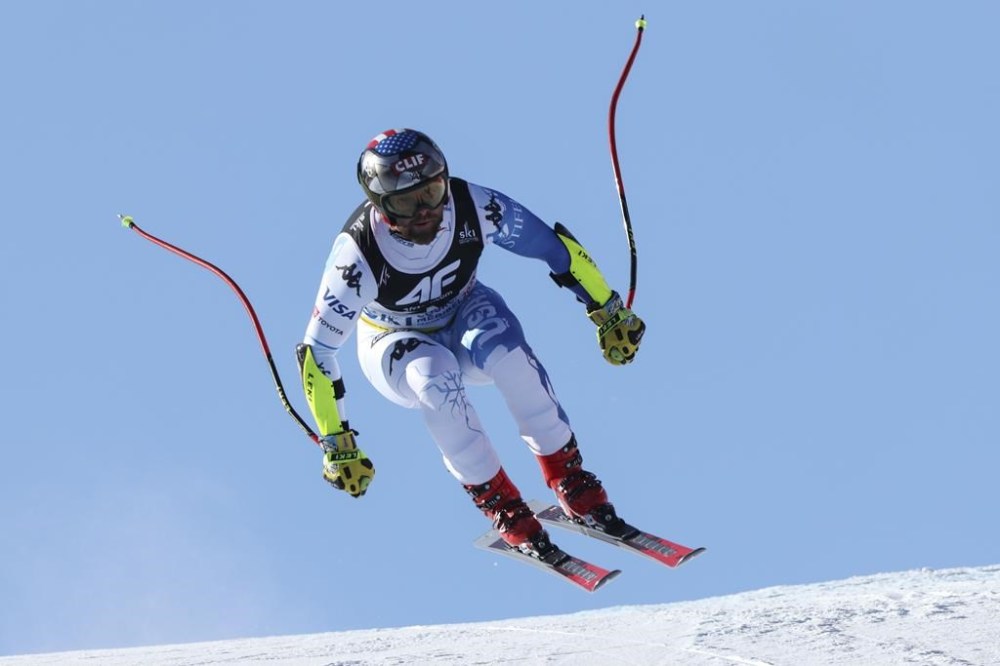
Aiming to raise awareness about climate change, American skiers at the world championships are wearing blue-and-white racing suits that depict an image of ice chunks floating in the ocean. It’s a concept based on a satellite photo of icebergs breaking off because of high temperatures. The suit was designed in collaboration with the nonprofit organization Protect Our Winters, known as POW.
“The simple truth of the matter is you can’t ski without snow and it’s going closer and closer every year to that,” said American downhiller and POW ambassador Travis Ganong. “We really want to push our organizing body to the leaders in this fight for climate change and currently I don’t think we are leading. I don’t know if it’s the schedule or what (the FIS) can change, but at least start looking deep into what we’re currently doing and how we can do it better.”
___
Willemsen reported from Soelden, Austria.
___
More AP skiing: https://apnews.com/hub/skiing and https://twitter.com/AP_Sports