Changing salmon hatchery release practices can improve survival rates: B.C. study

Advertisement

Advertise with us

A first-of-its kind study in British Columbia suggests salmon hatcheries could improve survival rates by optimizing the weight of the juvenile fish and the timing of their release.

Read this article for free:


or

Already have an account? Log in here »

To continue reading, please subscribe:

Subscribe and receive a limited-edition Free Press branded hat or tote.

Digital Subscription

One year of digital access for only $205*

  • Enjoy unlimited reading on winnipegfreepress.com
  • Read the E-Edition, our digital replica newspaper
  • Access News Break, our award-winning app
  • Play interactive puzzles

*First annual payment billed as $205.00 + GST for one year. This annual subscription will automatically renew at $233.00 + GST every 52 weeks (10% off the regular annual price of $259.35). Offer available to new and qualified returning subscribers only. Cancel any time.

To continue reading, please subscribe:

Add Free Press access to your Brandon Sun subscription for only an additional

$1 for the first 4 weeks*

  • Enjoy unlimited reading on winnipegfreepress.com
  • Read the E-Edition, our digital replica newspaper
  • Access News Break, our award-winning app
  • Play interactive puzzles
Start now

*Your next Brandon Sun subscription payment will increase by $1.00 and you will be charged $17.95 plus GST for four weeks. After four weeks, your payment will increase to $24.95 plus GST every four weeks.

Hey there, time traveller!
This article was published 24/03/2023 (1272 days ago), so information in it may no longer be current.

A first-of-its kind study in British Columbia suggests salmon hatcheries could improve survival rates by optimizing the weight of the juvenile fish and the timing of their release.

More than five billion juvenile salmon are released from hatcheries into the North Pacific Ocean each year, with about six per cent coming from B.C. and Yukon.

The hatcheries are aimed at stabilizing declining populations of wild salmon while keeping fisheries afloat, but the study says there’s a lack of robust scientific assessment of their overall efficacy for conservation purposes.
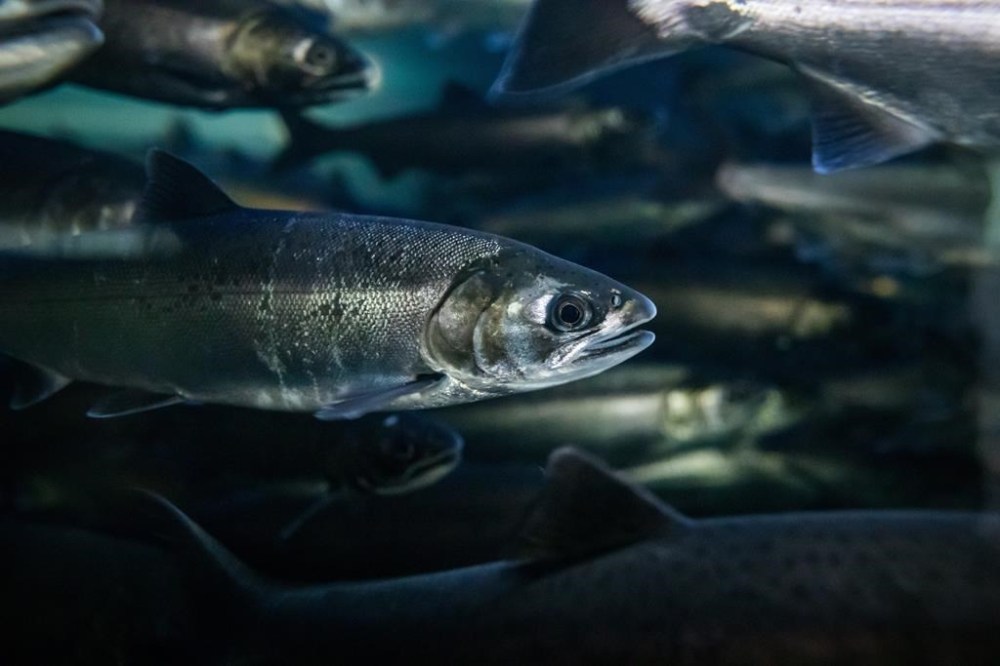
Coho salmon swim at the Fisheries and Oceans Canada Capilano River Hatchery, in North Vancouver, on Friday July 5, 2019. A first-of-its kind study in British Columbia suggests salmon hatcheries could improve survival rates by optimizing the weight of the juvenile fish and the timing of their release. THE CANADIAN PRESS/Darryl Dyck

The study published in the Canadian Journal of Fisheries and Aquatic Sciences analyzed data from 21 chinook and 16 coho hatcheries in B.C. over the last two decades, finding higher survival rates were linked to heavier weights upon release.

For ocean-type chinook, it found the average maximum survival stemmed from releases six to 27 days earlier than historical averages for most of the hatcheries.

Meanwhile, coho survival rates could be improved by releasing the fish eight to 33 days later than the historical average.

The locations of hatcheries in the study ranged from Prince George, Revelstoke and the Fraser Valley, to the Sunshine Coast and Vancouver Island.

The findings do not represent a one-size-fits-all solution across hatcheries, says lead author Sam James, a biologist with the Vancouver-based Pacific Salmon Foundation.

The study found the greatest improvements in salmon survival rates were generally predicted from a combination of the optimal weight and timing of release.

Optimizing hatchery release practices could increase salmon returns by six to as much as 245 per cent for chinook and five to 160 per cent for coho, the study suggests.

However, James says it’s important to look at full range of those possibilities, rather than focusing on the highest potential increases.

There were many locations for which changes were not expected to yield major increases in salmon survival and returns, and there was a high degree of uncertainty in the modelling around the ranges of potential gains, she says.

James says the study is unique because the researchers used an approach that examined numerous hatcheries as a group, allowing them to “unveil” the overarching relationships between release practices and survival while accounting for hatchery-specific deviations from the trends they identified.

Isobel Pearsall, the director of the Pacific Salmon Foundation’s marine science program, says the study is the first in B.C. to examine the efficacy of release practices on that larger scale.

“There were a couple of reports, lots of scattered information,” she says.

But there was no pre-existing larger study looking at different hatcheries together, and identifying release practices that could support higher survival rates, she says.

Salmon face many threats, James says, and while hatcheries cannot control conditions in the ocean, they can set the fish up for greater success with the right release practices.

The study did not consider economic factors, and additional expenses may be associated with optimizing release practices, Pearsall adds.

For example, it may be a challenge for hatcheries to increase the weight of juvenile chinook while also aiming to release them earlier, she says.

The researchers took into account the effects of other factors that can affect salmon survival rates, such as predators and environmental conditions, in order to focus their analysis on the role of release practices, she notes.

This report by The Canadian Press was first published March 24, 2023.
Report Error Submit a Tip

More Stories

Salmon survival linked to hatchery release weight

Brenna Owen, The Canadian Press 4 minute read Preview

Salmon survival linked to hatchery release weight

Brenna Owen, The Canadian Press 4 minute read Friday, Mar. 24, 2023

A first-of-its kind study in British Columbia suggests salmon hatcheries could improve survival rates by optimizing the weight of the juvenile fish and the timing of their release.

More than five billion juvenile salmon are released from hatcheries into the North Pacific Ocean each year, with about six per cent coming from B.C. and Yukon.

The hatcheries are aimed at stabilizing declining populations of wild salmon while keeping fisheries afloat, but the study says there’s a lack of robust scientific assessment of their overall efficacy for conservation purposes.

The study published in the Canadian Journal of Fisheries and Aquatic Sciences analyzed data from 21 chinook and 16 coho hatcheries in B.C. over the last two decades, finding higher survival rates were linked to heavier weights upon release.

Read
Friday, Mar. 24, 2023

Man, 21, killed in animal attack on Manitoba First Nation

Chris Kitching 5 minute read Preview

Man, 21, killed in animal attack on Manitoba First Nation

Chris Kitching 5 minute read Monday, Sep. 14, 2026

The family of “a kind and gentle giant” is grief-stricken as officials try to determine what kind of animal killed the 21-year-old man in western Manitoba.

Moses Campeau was walking on a road to a friend’s house in Sapotaweyak Cree Nation, about 600 kilometres northwest of Winnipeg, when he was fatally injured Sept. 9, his mother, Paula Campeau, said Monday.

“Moses was a kind and gentle giant,” she said. “He was a person who (people) would ask to come and help them, and he would go without even hesitating.”

Manitoba RCMP said officers from the Swan River detachment responded to a report of a suspicious death at about 3:10 a.m. The scene was held and the RCMP’s major crime services took over the investigation.

Read
Monday, Sep. 14, 2026

Suspension on the horizon for Hellebuyck as pre-season set to start

Ken Wiebe 7 minute read Preview

Suspension on the horizon for Hellebuyck as pre-season set to start

Ken Wiebe 7 minute read Yesterday at 6:21 PM CDT

In this high stakes game of chicken, Kevin Cheveldayoff, Connor Hellebuyck or any of the potential suitors for the Winnipeg Jets franchise netminder appear ready to blink.

Read
Yesterday at 6:21 PM CDT

MMF walks away from bid to buy Fort Garry Hotel

Carol Sanders 3 minute read Preview

MMF walks away from bid to buy Fort Garry Hotel

Carol Sanders 3 minute read Monday, Sep. 14, 2026

The Manitoba Métis Federation won’t buy the historic Fort Garry Hotel, President David Chartrand said Monday.

Read
Monday, Sep. 14, 2026

Transit safety drives first mayoral debate

Morgan Modjeski 4 minute read Preview

Transit safety drives first mayoral debate

Morgan Modjeski 4 minute read Yesterday at 2:01 AM CDT

The safety of Winnipeg Transit drivers was front and centre Monday as the first mayoral debate of the 2026 election focused on public transit.

Kevin Klein, the most experienced of the 10 candidates at the Amalgamated Transit Union 1505-hosted debate, said the time for partial safety shields has passed.

“The partial shields have failed drivers. That’s why we need change,” the former PC MLA and city councillor said, adding driver safety is not a staffing issue, but a “protection failure.”

If elected, Klein said he will bring in full-shield implementation across the city within two years and start a nine-bus pilot project immediately.

Read
Yesterday at 2:01 AM CDT

Two drivers suffer minor injuries in Highway 8 crash

1 minute read Yesterday at 12:30 PM CDT

Two men sustained minor, but not life-threatening injuries after a crash on Highway 8 at Whytewold Road in the RM of St. Andrews Monday afternoon.

At 3:45 p.m. Selkirk RCMP responded to the two-vehicle collision, which happened after a vehicle travelling south on Highway 8 collided with a westbound vehicle that was crossing the highway from Whytewold Road.

The driver of the southbound vehicle, a 26-year-old man, and the driver of the westbound vehicle, a 24-year-old man, both from the RM of Gimli, were involved. The 24-year-old was ticketed for proceeding before safe to do so.