Lawmakers back Paris Olympic law despite surveillance fears

Advertisement

Advertise with us

PARIS (AP) — A proposed French law for the 2024 Paris Olympics that critics contend will open the door for privacy-busting video surveillance technology in France and elsewhere in Europe passed an important hurdle on Tuesday with lawmakers overwhelmingly voting for it.

Read this article for free:


or

Already have an account? Log in here »

To continue reading, please subscribe:

Subscribe and receive a limited-edition Free Press branded hat or tote.

Digital Subscription

One year of digital access for only $205*

  • Enjoy unlimited reading on winnipegfreepress.com
  • Read the E-Edition, our digital replica newspaper
  • Access News Break, our award-winning app
  • Play interactive puzzles

*First annual payment billed as $205.00 + GST for one year. This annual subscription will automatically renew at $233.00 + GST every 52 weeks (10% off the regular annual price of $259.35). Offer available to new and qualified returning subscribers only. Cancel any time.

To continue reading, please subscribe:

Add Free Press access to your Brandon Sun subscription for only an additional

$1 for the first 4 weeks*

  • Enjoy unlimited reading on winnipegfreepress.com
  • Read the E-Edition, our digital replica newspaper
  • Access News Break, our award-winning app
  • Play interactive puzzles
Start now

*Your next Brandon Sun subscription payment will increase by $1.00 and you will be charged $17.95 plus GST for four weeks. After four weeks, your payment will increase to $24.95 plus GST every four weeks.

Hey there, time traveller!
This article was published 28/03/2023 (1273 days ago), so information in it may no longer be current.

PARIS (AP) — A proposed French law for the 2024 Paris Olympics that critics contend will open the door for privacy-busting video surveillance technology in France and elsewhere in Europe passed an important hurdle on Tuesday with lawmakers overwhelmingly voting for it.

The bill will legalize the temporary use of so-called intelligent surveillance systems to safeguard the Paris Games, which run next year from July 26-Aug. 11, and the Paralympics that follow. The systems combine cameras with artificial intelligence software to flag potential security concerns, such as abandoned packages or crowd surges. Human operators would decide whether action is needed.

French authorities insist the surveillance wouldn’t involve facial recognition. Supporters of the bill argue that the technology could help avert disasters like the deadly crowd crush that killed nearly 160 people during Halloween festivities in South Korea in October.
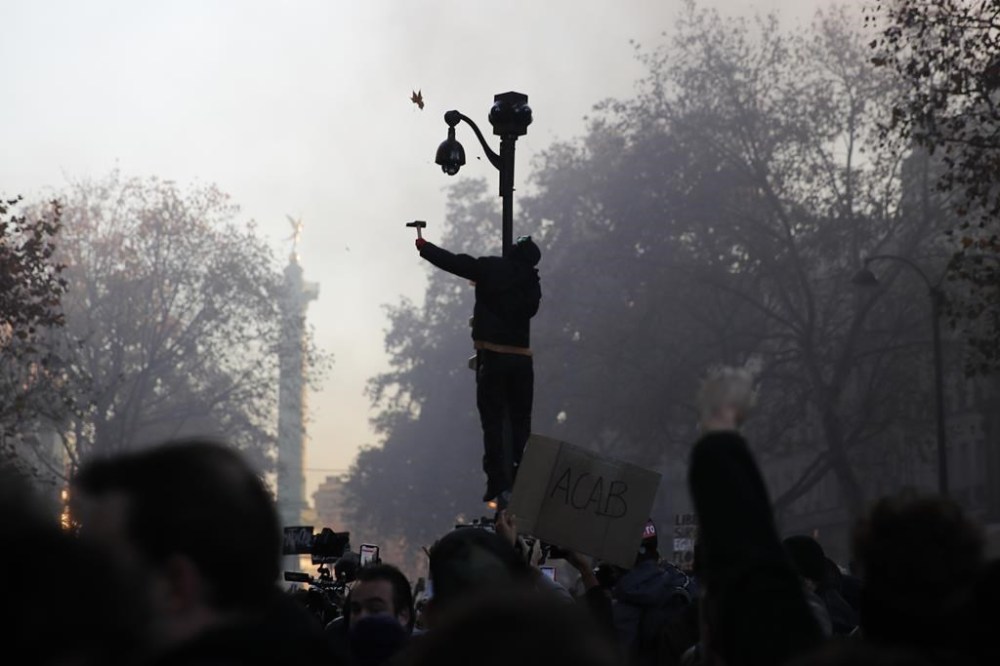
FILE - A protester uses a hammer to break a CCTV camera during a demonstration against a security law that would restrict sharing images of police, Saturday, Nov. 28, 2020 in Paris. A proposed French law for the 2024 Paris Olympics that critics contend will open the door for privacy busting video surveillance technology in France and elsewhere in Europe faces an important hurdle Tuesday March 28, 2023 with lawmakers set to vote on it. The bill would legalize the temporary use of so-called
FILE - A protester uses a hammer to break a CCTV camera during a demonstration against a security law that would restrict sharing images of police, Saturday, Nov. 28, 2020 in Paris. A proposed French law for the 2024 Paris Olympics that critics contend will open the door for privacy busting video surveillance technology in France and elsewhere in Europe faces an important hurdle Tuesday March 28, 2023 with lawmakers set to vote on it. The bill would legalize the temporary use of so-called "intelligent" surveillance systems to safeguard the Games and Paralympics. (AP Photo/Francois Mori, File)

“It’s not about recognizing ‘Mr. X’ in a crowd,” Interior Minister Gérald Darmanin told National Assembly lawmakers last week when they were debating the measures. “It’s about recognizing situations.”

The Senate overwhelmingly approved the draft in January, by 245 votes to 28. The National Assembly followed suit Tuesday with a 400-93 vote that the French government’s sports minister, Amélie Oudéa-Castéra, hailed as “an essential step.”

The draft is now slated for further fine-tuning by assembly members and senators before its final adoption, expected in April.

Digital rights watchdog groups argue that France will violate international human rights law by becoming the first of the European Union’s 27 countries to legalize AI-powered surveillance, even if just temporarily. The bill says the technology can be used on an experimental basis to the end of 2024 to safeguard sporting and cultural events in France that are particularly at risk of being targeted by terror attacks.

The technology’s use “risks permanently transforming France into a dystopian surveillance state” and “will lead to an all-out assault on the rights to privacy, protest, and freedom of assembly and expression,” said Mher Hakobyan, an Amnesty International adviser on AI regulation.

“It has also been well-documented that hostile surveillance technologies are disproportionately used to target marginalized groups, including migrants and Black and brown people,” Hakobyan added.

Even though the draft law says the cameras won’t use facial recognition, they are still liable to scrutinize physical traits including people’s postures, walks and gestures, critics contend. Opponents also are concerned that the technology risks zeroing-in on people who spend a lot of time in public spaces, such as the homeless. The bill also clears the way for the technology’s use with cameras mounted on drones.

___

More AP coverage of the Paris Olympics: https://apnews.com/hub/2024-paris-olympic-games and https://twitter.com/AP_Sports


Report Error Submit a Tip

More Stories

Klein has burned bridges with PM, Gillingham says

Joyanne Pursaga 3 minute read Preview

Klein has burned bridges with PM, Gillingham says

Joyanne Pursaga 3 minute read Friday, Sep. 18, 2026

One mayoral candidate accused another of writing a column so critical it could compromise his ability to work with the federal government.

Read
Friday, Sep. 18, 2026

Puzzles Palace

1 minute read Monday, Jul. 27, 2026

To solve our puzzles, please subscribe with this special offer: |

AC/DC leaves Winnipeg crowd thunderstruck

Rob Williams 5 minute read Preview

AC/DC leaves Winnipeg crowd thunderstruck

Rob Williams 5 minute read 12:11 AM CDT

AC/DC proved once again that rock ‘n’ roll ain’t noise pollution.

A rowdy stadium of about 35,000 people at Princess Auto Stadium couldn’t agree more as the Australian rock legends made their first trip to the city since 2015 on their PWR/UP tour, cranking out two hours and 20 minutes of raw and raunchy high-voltage material, a mix of blues, crunchy power chords, melodic riffs and double entendres that spanned five decades.

Their wide-ranging appeal was apparent in the demographic makeup of the crowd, which ranged from young children to seniors, many clad in $30 glowing devil horns from the well-stocked merch booth that also offered posters, banners, beer koozies, lanyards, tour books and T-shirts.

There is no one in music quite like guitar god Angus Young. He is 71, but onstage he is ageless, a hyperactive teenager dressed in his signature blue schoolboy uniform and yellow and blue cap, running around, duck-walking and leaping in the air while cranking out riff after riff and extended solos on his trusty black Gibson SG.

Read
12:11 AM CDT

National Black Canadians Summit celebrates culture, combats racism

Gabrielle Piché 4 minute read Preview

National Black Canadians Summit celebrates culture, combats racism

Gabrielle Piché 4 minute read Saturday, Sep. 19, 2026

Despite the event’s name — the National Black Canadians Summit — Bruce Miller felt he should attend.

He booked a ticket. And so, this weekend, the Indigenous Manitoban joined roughly 1,500 people flocking to the RBC Convention Centre.

It’s a full schedule — addresses from a former Canadian governor general, sessions on Black mental health and anti-Black racism.

The annual event draws politicians, artists and other professionals from across the country.

Read
Saturday, Sep. 19, 2026

Severe weather preparedness not one-time exercise for businesses

Abiola Odutola 3 minute read 2:00 AM CDT

BRANDON — Local business owners should prepare for the possibility that severe weather could disrupt their operations — even when their facilities escape major damage, a climate resilience expert told the Brandon Chamber of Commerce last week.

Emilia Cameron of the Institute for Catastrophic Loss Reduction told attendees at a September luncheon the recent flooding and heavy rainfall across southern Manitoba affected several businesses.

“Businesses need to prepare not just for direct damages to buildings, but for wide disruptions that can prevent them from operating,” she said. “Road closures, power outages, damaged infrastructure, internet failures and employees being unable to reach work can all bring operations to a standstill.”

Supply chains can also be affected when suppliers cannot reach their customers, she said.

Lawmakers back Paris Olympic law despite surveillance fears

John Leicester, The Associated Press 3 minute read Preview

Lawmakers back Paris Olympic law despite surveillance fears

John Leicester, The Associated Press 3 minute read Tuesday, Mar. 28, 2023

PARIS (AP) — A proposed French law for the 2024 Paris Olympics that critics contend will open the door for privacy-busting video surveillance technology in France and elsewhere in Europe passed an important hurdle on Tuesday with lawmakers overwhelmingly voting for it.

The bill will legalize the temporary use of so-called intelligent surveillance systems to safeguard the Paris Games, which run next year from July 26-Aug. 11, and the Paralympics that follow. The systems combine cameras with artificial intelligence software to flag potential security concerns, such as abandoned packages or crowd surges. Human operators would decide whether action is needed.

French authorities insist the surveillance wouldn't involve facial recognition. Supporters of the bill argue that the technology could help avert disasters like the deadly crowd crush that killed nearly 160 people during Halloween festivities in South Korea in October.

“It’s not about recognizing ‘Mr. X’ in a crowd,” Interior Minister Gérald Darmanin told National Assembly lawmakers last week when they were debating the measures. “It’s about recognizing situations.”

Read
Tuesday, Mar. 28, 2023