Their stories were lost to slavery. Now DNA is writing them
Advertisement
Read this article for free:
or
Already have an account? Log in here »
To continue reading, please subscribe:

Digital Subscription
One year of digital access for only $205*
- Enjoy unlimited reading on winnipegfreepress.com
- Read the E-Edition, our digital replica newspaper
- Access News Break, our award-winning app
- Play interactive puzzles
*First annual payment billed as $205.00 + GST for one year. This annual subscription will automatically renew at $233.00 + GST every 52 weeks (10% off the regular annual price of $259.35). Offer available to new and qualified returning subscribers only. Cancel any time.
To continue reading, please subscribe:
Add Free Press access to your Brandon Sun subscription for only an additional
$1 for the first 4 weeks*
- Enjoy unlimited reading on winnipegfreepress.com
- Read the E-Edition, our digital replica newspaper
- Access News Break, our award-winning app
- Play interactive puzzles
*Your next Brandon Sun subscription payment will increase by $1.00 and you will be charged $17.95 plus GST for four weeks. After four weeks, your payment will increase to $24.95 plus GST every four weeks.
Read unlimited articles for free today:
or
Already have an account? Log in here »
Hey there, time traveller!
This article was published 28/03/2023 (1271 days ago), so information in it may no longer be current.
CHARLESTON, S.C. (AP) — In the 1700s, a boy was born into slavery in Colonial America. He spent his life working in the coastal city of Charleston, South Carolina. And when he died in middle age, he was buried alongside 35 other slaves.
That’s the likely history that researchers have uncovered for the man — there’s no written record for him or the others buried at the long-forgotten site. Their names have been lost, along with any details of their lives. But their stories are now being told through what was left behind: bones, teeth and, especially, DNA.
In recent decades, advances in DNA research have allowed scientists to use ancient remains and peer into the lives of long-dead people. In Charleston, that’s meant tracing some of the African roots that were cut off by slavery.
“We’re bringing their memory back to life,” said Raquel Fleskes, an anthropologist at the University of Connecticut who studied the remains. “This is a way of restoring dignity to individuals that should’ve always had this dignity.”
The Charleston project started a decade ago, when construction workers unearthed the remains beneath the grounds of the Gaillard Center, an arts venue in the city that was going through an expansion.
Dating back to the second half of the 18th century, the remains are believed to be mostly from enslaved people of African descent who lived nearby. A few of them were likely among the estimated 175,000 Africans brought through Charleston’s port, a hub for the trans-Atlantic slave trade.
The city reburied the remains at the site, where a memorial fountain is planned. But with few recorded details available, community members were also interested in using science to learn more about the people, Fleskes said.
So, the Anson Street African Burial Ground Project was born, and researchers started looking for clues.
____
Artifacts from the site showed that the bodies were buried with care, explained Theodore Schurr, an anthropologist at the University of Pennsylvania who worked on the research. Some of them had beads in their hair or coins over their eyes. Minerals in their teeth showed only a few had been born in Africa, while most had likely been born into slavery in Charleston or nearby.
Scientists also coaxed DNA from the centuries-old skeletons — drilling small samples of bones and teeth, grinding them up into powder, mixing them into a solution and filtering out everything but the human DNA. They were able to get some genetic material for most of the 36 and full genomes for half of them, which were compared with the genetic makeup of people in Africa today.
Results showed that they had ties to many different places along the West African coast, from Gambia to Gabon. They were mostly male, and largely died as adults. Their ages ranged from a child under 3 to a man over 50.
Their DNA showed they were unrelated, aside from one possible mother-child pair.
Researchers also offered DNA tests to 78 African Americans living in the Charleston area today, said La’Sheia Oubré, who led community education for the project. So far, they haven’t found any direct relatives of those buried at Anson Street.
Still, Oubré — who took a DNA test — said she and other community members consider them family.
“They have such a story to tell,” she said. “And because they’re not related to us by blood, it doesn’t mean that it’s not our moral responsibility to take care of them.”
___
Since it became possible to sequence DNA from ancient remains, the technology has taken us back to the days of Neanderthals and mammoths.
Some researchers have been using ancient DNA to fill gaps in our more recent history. That includes cases like Charleston as well as the New York African Burial Ground Project, which revealed new details about Africans and their descendants in 18th century Manhattan.
There aren’t many records for these people from the time, said Michael Blakey, an anthropologist who served as the scientific director on the New York project. The records that are available focuses on things like how much enslaved people cost and what kinds of laws were used to control them, he said.
Oubré said it’s been powerful to have DNA reveal some of the “stolen history” of those buried in her city.
“To be able to know all of this, it’s still mind-blowing to me,” Oubré said. “It still just warms my heart that we’re able to find out where we come from — where we really come from.”
In some cases, ancient DNA research has also challenged the history that’s been written about certain communities.
Growing up in Puerto Rico, anthropologist Maria Nieves-Colon was taught that the Indigenous peoples of the islands were quickly wiped out by European colonization, and didn’t pass on their genes to people on the island today. But after looking at ancient remains from the island in a 2020 study, Nieves-Colon found genetic links did exist between those Indigenous groups and modern-day Puerto Ricans.
Research like this shows “we need to think more critically about what was left in the historical record,” said Nieves-Colon, who is now at the University of Minnesota.
___
While ancient DNA can be a powerful tool for uncovering history, it needs to be used with caution, researchers note, especially when it comes to vulnerable groups.
Unlike research on living subjects, work on recovered human remains doesn’t require scientists to get consent, explained Krystal Tsosie, a geneticist at Arizona State University. And in the past, most researchers haven’t consulted with groups like Native tribes or African descendants before studying the remains of possible ancestors.
But this kind of work does impact living communities and they should be part of the conversation, researchers said.
“In many ways, it’s about power,” Blakey said. “The right to tell your story.”
In Charleston, project leaders asked community members for their permission before every step, Oubré said. The names of the 36 had been lost to history and the team gave them new ones — like Coosaw, Welela, Isi and Kuto — so they wouldn’t be just numbers on a burial plot, said Joanna Gilmore, director of research and interpretation with the Anson Street project.
Now, the new memorial is set to honor the lives of these 36 individuals, as well as the thousands of enslaved people who helped build Charleston, project leaders said.
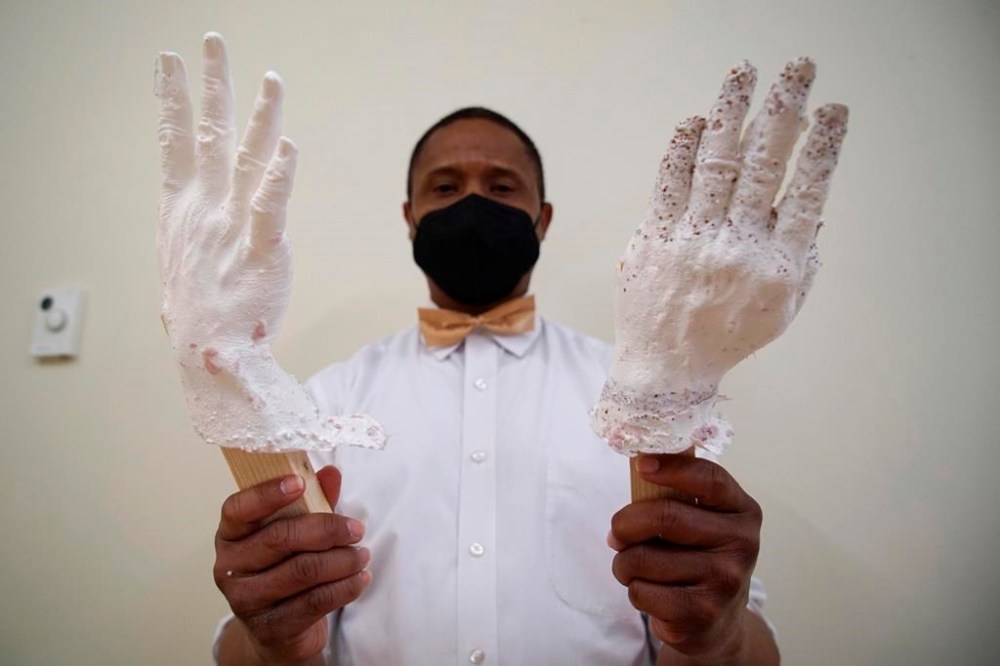
The memorial will be at the Gaillard Center, where a small plaque now marks the site where the remains were uncovered. It will include a fountain circled by pairs of bronze hands cast from current residents, and a base made of soil from other African burial grounds across the city, Gilmore explained.
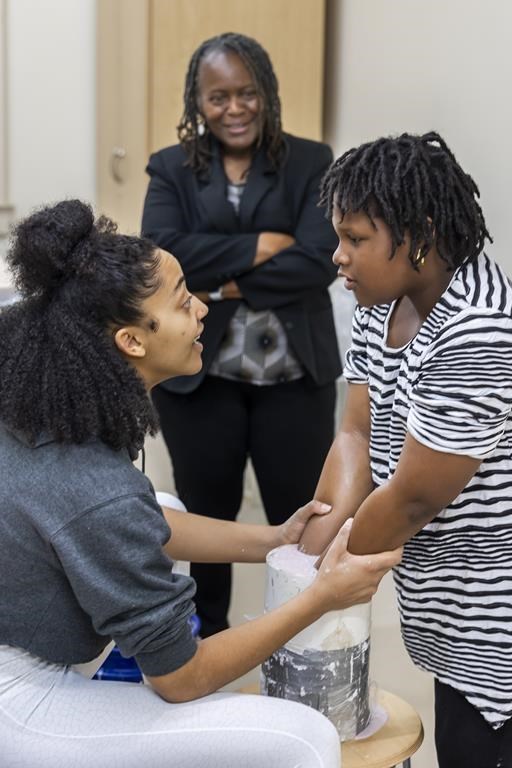
Last month at an art studio, residents created a copy of their hands, leaning elbow-deep into buckets of pink goo that hardened into molds. Artist Stephen Hayes poured liquid plastic into the molds to make shiny white replicas.
Adrian Swinton got her hands cast to represent a woman given the name Tima. Swinton is descended from slaves herself, and said the memorial was a powerful way to remember their sacrifices.
“Her legacy hasn’t gone unnoticed,” Swinton said. “And she wasn’t property. She was a human. She was part of my Black history.”
Retiree Ervin McDaniel Jr. was giddy as he held up his freshly made plastic hands, which will be cast in bronze to represent the boy born into slavery who was given the name Fumu.
“They lived, they worked, they died — and now they’re being remembered forever,” McDaniel said
___
The Associated Press Health and Science Department receives support from the Howard Hughes Medical Institute’s Science and Educational Media Group. The AP is solely responsible for all content.