Drought-struck Barcelona quenches thirst with costly desalination
Advertisement
Read this article for free:
or
Already have an account? Log in here »
To continue reading, please subscribe:

Digital Subscription
One year of digital access for only $205*
- Enjoy unlimited reading on winnipegfreepress.com
- Read the E-Edition, our digital replica newspaper
- Access News Break, our award-winning app
- Play interactive puzzles
*First annual payment billed as $205.00 + GST for one year. This annual subscription will automatically renew at $233.00 + GST every 52 weeks (10% off the regular annual price of $259.35). Offer available to new and qualified returning subscribers only. Cancel any time.
To continue reading, please subscribe:
Add Free Press access to your Brandon Sun subscription for only an additional
$1 for the first 4 weeks*
- Enjoy unlimited reading on winnipegfreepress.com
- Read the E-Edition, our digital replica newspaper
- Access News Break, our award-winning app
- Play interactive puzzles
*Your next Brandon Sun subscription payment will increase by $1.00 and you will be charged $17.95 plus GST for four weeks. After four weeks, your payment will increase to $24.95 plus GST every four weeks.
Read unlimited articles for free today:
or
Already have an account? Log in here »
Hey there, time traveller!
This article was published 29/05/2023 (1181 days ago), so information in it may no longer be current.
EL PRAT DE LLOBREGAT, Spain (AP) — Where once the population of Barcelona drank mostly from its rivers and wells, Spain’s second city now relies upon a labyrinth-like mesh of green, blue and purple pipes inside an industrial plant to keep it from going thirsty amid a prolonged drought.
Water is pumped from two kilometers (1.2 miles) into the Mediterranean Sea to where the Llobregat desalination plant sits on an isolated stretch of beach. After journeying through several cleaning and filtering systems it reaches its final stop: the twisting and turning multi-colored channels that squeeze every drop of water free of its salt.
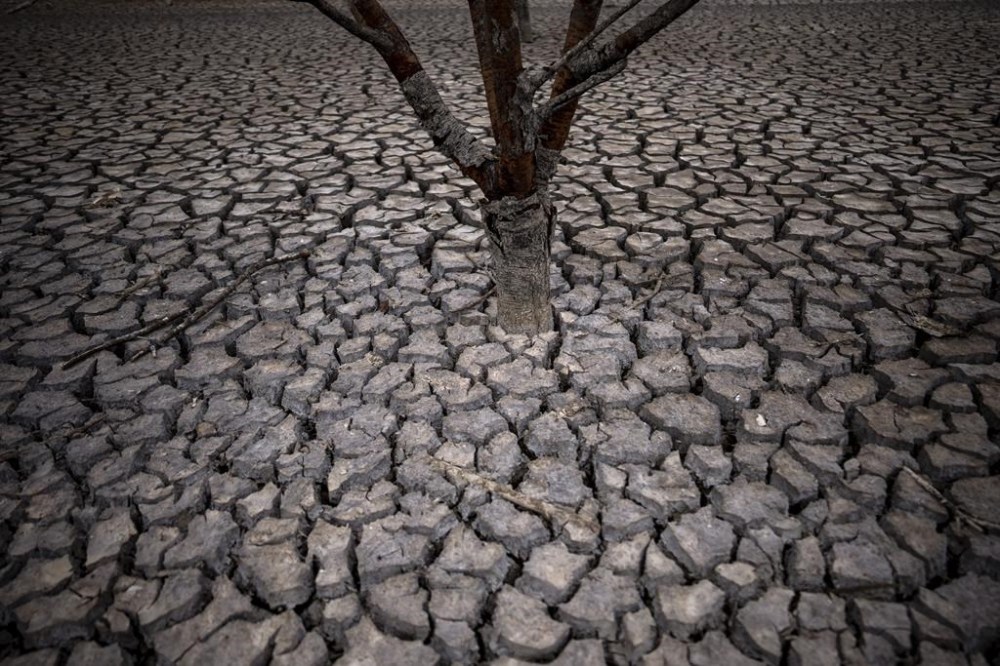
Barely used after being built in 2009, Europe’s largest desalination plant for drinking water is running at full throttle to help the greater Barcelona area and some five million people adapt to the impact of climate change, which has contributed to the drying up of southern Europe’s fresh water reserves through heat waves and drought.
In April 2021, before the drought, rivers provided 63% of Barcelona’s drinking water, wells provided 34% and desalination just 3%. Two years later desalination makes up 33% of Barcelona’s drinking water, while wells provide 23% and its shrinking rivers just 19%, according to Barcelona’s municipal water company.
With the reservoirs fed by Catalonia’s northern river basins at just 25% capacity, limits have been placed on the amount of water available for agriculture, industry and some municipal uses. But authorities have not had to take drastic action like during the 2006-2008 drought when tanker vessels shipped in drinking water.
“We knew that sooner or later a drought would come,” Carlos Miguel, plant manager, told The Associated Press during a recent visit to the Llobregat plant.
“As long as the drought continues the plant will keep running. That is clear.”
While the building of the Llobregat plant is the result of authorities heeding warnings from climate experts and planning ahead, it comes at high economic and environmental costs.
In the desalination process at the Llobregat plant, for every 0.45 liters of fresh water, around 0.55 liters of extremely salty brine is produced as waste. The reverse osmosis process, where high pressure forces seawater through membranes which separates the salt, also requires a lot of energy that doesn’t yet come entirely from renewable energy sources.
The Mediterranean region is heating up at a faster rate than many other areas of the globe, leading to a record-hot 2022 in Spain and a widespread drought that is hurting agriculture. The lack of water is particularly acute in northeast Catalonia, whose water agency forecasts that its water resources will shrink by 18% before 2050.
Water authorities predict that the Barcelona area is heading for an official “drought emergency”, which will imply tighter restrictions, by September.
“We forecast that for the rest of May rainfall will be above average, but that does not make up for 32 months of drought,” Samuel Reyes, head of the Catalan Water Agency, said recently.
Desalination has formed a key part of Spain’s water policy for over half a century. The island of Lanzarote in Spain’s Canary Islands archipelago installed Europe’s first desalination plant back in 1964, and the industry has kept growing in the southern European country prone to long, dry summers. The development and spread of the reverse osmosis technique in the 1980s and 90s, along with reduced costs, led to its buildout across many areas of mainland Spain.
Spain is now fourth in the world for its desalination capacity, about 5% of the global total, behind Saudi Arabia, the United States and the United Arab Emirates, according to the Spanish Association of Desalination and Water Re-utilization. Desalination capacity has steadily gone up worldwide in the past decade, with the technology seeing a bigger uptick in Europe and Africa.
Spain has some 800 desalination plants that can produce 5 million cubic liters a day of water for drinking, agriculture, and industry. If that were dedicated solely for human consumption, it would quench the thirst of 34 million people — over 70% of Spain’s population.
As part of a 2.2-billion euro ($2.4-billion) drought response package, Spain’s national government said this week that it was setting aside 220 million euros ($238 million) to expand another desalination plant north of Barcelona, plus another 200 million euros ($216 million) for a plant on Spain’s southern coast. It also pledged to spend 224 million euros ($242 million) on improving water purification systems in southern Spain.
This small miracle of scientific innovation, however, includes even more costs.
According to the public company that runs the Llobregat plant, a thousand liters of desalinated water costs 0.70 euros to produce, compared to 0.20 euros for the same quantity of water pulled from the Llobregat river and purified for drinking. That means a heavier tax burden and, possibly, higher water bills.
Xavier Sánchez-Vila, professor of civil engineering and groundwater expert for the Universitat Politecnica de Catalunya, said that while desalination plants like the one in Barcelona have provided a lifeline in a time of crisis, authorities should continue to diversify their strategies and focus on improving water purification and reuse.
“Of course, with climate change we know that droughts are going to be more frequent and therefore there is this need (for desalination),” he said. “But in economic terms, I am not completely sure whether it makes sense to keep building them. A few more maybe, but knowing that these are a really expensive solution.”
Instead, Sánchez-Vila applauds the boost in Barcelona’s use of treated sewage water in a separate treatment plant sitting next to the Llobregat desalination facility. This treated water that is reintroduced upstream and then available to be pulled back into the city’s supply now accounts for 25% of Barcelona’s water.
The more pressing problem for the planet is the energy-intensive processes involved in desalination.
Spain generated 42% of its electricity from renewable energy sources in 2022 and it hopes to reach 50% this year, but it still uses large amounts of planet-warming natural gas. The electricity generated by the solar panels on the Llobregat plant goes into the electrical grid, not directly to the site’s operations.
Julio Barea, water expert for Greenpeace in Spain, insists that desalination is not a panacea.
Barea cited the steady increase of water use in Spain over past decades to support two of the country’s economic pillars: agriculture and tourism. Some 80% of Spain’s water goes to agriculture, Greenpeace calculates, while coastal areas including Barcelona are huge tourist magnets, many offering hotels with swimming pools that need filling. Soon-to-be implemented water restrictions in Catalonia will prohibit the filling of private pools, while hotels will still be able to fill theirs.
And then there is the impact of dumping the brine waste product into the sea, where its super salty load can hurt the ecosystem.

“(Authorities) have to provide drinking water for people, but desalination plants have an impact because they are essentially water factories that need a lot of energy,“ Barea said. “It should be a last resource, and we should ask ourselves how we have gotten into this situation.”
___
Follow AP’s climate coverage at https://apnews.com/hub/climate-and-environment
___
Associated Press climate and environmental coverage receives support from several private foundations. See more about AP’s climate initiative here. The AP is solely responsible for all content.