Sonic boom heard over Washington is a rare sound with a rich history

Advertisement

Advertise with us

NORFOLK, Va. (AP) — People living in and around the nation’s capital experienced a rare, if startling, sound that has a rich history in American aviation and possibly a muted future: A sonic boom.

Read this article for free:


or

Already have an account? Log in here »

To continue reading, please subscribe:

Subscribe and receive a limited-edition Free Press branded hat or tote.

Digital Subscription

One year of digital access for only $205*

  • Enjoy unlimited reading on winnipegfreepress.com
  • Read the E-Edition, our digital replica newspaper
  • Access News Break, our award-winning app
  • Play interactive puzzles

*First annual payment billed as $205.00 + GST for one year. This annual subscription will automatically renew at $233.00 + GST every 52 weeks (10% off the regular annual price of $259.35). Offer available to new and qualified returning subscribers only. Cancel any time.

To continue reading, please subscribe:

Add Free Press access to your Brandon Sun subscription for only an additional

$1 for the first 4 weeks*

  • Enjoy unlimited reading on winnipegfreepress.com
  • Read the E-Edition, our digital replica newspaper
  • Access News Break, our award-winning app
  • Play interactive puzzles
Start now

*Your next Brandon Sun subscription payment will increase by $1.00 and you will be charged $17.95 plus GST for four weeks. After four weeks, your payment will increase to $24.95 plus GST every four weeks.

Hey there, time traveller!
This article was published 05/06/2023 (1214 days ago), so information in it may no longer be current.

NORFOLK, Va. (AP) — People living in and around the nation’s capital experienced a rare, if startling, sound that has a rich history in American aviation and possibly a muted future: A sonic boom.

The boom was heard Sunday after the U.S. military dispatched six fighter jets to intercept an unresponsive business plane flying over restricted airspace.

The Air Force gave the F-16s permission to fly faster than the speed of sound — something civilian aircraft rarely get to do — as the jets scrambled to catch up with the Cessna Citation. The result was a thunderous rumble that resonated across a metropolitan area that’s home to more than six million people.
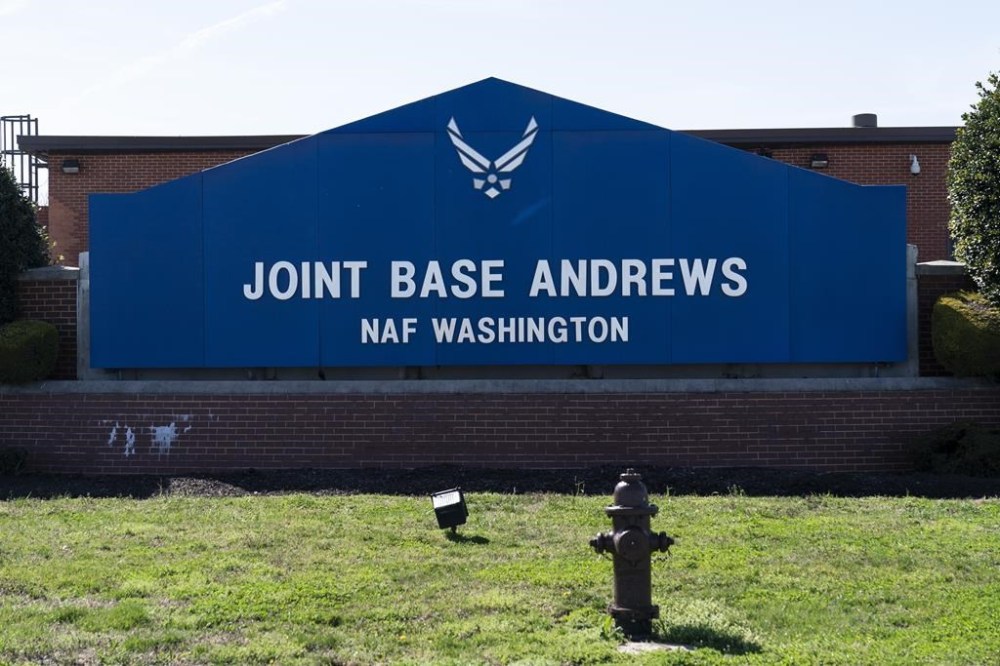
FILE - The sign for Joint Base Andrews is seen on March 26, 2021, at Andrews Air Force Base, Md. A wayward and unresponsive business jet that flew over the nation's capital Sunday afternoon, June 4, 2023, caused the military to scramble a fighter plane from Joint Base Andrews before the jet crashed in Virginia, officials said. The fighter jet caused a loud sonic boom that was heard across the capital region. (AP Photo/Alex Brandon, File)

The business jet eventually crashed in rural Virginia, killing the pilot and three passengers.

Below is an explanation of what sonic booms are, their history in the U.S. and their potential future.

WHAT IS A SONIC BOOM?

Sonic booms are heard on the ground when airplanes overhead fly faster than the speed of sound. That speed is typically about 760 mph near sea level, but can vary depending on the temperature, altitude and other conditions, according to the Congressional Research Service.

As the plane speeds through the air, molecules are pushed aside with great force, “and this forms a shock wave, much like a boat creates a wake in water,” according to NASA.

“When this line of shock wave passes by, listeners on the ground hear a very loud noise,” according to an explanation from Australia’s University of New South Wales.

The F-16s flying over Washington on Sunday were “probably trying to go as fast it could to catch up” with the wayward Cessna airplane, said Anthony Brickhouse, an associate professor of applied aviation sciences at Embry-Riddle Aeronautical University.

The F-16 Fighting Falcon can fly 1,500 mph or twice the speed of sound, known as Mach 2, according to the Air Force.

WHAT IS THE HISTORY OF SUPERSONIC TRAVEL — AND BOOMS?

In 1947, test pilot Charles “Chuck” Yeager became the first person to fly faster than sound in an orange, bullet-shaped Bell X-1 rocket plane. His exploits were told in Tom Wolfe’s book “The Right Stuff,” and in the 1983 film it inspired.

In the movie, someone on the ground asks, “What’s that sound?” as Yeager’s plane flies above the Mojave Desert and breaks the sound barrier.

Interest in supersonic flight initially focused mostly on military planes, according to the Congressional Research Service. But it grew to include supersonic civil aircraft in the 1960s.

For example, the Soviet Union became the first country in 1968 to fly a supersonic passenger plane, the Tupolev TU-144. But a fatal crash at the 1973 Paris Air Show ended that ambition.

In 1963, the U.S. government announced a major program to develop a supersonic passenger aircraft. But serious problems soon surfaced, including massive development costs and doubts about financial viability. The program was terminated in 1971.

During the 1960s, NASA was tasked with helping to develop commercial supersonic aircraft and researched the effects of sonic booms. It found that people who experienced them were not happy with the loud sounds, describing them as “annoying,” “irritating” and “startling.”

FILE - A Lockheed Martin F-16 Jet fighter performs its demonstration flight, June 22, 2011, at the 49th Paris Air Show at Le Bourget airport, east of Paris. People living in and around Washington D.C. experienced a rare, if startling, sound: A sonic boom. The U.S. military had dispatched a fighter jet on Sunday, June 4, 2023, to intercept an unresponsive business plane that was flying over restricted airspace. The Air Force gave the F-16 permission to fly faster than the speed of sound to catch up with it. (AP Photo/Francois Mori, File)

In 1973, the Federal Aviation Administration prohibited supersonic flights over land, “based on the expectation that such flights would cause a sonic boom to reach the ground,” the Congressional Research Service wrote.

The Concorde, an Anglo-French supersonic jetliner, saw success for a number of years after making its first commercial flights in 1976. However, its ear-rattling sonic booms irritated people on the ground and led to restrictions on where the jet could fly.

In the U.S., the plane flew mainly over the Atlantic to New York and Washington. It could fly at twice the speed of sound. And it promised to revolutionize long-distance travel by cutting flying time from the U.S. East Coast to Europe from eight hours to three and a half hours.

The Concorde never caught on widely. The plane’s economics were challenging, and its sonic booms led it to be banned on many overland routes. Only 20 were built; 14 of which were used for passenger service.

In 2003, British Airways and Air France both stopped Concorde service.

Sonic booms are still heard in the U.S. from the nation’s military aircraft. In 2021, a sonic boom from F-15 fighter jets caused widespread concern that there was an earthquake on the Oregon coast.

WHAT IS THE FUTURE OF SUPERSONIC PASSENGER TRAVEL — AND SONIC BOOMS?

In 2018, the Congressional Research Service noted a revival of interest in supersonic aircraft, with startups hoping new technology could make them quieter and profitable.

Since then, American Airlines and United have bought supersonic jets from manufacturer Boom Supersonic. The aircraft are still on the drawing board and years away from flying — an not all industry observers believe they’ll be profitable.

Meanwhile, NASA’s X-59 airplane is designed to fly faster than sound — but with drastically reduced noise — over land, according to April blog post from the agency.

“People below would hear sonic ‘thumps’ rather than booms, if they hear anything at all,” NASA wrote.
Report Error Submit a Tip

More Stories

Man charged after drugs, thousands of dollars seized

2 minute read Yesterday at 10:17 AM CDT

A 24-year-old man has been charged with numerous offences following a drug trafficking investigation by Winnipeg police.

In September, the Organized Crime Unit (OCU), initiated an investigation involving an individual and a residence in the 300 block of Stradbrook Avenue.

On Sept. 22, with the assistance of the Tactical Support Team (TST) and the Central District Community Support Team, officers attempted a traffic stop on a vehicle. The driver refused to stop and fled, colliding with another vehicle. A suspect was arrested a short time later after a brief foot pursuit. No injuries were reported as a result of the motor vehicle collision.

Subsequent search warrants were executed on the suspect’s vehicle and a residence on Stradbrook. Officers seized three ounces of cocaine (estimated street value $6,000); approximately $30,000 in Canadian currency; approximately $13,000 in counterfeit currency; packaging and other illicit drug paraphernalia; a scale; a vacuum sealer; fraudulent photo ID; and three cellphones.

‘We’ll stand for the children’: crowds gather for Orange Shirt Day in Winnipeg

Matthew Frank 5 minute read Preview

‘We’ll stand for the children’: crowds gather for Orange Shirt Day in Winnipeg

Matthew Frank 5 minute read Updated: Yesterday at 6:08 PM CDT

A sea of people clad in orange shirts and waving flags marched through downtown Winnipeg to honour those who survived and died in residential schools.

Read
Updated: Yesterday at 6:08 PM CDT

What does the PC stand for in party’s name? Seems to be Pretty Confused

Tom Brodbeck 5 minute read Preview

What does the PC stand for in party’s name? Seems to be Pretty Confused

Tom Brodbeck 5 minute read Tuesday, Sep. 29, 2026

It should have been obvious from the beginning that the Manitoba Progressive Conservative party was going to have trouble holding itself together under Obby Khan.

Read
Tuesday, Sep. 29, 2026

Acquisition of former residential school grounds will help educate future generations: premier

Connor McDowell and Morgan Modjeski 6 minute read Preview

Acquisition of former residential school grounds will help educate future generations: premier

Connor McDowell and Morgan Modjeski 6 minute read Tuesday, Sep. 29, 2026

Premier Wab Kinew says a former Brandon-area campground acquired by the province will help educate future generations about the horrors of residential schools.

“We live in an era where people are trying to deny what happened in residential schools,” Kinew said during a Tuesday afternoon visit to Turtle Crossing Campground, near the former Brandon Indian Residential School. “It’s an important part of our national history, and keeping that truth alive.”

Kinew officially announced the province’s plan Tuesday, in partnership with the City of Brandon, to acquire and protect the site where the bodies of more than 50 Indigenous children are located.

The premier said the property has “huge national significance” for education about residential school history because it is one of the “most documented” in the country. He carried photographs, and some 20th century newspaper clippings from the Brandon Sun around the site Tuesday.

Read
Tuesday, Sep. 29, 2026

Who has been invited to the table?

Stephen Borys 6 minute read Preview

Who has been invited to the table?

Stephen Borys 6 minute read 2:01 AM CDT

Last Friday, I spoke at Booth University College’s inaugural Honour and Hope Harvest Dinner in support of Shelter U. I had been asked to speak about the power of art in the community, a subject I have spent much of my professional life thinking about — as a museum director, writer and teacher, and now through my consulting work with Civic Muse.

What continues to interest me is not simply what museums, universities and other public institutions do, but whether their work actually matters — whether they make a difference in the lives of the people and communities around them.

Preparing for the evening brought me back to an even more fundamental question: Who has been invited in?

One of my museum mentors used to remind me that institutions often begin the conversation about public engagement too late. Before engagement comes the welcome, and before the welcome comes the invitation. We can create extraordinary buildings, exhibitions and programs and say that everyone is welcome. But unless people believe that these places are also meant for them, many will never cross the threshold.

Read
2:01 AM CDT

Woman took ‘meaningful’ responsibility after disposing of body: lawyer

Dean Pritchard 5 minute read Preview

Woman took ‘meaningful’ responsibility after disposing of body: lawyer

Dean Pritchard 5 minute read Yesterday at 6:00 AM CDT

A woman who was threatened with death if she didn’t help dispose the body of a Mexican man murdered in the basement of a North End home should serve no more jail time, a judge has been told.

Devlin Langlois, 25, has pleaded guilty to accessory after the fact to murder in the March 2025 killing of 28-year-old Diego Moscoza.

“By pleading guilty, Ms. Langlois has already taken meaningful accountability for her actions,” defence lawyer Joshua Rogala told King’s Bench Justice Candace Grammond at a sentencing hearing Monday.

He urged the judge to sentence Langlois to the equivalent of 14 months already served, plus two years supervised probation.

Read
Yesterday at 6:00 AM CDT