Research advances date for likely summer ice-free Arctic by a decade

Advertisement

Advertise with us

New research has moved up the time by which the Arctic Ocean is predicted to be free of summer ice.

Read this article for free:


or

Already have an account? Log in here »

To continue reading, please subscribe:

Subscribe and receive a limited-edition Free Press branded hat or tote.

Digital Subscription

One year of digital access for only $205*

  • Enjoy unlimited reading on winnipegfreepress.com
  • Read the E-Edition, our digital replica newspaper
  • Access News Break, our award-winning app
  • Play interactive puzzles

*First annual payment billed as $205.00 + GST for one year. This annual subscription will automatically renew at $233.00 + GST every 52 weeks (10% off the regular annual price of $259.35). Offer available to new and qualified returning subscribers only. Cancel any time.

To continue reading, please subscribe:

Add Free Press access to your Brandon Sun subscription for only an additional

$1 for the first 4 weeks*

  • Enjoy unlimited reading on winnipegfreepress.com
  • Read the E-Edition, our digital replica newspaper
  • Access News Break, our award-winning app
  • Play interactive puzzles
Start now

*Your next Brandon Sun subscription payment will increase by $1.00 and you will be charged $17.95 plus GST for four weeks. After four weeks, your payment will increase to $24.95 plus GST every four weeks.

Hey there, time traveller!
This article was published 06/06/2023 (1173 days ago), so information in it may no longer be current.

New research has moved up the time by which the Arctic Ocean is predicted to be free of summer ice.

A paper published Tuesday in the journal Nature has concluded that those northern waters could be open for months at a time as early as 2030, even if humanity manages to drastically scale back its greenhouse gas emissions.

“It brings it about a decade sooner,” said Nathan Gillett, an Environment and Climate Change Canada scientist and one of the co-authors of the study.
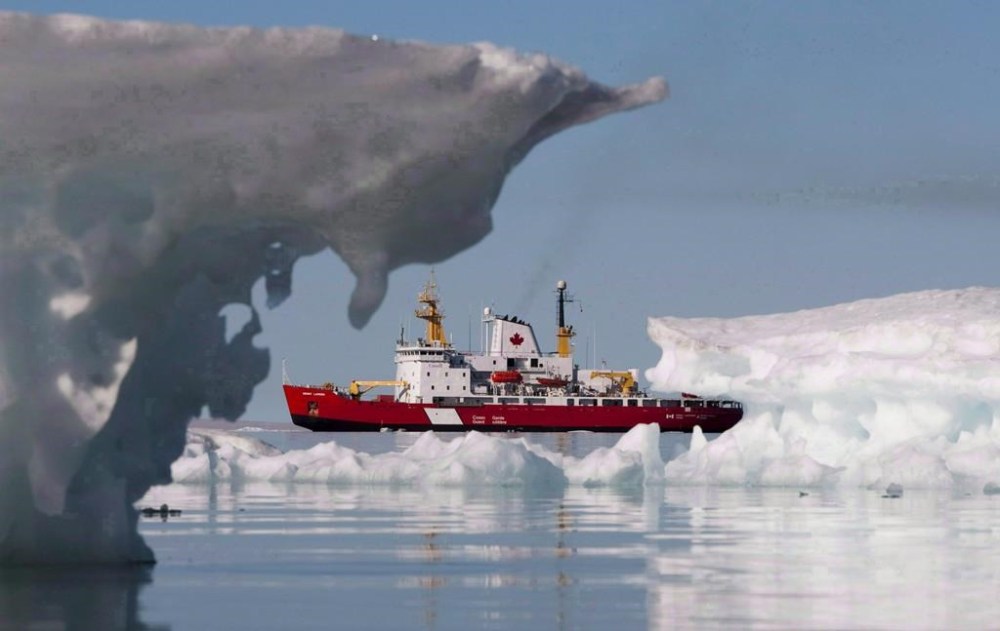
The Canadian Coast guard's medium icebreaker Henry Larsen is seen in Allen Bay during Operation Nanook near Resolute, Nvt, Aug. 25, 2010. New research has moved up the time by which the Arctic Ocean is predicted to be free of summer ice. THE CANADIAN PRESS/Sean Kilpatrick

Gillett and his colleagues had noticed the growing differences between what climate models say should be happening to sea ice and what’s actually going on.

“The models, on average, underestimate sea ice decline compared with observations,” Gillett said.

They wanted to know how much they’d have to tweak the model to make it fit the data — and what those tweaks might reveal if they were projected into the future.

To do so, the scientists first teased out the effect of greenhouse gases from other factors that affect sea ice loss, such as artificial chemicals from aerosols or natural events such as volcanic eruptions. The impact of aerosols was found to be negligible and the study concluded that natural events contributed no more than 10 per cent of sea ice loss.

With greenhouse gases isolated as the main culprit, they then looked at how those emissions were used in their climate model. By “scaling up” the effect of greenhouse gases, the researchers achieved a much better fit with satellite images of ice cover.

That more accurate assessment of the influence of greenhouses turned out to come with a warning.

Previous estimates had suggested that Arctic summer sea ice wouldn’t disappear until the 2040s at the earliest. If humanity managed to bring its emissions down, year-round sea ice might even survive.

But once the model had been brought in line with what was happening on the water, predictions of summer ice disappearance got a lot closer.

“The range is then 2030 to 2050,” Gillett said. “And even under the lowest emission scenario, with the scaling the Arctic is ice-free.”

Nothing is certain, Gillett cautions. But this is close.

“I would say it’s extremely likely.”

That would mean that by the end of the melt season in September, the Arctic would have less than one million square kilometres of sea ice, even under low emissions. If emissions remain high, that ice-free period could last months.

The average ice extent for April 2023 was 14 million square kilometres.

As well, the study is the first to measure sea ice trends for every month of the year. Previous studies have focused on the summer months.

By comparing ice extent year-over-year — February 2019 against February 2018, for example — the data showed ice loss from climate change in every month of the year.

Pam Pearson of the International Cryosphere Climate Initiative, a network of policy experts and researchers, has seen the Nature study and said it’s strong evidence that greenhouse gases are changing the Arctic faster than previously thought.

“More ice is being lost, faster than even the most recent models predict,” she wrote in an email.

“Observations today outpace even high-end predictions. Global ice stores simply are more sensitive than we thought to slight changes in warming.”

Gillett said an ice-free Arctic would certainly hasten the warming of lands around the waters — already warming at three times the global average. The fragile ecosystem that depends on sea ice — home to everything from algae to polar bears — would change utterly.

And when it comes to climate, what happens in the Arctic may not stay in the Arctic.

“People have looked at the possible implications of Arctic warming on the climate at lower latitudes,” Gillett. “That’s still a topic of debate.”

This report by The Canadian Press was first published June 6, 2023.

— Follow Bob Weber on Twitter at @row1960
Report Error Submit a Tip

More Stories

Rail-traffic alert beacons, signs will give drivers chance to change routes, save time

Joyanne Pursaga 2 minute read Preview

Rail-traffic alert beacons, signs will give drivers chance to change routes, save time

Joyanne Pursaga 2 minute read Yesterday at 1:51 PM CDT

A new rail-crossing alert system will help Winnipeg drivers avoid train delays.

Roadside TRAINFO beacons and digital message boards will now flash at locations prior to select rail crossings. They will alert drivers to approaching trains, with adequate time to let them choose an alternate route and avoid the wait.

The flashing beacons are now located at the following high train-traffic spots:

Pandora Avenue at Day Street, Redonda Street and Ravenhurst Street, to note trains at the Ravenhurst rail crossing north of Dugald Road.East and west of the multiple rail crossings on Marion Avenue between Archibald Street and Lagimodiere Boulevard, to note trains along the corridor.At the intersection of McGillivray Boulevard and Waverley Street, to note trains crossing McGillivray at Pembina Highway.Digital message sign boards will also be placed on Sterling Lyon Boulevard and Kenaston Boulevard to note when trains are present at the McGillivray/Pembina crossing.

Read
Yesterday at 1:51 PM CDT

Letters, Aug. 22

7 minute read 2:01 AM CDT

Foster system must be better

Re: Paralyzed foster girl has system under a microscope (Aug. 18)

Families Minister Nahanni Fontaine’s assertion that “you can’t train people not to be violent” should concern everyone who cares about the safety of children in Manitoba’s child welfare system.

Of course, no training program can guarantee that an individual will never harm a child. But framing these tragedies as the actions of a few “abominable” people risks absolving the system of its responsibility to prevent harm.

Residents fear mailbox crime sprees

Morgan Modjeski 4 minute read Preview

Residents fear mailbox crime sprees

Morgan Modjeski 4 minute read 2:01 AM CDT

Some North End residents are concerned new community mailboxes will become a target for vandalism and crime after the base of one was recently lit ablaze — before it was even installed.

The community mailboxes started to show up on Andrews Street within the last two weeks. Some have been installed, while at other locations, only the concrete foundation is in place.

“They just dumped them on the boulevard,” said Stephen Giesbrecht, who lives beside one of the boxes in the St. John’s neighbourhood. “They dumped them on the corner and then they were gone.”

One of the concrete slabs has already played host to a fire and some of the hardware needed to install the mailbox melted.

Read
2:01 AM CDT

Don’t buy U.S. booze if, when it’s back on Liquor Mart shelves: Kinew

Chris Kitching 6 minute read Preview

Don’t buy U.S. booze if, when it’s back on Liquor Mart shelves: Kinew

Chris Kitching 6 minute read Updated: Yesterday at 10:25 AM CDT

Manitoba hasn’t agreed to put American liquor back on shelves despite Prime Minister Mark Carney’s request while his government finalizes a trade deal with the U.S. to avoid new tariffs.

Read
Updated: Yesterday at 10:25 AM CDT

Free Press literary editor picks noteworthy Canadian fiction and non-fiction titles to watch for this fall

Ben Sigurdson 8 minute read Preview

Free Press literary editor picks noteworthy Canadian fiction and non-fiction titles to watch for this fall

Ben Sigurdson 8 minute read 6:00 AM CDT

For many book lovers, summer means relaxing at the beach, in the backyard or at the cottage with fun, warm-weather page-turners — easy-going romance novels, gripping thrillers or even a dishy biography.

And some may long for the summer months to slow down, fall books season always offers up some of the most compelling reads for bookworms.

Here are 10 works of fiction and 10 non-fiction titles from Canadian authors slated to be published in the coming months — from Olympians to separatists, draft dodgers, plutocrats, prime ministers, bird-men and beyond, the characters in these forthcoming titles run the gamut.

FICTIONEliza Sunshine

Read
6:00 AM CDT

Provincial teacher watchdog releases names, details in three disciplinary matters

Maggie Macintosh 6 minute read Preview

Provincial teacher watchdog releases names, details in three disciplinary matters

Maggie Macintosh 6 minute read Updated: Yesterday at 11:19 AM CDT

An Interlake teacher with a history of “intimidating” outbursts has been ordered to participate in counselling and study anger-management strategies after he made a child cry.

Read
Updated: Yesterday at 11:19 AM CDT