What is a strike in baseball? Robots, rule book and umpires view it differently
Advertisement
Read this article for free:
or
Already have an account? Log in here »
To continue reading, please subscribe:

Digital Subscription
One year of digital access for only $205*
- Enjoy unlimited reading on winnipegfreepress.com
- Read the E-Edition, our digital replica newspaper
- Access News Break, our award-winning app
- Play interactive puzzles
*First annual payment billed as $205.00 + GST for one year. This annual subscription will automatically renew at $233.00 + GST every 52 weeks (10% off the regular annual price of $259.35). Offer available to new and qualified returning subscribers only. Cancel any time.
To continue reading, please subscribe:
Add Free Press access to your Brandon Sun subscription for only an additional
$1 for the first 4 weeks*
- Enjoy unlimited reading on winnipegfreepress.com
- Read the E-Edition, our digital replica newspaper
- Access News Break, our award-winning app
- Play interactive puzzles
*Your next Brandon Sun subscription payment will increase by $1.00 and you will be charged $17.95 plus GST for four weeks. After four weeks, your payment will increase to $24.95 plus GST every four weeks.
Read unlimited articles for free today:
or
Already have an account? Log in here »
Hey there, time traveller!
This article was published 10/07/2023 (1176 days ago), so information in it may no longer be current.
SEATTLE (AP) — The education of robot umpires has been complicated by an open secret in baseball for the past 150 years: The strike zone called on the field doesn’t match the one mapped out in the rule book.
Before the Automated Ball-Strike System is ready for the major leagues, there has to be agreement on what a strike is.
“You go in a rabbit hole where it might not be fair for some hitters,” Minnesota Twins star Carlos Correa said. “A pitcher has big curveballs that cross the zone and end up a ball, but the zone has it as a strike. I prefer the human element of things, but who knows, maybe they can perfect it at some point.”
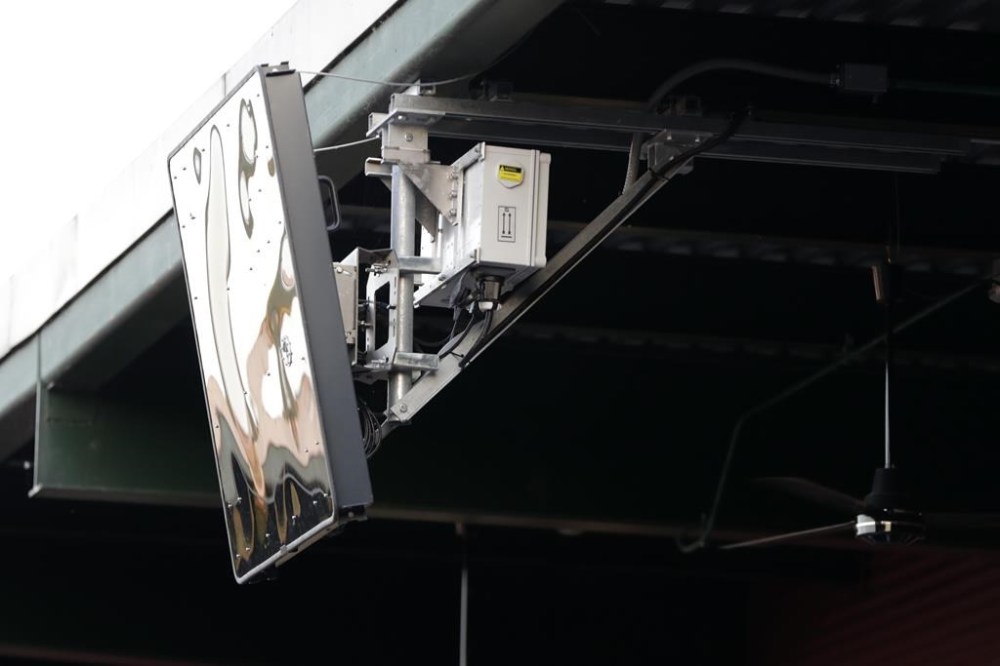
MLB started experimenting with robots calling balls and strikes in the independent Atlantic League in 2019 and used the computer at Low-A in 2021. A challenge system was tried last season at some minor league ballparks, in which a pitcher, batter or catcher had the right to appeal a human umpire’s decision to the computer. This year, ABS is being used at all Triple-A parks, the robot alone for the first three games of each series and a human with a challenge system in the final three.
The Official Baseball Rules define the strike zone as “that area over home plate the upper limit of which is a horizontal line at the midpoint between the top of the shoulders and the top of the uniform pants, and the lower level is a line at the hollow beneath the kneecap.”
In practice, big league umpires usually don’t call strikes on pitches that clip the bottom of the three-dimensional zone’s front or the top of the back, making the actual strike zone more of an oval than a cube.
“If you looked good at the average zone that’s called in the major leagues and has been called forever, it’s not a rectangle the way that the system calls it,” MLB executive vice president of operations Morgan Sword said.
At first, the robots were programmed to call a two-dimensional zone at the front of the plate, and MLB also experimented with a three-dimensional zone. This year, the ABS calls strikes solely based on where the ball crosses the midpoint of the plate, 8.5 inches from the front and the back.
MLB reduced the top of the zone to 51% of a batter’s height from 56%.
“The two-dimensional zone has minimized the number of pitches that feel wrong to people, particularly when it’s at the middle of the plate because you’re not catching quite as many of those breaking balls down and also those balls that clip the back of the plate,” Sword said. “We like the two-dimensional nature of it.
“It also allows whatever zone we use on the field to match the representations of the zone that we provide to fans and players and coaches and everybody else. But the specifics of what two-dimensional shape you use and what the dimensions of that shape are, I think are still in flux.”
MLB reduced the width of the computer strike zone from 19 inches to 17 this year, matching the width of the plate. Any part of the ball crossing that zone results in a strike.
“Last year in the Florida State League, the 19 inches, I was getting some calls I wasn’t even getting in the (Atlantic Coast Conference). It gets a little funky,” said Mike Vasil, a 23-year-old New York Mets pitching prospect who played at the University of Virginia.
According to MLB data, strikeouts at Triple-A dropped from 23.3% of batters with human umpires last year to 22.2% this year with automated umpires and 22% when humans were used with the challenge system. Walks climbed from 10.2% last year to 12.7% with robots and 11.5% with the challenge system.
Batting average rose from .252 last season to .266 in full ABS games and .273 in challenge games. Home runs runs increased from 2.9% to 3.2% in full ABS and 3.3% in challenge.
Each team gets three challenges, which can be made by a pitcher, batter or catcher. A team retains a successful challenge.
“I enjoyed it because it was consistent,” said Yankees center fielder Harrison Bader, who played five games at Triple-A this year. “ You want to know what the zone is at all times, even if it’s a little funkier, a little different.”
Texas manager Bruce Bochy, a veteran of nearly a half-century of pro ball, favors a three-dimensional zone.
“It has to cover all four quadrants,” he said. “You want that strike called if you’re hitting the inside lower box or quadrant or the top quadrant,” he said.
Rich Garcia, a major league umpire from 1975-99 and ump supervisor from 2002-09, faults the ABS system for not being as accurate at matching human calls as the strike zone usually is applied. And critically to umpires’ reputations, he says television graphics overlaying the strike zone frequently mislead fans.
“Could be one of the dumbest things baseball could do,” he said. “Why don’t they tell the fans that the box on the screen is not the same box that the umpires get graded on and that the box on the screen is supposed to be used for entertainment only?”
Using a two-dimensional zone rather than a rectangle could hurt sinkerball pitchers, such as the Yankees’ Clay Holmes.
“You’re shrinking the zone a little bit, the depth of it,” he said. “Maybe they need to redefine the strike zone.”
Mike Tauchman, a Chicago Cubs outfielder who played 24 games at Triple-A Iowa, said the robot umpires could cause unintended consequences. He recalled when ABS measured strikes at the front of the plate.
“I struck out on two pitches at my ankle, so I think it’s a good idea that they moved it back,” he said. “I don’t like the idea of the game becoming something where people are trying to outsmart a computer. I still like there is a human element of the umpire because there are nuances of the game that I don’t think a computer can fully understand.”
___
AP MLB: https://apnews.com/hub/MLB and https://twitter.com/AP_Sports
Related Articles
With player stylists and Gucci collabs, MLB eyes a fresh look with younger fans








Advertisement Advertise With Us
Advertisement Advertise With Us