
Scientists head to Nunavut island to help solve Mars methane mystery

Advertisement

Advertise with us

AXEL HEIBERG ISLAND, NUNAVUT - A team of researchers has travelled to a remote Arctic island in the hopes of better understanding the possibility of life on Mars.

Read this article for free:


or

Already have an account? Log in here »

To continue reading, please subscribe:

Subscribe and receive a limited-edition Free Press branded hat or tote.

Digital Subscription

One year of digital access for only $205*

  • Enjoy unlimited reading on winnipegfreepress.com
  • Read the E-Edition, our digital replica newspaper
  • Access News Break, our award-winning app
  • Play interactive puzzles

*First annual payment billed as $205.00 + GST for one year. This annual subscription will automatically renew at $233.00 + GST every 52 weeks (10% off the regular annual price of $259.35). Offer available to new and qualified returning subscribers only. Cancel any time.

To continue reading, please subscribe:

Add Free Press access to your Brandon Sun subscription for only an additional

$1 for the first 4 weeks*

  • Enjoy unlimited reading on winnipegfreepress.com
  • Read the E-Edition, our digital replica newspaper
  • Access News Break, our award-winning app
  • Play interactive puzzles
Start now

*Your next Brandon Sun subscription payment will increase by $1.00 and you will be charged $17.95 plus GST for four weeks. After four weeks, your payment will increase to $24.95 plus GST every four weeks.

Hey there, time traveller!
This article was published 18/07/2023 (1147 days ago), so information in it may no longer be current.

AXEL HEIBERG ISLAND, NUNAVUT – A team of researchers has travelled to a remote Arctic island in the hopes of better understanding the possibility of life on Mars.

Astrobiologist Haley Sapers, an adjunct professor at York University in the Lassonde School of Engineering, is leading the team at the McGill Arctic Research Station, or MARS, on Axel Heiberg Island. The uninhabited island is in Nunavut’s Qikiqtaaluk region and has conditions similar to the red planet.

Under the 24-hour midnight sun, they plan to study super-salty cold springs that release methane on Gypsum Hill, about a 45-minute hike from the research station. They also plan to take methane readings from the atmosphere and carry out a simulated Mars Rover mission.
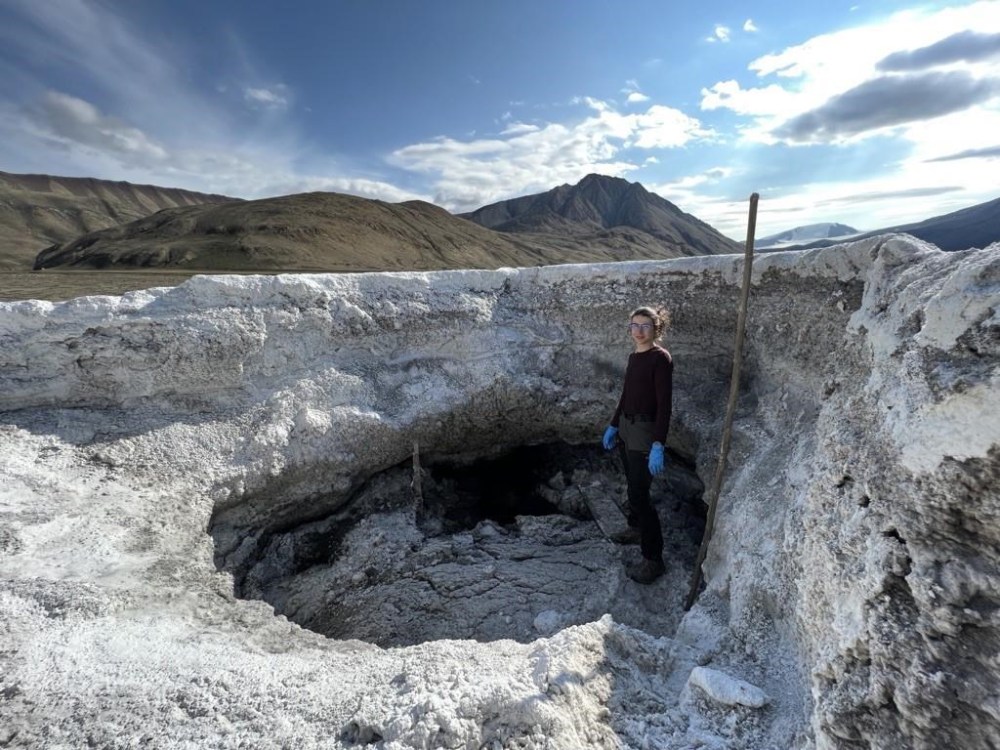
Astrobiologist Haley Sapers, an adjunct professor at York University in the Lassonde School of Engineering and visiting scientist with the California Institute of Technology, is pictured on Axel Heiberg Island in an undated handout photo. THE CANADIAN PRESS/HO-Haley Sapers, *MANDATORY CREDIT*

“Methane is a really important atmospheric gas here on Earth because it contributes significantly to global warming,” said Sapers, a visiting scientist with the California Institute of Technology. “It’s also a really interesting gas on Mars … And we don’t understand exactly where it’s coming from or where it’s disappearing to.”

On Earth, Sapers said, most methane is biogenic, meaning it’s produced by living organisms. The gas can also be produced by geological processes.

Its presence on Mars could be evidence of past or present life, or indicate areas on the planet that could be inhabited in the future.

Scientists first detected trace amounts of methane in the Mars atmosphere in 2003 and have continued to be perplexed by it.

Sapers said an instrument on the Curiousity rover has to take samples from the Martian atmosphere over several hours to enrich methane to where it can be analyzed. She said there aren’t many measurements of methane from the surface of Mars.

“We need a new type of instrument that doesn’t take as many resources that can take really fast, really sensitive measurements of methane,” she said.

On Axel Heiberg Island, the research team plans to test a new instrument developed with ABB Inc., a technology and engineering company based in Quebec, that aims to do just that.

Sapers said they also plan to complete detailed sampling of micro-organisms that have previously been detected by scientists from McGill University in the sediment of the island’s hyper-saline cold springs. She said they want to determine whether those micro-organisms oxidize methane, like those she has studied in deep ocean methane seeps.

“Understanding more about these micro-organisms up in the Arctic might help us understand the potential for micro-organisms to prevent significant amounts of methane from being released in the subsurface of the Arctic,” she said. “That would be really important, especially in the context of climate change and global warming.”

Sapers said the polar desert island is the ideal place to do this research as it is the only place on Earth where hyper-saline cold springs that are methane seeps are situated in permafrost — similar to subsurface conditions on Mars.

The planet and island also both have cold and dry conditions, she said, and polygonal terrain — a type of patterned ground that forms in permafrost regions on Earth by freezing and thawing.

“It is wonderful to be up here,” she said. “It is a very exciting place to do research.”

This report by The Canadian Press was first published July 18, 2023.

— By Emily Blake in Yellowknife

___

This story was produced with the financial assistance of the Meta and Canadian Press News Fellowship.


Report Error Submit a Tip

More Stories

Woman died while getting wisdom teeth out; case raises questions about transparency of dental association

Nicole Buffie 5 minute read Preview

Woman died while getting wisdom teeth out; case raises questions about transparency of dental association

Nicole Buffie 5 minute read Friday, Sep. 4, 2026

The parents of a 23-year-old southwestern Manitoba woman who died after receiving a local anesthetic during a wisdom tooth extraction say they are in the dark about the investigation into their daughter’s death.

Dulaney and Victoria Blatz say the Manitoba Dental Association has been unwilling to give them information about the probe into their daughter’s death, saying the self-governing regulatory body must be more transparent with the public.

“We have pushed through various channels trying to get information, but it’s nothing but stalling and sidelining,” Victoria said Friday. “This has crashed our world to pieces and we just want answers.”

Virginia Blatz went to Boundary Trails Dental Centre in Morden on Nov. 27, 2024, to have her wisdom teeth removed, but never returned home.

Read
Friday, Sep. 4, 2026

Puzzles Palace

1 minute read Monday, Jul. 27, 2026

To solve our puzzles, please subscribe with this special offer: |

U of M study shows female entrepreneurs have it tough on dating market

Jen Zoratti 6 minute read Preview

U of M study shows female entrepreneurs have it tough on dating market

Jen Zoratti 6 minute read 10:00 AM CDT

Xiumei Li had a friend who had been on the dating scene for a while.

He’d been seeing an impressive woman, a startup founder building a successful business. She was a good conversationalist. She was interesting.

She sounded great. So why didn’t it work out?

Some gentle prodding revealed he was intimidated by her, but also felt that “there was a gap between what he expected for a partner versus what this female entrepreneur had to offer,” Li says.

Read
10:00 AM CDT

Today’s horoscope

Georgia Nicols 4 minute read 2:00 AM CDT

MOON ALERT: Avoid shopping (except food and gas) and important decisions from 8 a.m. until noon today. After that, the moon moves from Cancer into Leo.

ARIES (March 21-April 19)

Hang in there, because as this day progresses, it becomes more lighthearted and fun-loving. Admittedly, power struggles with a friend or member of a group might squelch things. Be patient with kids. Basically, this is a friendly and productive day.

TAURUS (April 20-May 20)

News briefs for Sunday, September 6, 2026

1 minute read Updated: Yesterday at 2:41 PM CDT

A collection of breaking news briefs filed on Sunday, September 6, 2026

Man injured in downtown shooting

2:40 PM

A man in his 20s is in critical condition after he was shot in downtown Winnipeg early Sunday morning.

Researchers in Nunavut to explore Mars mystery

The Canadian Press 4 minute read Preview

Researchers in Nunavut to explore Mars mystery

The Canadian Press 4 minute read Tuesday, Jul. 18, 2023

AXEL HEIBERG ISLAND, NUNAVUT - A team of researchers has travelled to a remote Arctic island in the hopes of better understanding the possibility of life on Mars.

Astrobiologist Haley Sapers, an adjunct professor at York University in the Lassonde School of Engineering, is leading the team at the McGill Arctic Research Station, or MARS, on Axel Heiberg Island. The uninhabited island is in Nunavut's Qikiqtaaluk region and has conditions similar to the red planet.

Under the 24-hour midnight sun, they plan to study super-salty cold springs that release methane on Gypsum Hill, about a 45-minute hike from the research station. They also plan to take methane readings from the atmosphere and carry out a simulated Mars Rover mission.

"Methane is a really important atmospheric gas here on Earth because it contributes significantly to global warming," said Sapers, a visiting scientist with the California Institute of Technology. "It's also a really interesting gas on Mars … And we don't understand exactly where it's coming from or where it's disappearing to."

Read
Tuesday, Jul. 18, 2023