How you walk could shape the future of biometrics: experts

Advertisement

Advertise with us

Canadians have been unlocking iPhones with their fingerprint since 2013 and are sometimes exposed to facial recognition software before boarding planes, but when it comes to biometric technology, Erik Scheme and Mayssa Rekik are one step ahead.

Read this article for free:


By clicking the button above, an account will be created and you will begin to receive some of our recommended newsletters. You may opt out of any newsletter by visiting your Email and Communication Preferences page or by clicking "unsubscribe" at the bottom of any email.

or

Already have an account? Log in here »

To continue reading, please subscribe:

Digital Subscription

One year of digital access for only $1.44 a week*

  • Enjoy unlimited reading on winnipegfreepress.com
  • Read the E-Edition, our digital replica newspaper
  • Access News Break, our award-winning app
  • Play interactive puzzles

*Billed as $5.77 plus GST every four weeks. After 52 weeks, price increases to the regular rate of $19.95 plus GST every four weeks. Offer available to new and qualified returning subscribers only. Cancel any time.

To continue reading, please subscribe:

Add Free Press access to your Brandon Sun subscription for only an additional

$1 for the first 4 weeks*

  • Enjoy unlimited reading on winnipegfreepress.com
  • Read the E-Edition, our digital replica newspaper
  • Access News Break, our award-winning app
  • Play interactive puzzles
Start now

*Your next Brandon Sun subscription payment will increase by $1.00 and you will be charged $17.95 plus GST for four weeks. After four weeks, your payment will increase to $24.95 plus GST every four weeks.

Hey there, time traveller!
This article was published 06/08/2023 (1167 days ago), so information in it may no longer be current.

Canadians have been unlocking iPhones with their fingerprint since 2013 and are sometimes exposed to facial recognition software before boarding planes, but when it comes to biometric technology, Erik Scheme and Mayssa Rekik are one step ahead.

The associate director of the University of New Brunswick’s Institute of Biomedical Engineering and the advanced technologies undergraduate student are part of a team researching what could be the future of biometric security: footsteps.

They installed electronic tiles from P.E.I.’s Stepscan Technologies at their university lab and in the lobby of Fredericton’s Cyber Centre to generate a pixel-by-pixel heat map of the pressure distribution of someone’s feet as they walk.
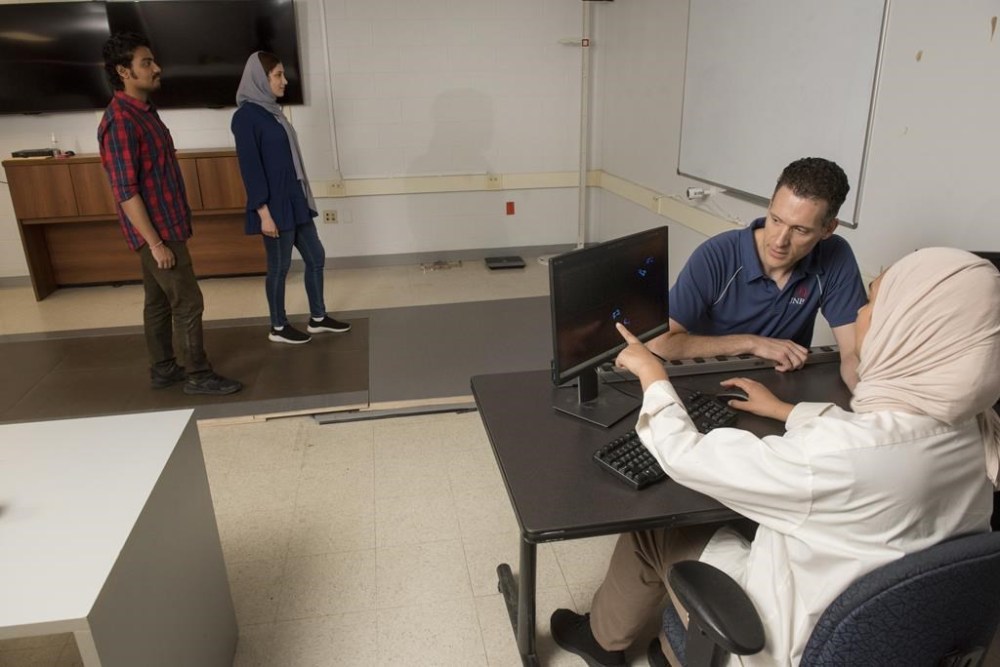
University of New Brunswick professor Erik Scheme, second from right, is shown in his lab at UNB where they use pressure-sensitive floor tiles to analyze people's gait in Fredericton, New Brunswick on Friday August 4, 2023. Here Scheme and Mayssa Rekik, Mitacs Globalink Intern from Tunisia, right, analyze the footsteps of Arijit Samal, Mitacs Globalink Intern from India, left, and Ala Salehi, graduate student.  THE CANADIAN PRESS/Stephen MacGillivray
University of New Brunswick professor Erik Scheme, second from right, is shown in his lab at UNB where they use pressure-sensitive floor tiles to analyze people's gait in Fredericton, New Brunswick on Friday August 4, 2023. Here Scheme and Mayssa Rekik, Mitacs Globalink Intern from Tunisia, right, analyze the footsteps of Arijit Samal, Mitacs Globalink Intern from India, left, and Ala Salehi, graduate student. THE CANADIAN PRESS/Stephen MacGillivray

The heel-to-toe data they are capturing will help develop 3D models of the people walking across the tiles and deep learning frameworks that can differentiate one person’s walk from another to identify individuals based on gait.

“Whether that’s different footwear or carrying different objects or walking in a distracted way, we’re trying to build the world’s largest data set to make publicly available to the research community, so that we can move this discipline forward,” Scheme said.

Interest in biometric technology, which relies on unique physical characteristics like a person’s gait, retina, face, heartbeat or voice, is growing in part because most businesses rely on keys, cards, pin codes or personnel to broker access to their spaces or systems.

The methods often leave people rummaging through bags for keys and cards, trying to recall passwords or seeking help from system administrators or security guards, when they’re without their means of entry.

Some businesses have tried to do away with these methods by turning to fingerprint and facial scanners, but neither is completely failproof.

Lighting conditions, masks and other accessories can challenge facial scanners, while glove wearers and people wanting to avoid touching additional surfaces in a COVID-19 conscious world pose difficulties for fingerprint-based systems.

“Gait creates an interesting opportunity because, not only is it contactless, you don’t even have to stop, you just kind of keep walking and we can authenticate you that way,” Scheme said.

“It’s a new modality.”

Rekik, who has come to Canada from Tunisia for three months to help work on the gait project with the help of research non-profit Mitacs, sees several obvious uses for the technology.

“It would be really helpful for security reasons and it can be used for airports or for entrance to a building,” she said.

While banks were once among the most interested sectors in the technology because of the large volumes of sensitive data they handle, enthusiasm around biometric systems has broadly tempered recently, said Imran Ahmad.

The head of technology at law firm Norton Rose Fulbright attributed the pullback to a wave of U.S. litigation and controversies around the use of biometrics.

San Francisco and Oakland, Calif. along with Somerville, Mass. banned the use of facial recognition technology by city agencies in 2019. Many of the bans were sparked by troubles the technology faced in recognizing women and racialized populations.

Ahmad has also seen Illinois, Texas and Washington, where he’s found most class actions around biometrics are happening, regulate the collection and use of such data.

“Right now, it’s sort of a wait-and-see model, like where is this going to go in Canada?” he said.

Concerns around biometrics are part of why Scheme’s team has adopted a careful approach to its research.

Cyber Centre employees who step on the tiles had to first give individual consent to be part of the research as did a second group who visit the lab for more specialized testing, where their data is collected as they walk barefoot, in specific shoes or while carrying a backpack or briefcase.

In both scenarios, all data is de-identified, which means it is stripped of personal information and used as part of a larger anonymous repository.

The hope is for the research to form the basis of future biometric innovations by helping determine how unique our gait is and whether technology can detect changes to it when we face impediments or even cycle through footwear.

“Certainly, if you fall and break your leg, it’s probably going to have an issue in the same way that if you we’re using a fingerprint system and you cut your thumb, they no longer work either,” Scheme said.

He believes machine learning models will eventually learn which of our gait’s characteristics won’t change even when someone is all of a sudden walking with a limp, slowing their pace or even ditching their heels for running shoes midday.

But before gait-based biometrics can make their way into offices or other areas requiring secure access, companies must consider laws and other regulations.

Canada’s privacy commissioner, for example, has developed guidelines requiring anyone collecting sensitive information, including biometric data, to acquire express and meaningful consent first, Ahmad said.

In Quebec, anyone creating a database of biometric characteristics or measurements must disclose its existence to the province’s access to information commission at least 60 days before it is brought into service.

Ahmad suspects even more regulations are on their way. Though they’ll give some further pause, he doesn’t think they will be a death knell for the technology.

“Biometrics are here to stay,” he said.

“It’s not something we’re just going to turn our backs to … it will be part of our lives.”

This report by The Canadian Press was first published Aug. 6, 2023.
Report Error Submit a Tip

More Stories

The future of biometrics could lie with your walk

Tara Deschamps, The Canadian Press 5 minute read Preview

The future of biometrics could lie with your walk

Tara Deschamps, The Canadian Press 5 minute read Sunday, Aug. 6, 2023

Canadians have been unlocking iPhones with their fingerprint since 2013 and are sometimes exposed to facial recognition software before boarding planes, but when it comes to biometric technology, Erik Scheme and Mayssa Rekik are one step ahead.

The associate director of the University of New Brunswick's Institute of Biomedical Engineering and the advanced technologies undergraduate student are part of a team researching what could be the future of biometric security: footsteps.

They installed electronic tiles from P.E.I.'s Stepscan Technologies at their university lab and in the lobby of Fredericton's Cyber Centre to generate a pixel-by-pixel heat map of the pressure distribution of someone’s feet as they walk.

The heel-to-toe data they are capturing will help develop 3D models of the people walking across the tiles and deep learning frameworks that can differentiate one person's walk from another to identify individuals based on gait.

Read
Sunday, Aug. 6, 2023

Serial arsonist gets more jail time, community ban

Tessa Adamski 4 minute read Preview

Serial arsonist gets more jail time, community ban

Tessa Adamski 4 minute read Yesterday at 2:01 AM CDT

A serial arsonist who believes controlled burning is his “calling” was sentenced to nine months in jail and barred for two years from a southwestern Manitoba community after he deliberately set multiple grass fires during a fire ban in May.

Read
Yesterday at 2:01 AM CDT

Mayoral candidates’ promises worthless without price tags, payment plans

Tom Brodbeck 5 minute read Preview

Mayoral candidates’ promises worthless without price tags, payment plans

Tom Brodbeck 5 minute read 1:57 PM CDT

Winnipeg’s mayoral candidates have plenty to say about what they want to do for the city. But there’s one question they haven’t answered very clearly: how much are they prepared to raise property taxes to pay for it?

It’s an important question, because almost everything candidates are promising — more police officers, better transit, safer buses, improved roads, expanded library hours and better-maintained infrastructure — costs money. And in a city with limited revenue sources and growing expenses, that money has to come from somewhere.

City hall can’t even pay for what it does now with existing revenues — it has been drawing down reserve accounts in recent years just to balance the books.

So far voters haven’t heard much — if anything — from candidates about what they would do with property taxes. Would they raise them every year? By how much? Would they freeze them? Cut them?

Read
1:57 PM CDT

Possibility of Hellebuyck’s return grows each day as pay slips away

Mike McIntyre 7 minute read Preview

Possibility of Hellebuyck’s return grows each day as pay slips away

Mike McIntyre 7 minute read Wednesday, Oct. 14, 2026

CHICAGO — Buckle up, folks. The next plot twist in the ongoing soap opera between the Winnipeg Jets and Connor Hellebuyck could be a doozy.

Let’s start with a few cold, hard facts. Or, if you prefer: “Previously on As the Hellebuyck Turns…”

The franchise goaltender, with five years remaining on a contract extension he willingly signed with Winnipeg in 2023, refused to report to training camp last month as he awaits word on a trade request made at the end of last season. He’s the first NHL player in more than a quarter century to essentially go on strike.

The Jets are under no obligation to move Hellebuyck, but have indicated they would try to accommodate him if another team meets their needs. General manager Kevin Cheveldayoff has made it clear he needs to “get this right” and wants a haul for a three-time Vezina Trophy winner and one-time Hart Trophy recipient.

Read
Wednesday, Oct. 14, 2026

Disgraced ex-dean landed job at German university after fleeing Winnipeg

Maggie Macintosh 8 minute read Preview

Disgraced ex-dean landed job at German university after fleeing Winnipeg

Maggie Macintosh 8 minute read 3:07 PM CDT

Before he was arrested in a posh Paris suburb, the disgraced dean of Manitoba’s only law school — who fled the country following a 2020 expense scandal — kept a low profile at a German university.

Jonathan Black-Branch, 64, was apprehended on April 21 in Neuilly-sur-Seine. He owes the University of Manitoba more than $700,000 and faces extradition to Canada to be prosecuted for fraud.

The former dean of the faculty of law at U of M appeared in the Versailles Court of Appeal Friday opposing his extradition. The court reserved its decision to Nov. 6.

Black-Branch evaded Canadian authorities for years while he taught finance and other subjects at the International University of Applied Sciences in Germany, the Free Press has learned.

Read
3:07 PM CDT

Manitoba Hydro to replace dozens of electrical substations over 20 years

Chris Kitching 5 minute read Preview

Manitoba Hydro to replace dozens of electrical substations over 20 years

Chris Kitching 5 minute read Updated: 4:33 PM CDT

Manitoba Hydro is promising fewer power outages in Winnipeg once it replaces or converts 41 electrical substations in a project the utility says will last up to 20 years and cost as much as $1.2 billion.

Spokesman Peter Chura said upgrades to the electrical distribution system will improve safety, reliability and resiliency, and reduce maintenance costs.

“We’ve been clear for a few years now that aging infrastructure is a challenge for the province going forward, so our programs like this are solving that problem incrementally,” he said Friday.

Many substations in Winnipeg are nearing the end of their service life or operating close to capacity. The upgrades will increase capacity, said Craig Sambrooke, Hydro’s construction community liaison.

Read
Updated: 4:33 PM CDT