San Francisco launches driverless bus service following robotaxi expansion

Advertisement

Advertise with us

SAN FRANCISCO (AP) — First came the robotaxis. Then the driverless buses arrived.

Read this article for free:


or

Already have an account? Log in here »

To continue reading, please subscribe:

Subscribe and receive a limited-edition Free Press branded hat or tote.

Digital Subscription

One year of digital access for only $205*

  • Enjoy unlimited reading on winnipegfreepress.com
  • Read the E-Edition, our digital replica newspaper
  • Access News Break, our award-winning app
  • Play interactive puzzles

*First annual payment billed as $205.00 + GST for one year. This annual subscription will automatically renew at $233.00 + GST every 52 weeks (10% off the regular annual price of $259.35). Offer available to new and qualified returning subscribers only. Cancel any time.

To continue reading, please subscribe:

Add Free Press access to your Brandon Sun subscription for only an additional

$1 for the first 4 weeks*

  • Enjoy unlimited reading on winnipegfreepress.com
  • Read the E-Edition, our digital replica newspaper
  • Access News Break, our award-winning app
  • Play interactive puzzles
Start now

*Your next Brandon Sun subscription payment will increase by $1.00 and you will be charged $17.95 plus GST for four weeks. After four weeks, your payment will increase to $24.95 plus GST every four weeks.

Hey there, time traveller!
This article was published 18/08/2023 (1118 days ago), so information in it may no longer be current.

SAN FRANCISCO (AP) — First came the robotaxis. Then the driverless buses arrived.

San Francisco has launched an autonomous shuttle service — less than a week after California regulators approved the expansion of robotaxis despite traffic and safety concerns.

The free shuttle will run daily in a fixed route called the Loop around Treasure Island, the site of a former U.S. Navy base in the middle of San Francisco Bay. The Loop makes seven stops, connecting residential neighborhoods with stores and community centers. About 2,000 people live on the island.
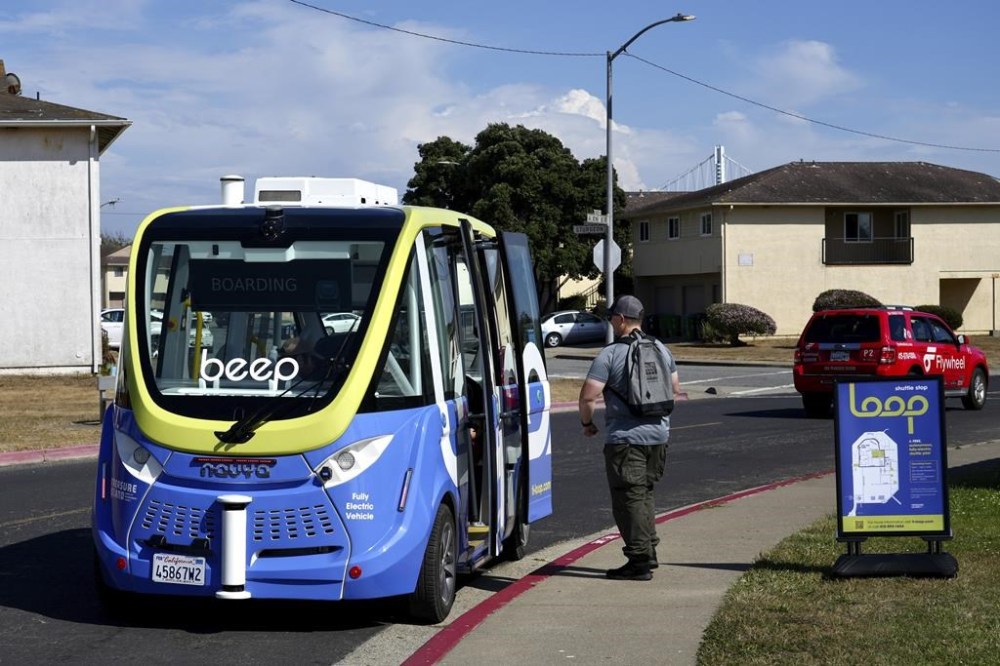
A driverless shuttle stops for a passenger on San Francisco's Treasure Island as part of a pilot program to assess the safety and effectiveness of autonomous vehicles for public transit on Aug. 16, 2023. The free bus service was launched less than a week after California regulators approved the controversial expansion of robotaxis on city streets. (AP Photo/Terry Chea)

The all-electric vehicle, which doesn’t have a driver’s seat or steering wheel, is staffed with an attendant who can drive the bus with a handheld controller if necessary. The county is offering the shuttle service as part of a grant-funded pilot program to assess how autonomous vehicles can supplement the public transit system.

“Having the attendant on board makes everyone feel comfortable,” said Tilly Chang, executive director of the San Francisco County Transportation Authority. “This is just a demonstration for now to see, what does it look like and how does it work to have a driverless shuttle in a low-volume, low-speed environment?”

San Francisco is one of a growing number of cities worldwide that are testing the safety and potential of self-driving vehicles to transform public transportation.

The shuttles are operated by Beep, an Orlando, Florida-based company that has run similar pilot programs in more than a dozen U.S. communities, including service at the Miami Zoo, Mayo Clinic and Yellowstone National Park.

“These shuttles are built for first-mile, last-mile, short connectivity routes. They’re not intended to take the place of a bus system,” said Beep project manager Shelley Caran. “The autonomous vehicle will have a better reaction time than a human and it will offer a more reliable service because they won’t be distracted.”

During a test ride Wednesday, the shuttle drove slowly and cautiously in autonomous mode. An attendant manually steered the vehicle around a utility truck that blocked part of the road.

“I didn’t feel unsafe,” said Dominic Lucchesi, an Oakland resident who was among the first to ride the autonomous shuttle. “I thought that it made some abrupt stops, but otherwise I felt like I was riding any other bus for the most part.”

The boxy shuttle, which can sit up to 10 passengers, will operate 9 a.m. to 6 p.m. every day and circle the Loop every 20 minutes. The city has two shuttles — one can charge while the other ferries passengers.

The autonomous shuttle pilot project was launched after the California Public Utilities Commission voted to allow two rival robotaxi companies, Cruise and Waymo, to offer around-the-clock passenger service in San Francisco.
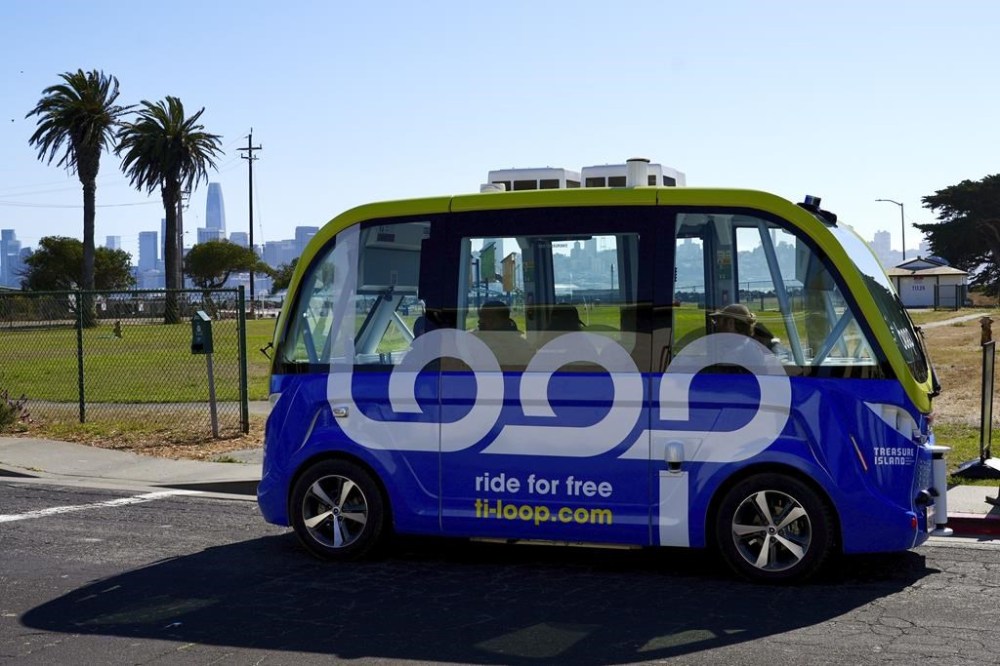
A driverless shuttle transports passengers on San Francisco's Treasure Island as part of a pilot program to assess the safety and effectiveness of autonomous vehicles for public transit on Aug. 16, 2023. The free bus service was launched less than a week after California regulators approved the controversial expansion of robotaxis on city streets. (AP Photo/Terry Chea)

The approval came despite widespread complaints that the driverless taxis make unexpected stops, cause traffic backups and block emergency vehicles. On Wednesday, the city asked the commission to pause the robotaxi expansion.

Cruise, a subsidiary of General Motors, reported on social media that one of its robotaxis crashed into a city fire truck Thursday night, sending one passenger to the hospital.

Experts don’t anticipate the same problems with driverless buses because they’re expected to be staffed with drivers or attendants for the foreseeable future.

“Trained operators are going to be required even as we increase automation,” said Nikolas Martelaro, autonomous-vehicle researcher at Carnegie Mellon University. “So the question there may not be how worried should someone be about losing their job versus what should they be thinking about the potential training that’s required.”

Autonomous driving technology could make buses safer, but requiring drivers or attendants on-board could undermine one of their perceived advantages: reduced labor costs.

“We still have to find a market for them,” said Art Guzzetti, vice president at the American Public Transportation Association. “We’re doing it to make the trip better, more efficient, not to take the worker’s job.”
Report Error Submit a Tip

More Stories

Puzzles Palace

1 minute read Monday, Jul. 27, 2026

To solve our puzzles, please subscribe with this special offer: |

All that glitters … could work here

Editorial 4 minute read Preview

All that glitters … could work here

Editorial 4 minute read Yesterday at 2:00 AM CDT

Sometimes, it’s hard to even suggest a change, because it seems there is always a plethora of people ready to tell you that your idea just won’t work.

Read
Yesterday at 2:00 AM CDT

Vita Health Fresh Market nears 90th anniversary in Winnipeg with new St. Vital Square location

Aaron Epp 5 minute read Preview

Vita Health Fresh Market nears 90th anniversary in Winnipeg with new St. Vital Square location

Aaron Epp 5 minute read Yesterday at 7:09 PM CDT

Yogurt, avocados, organic eggs and kefir — when Manja Nyland wants to purchase her favourite items, she visits Vita Health Fresh Market.

“They have healthy food,” she said of the Winnipeg retail chain, which sells wellness products and organic groceries.

Vita Health launched a grand opening celebration on Tuesday for its new store in southeast Winnipeg. Nyland was one of the customers who stopped in.

Located in St. Vital Square at 2-785 Dakota St., the new store replaces a smaller space Vita Health occupied in the same shopping centre for 19 years. At 4,700 square feet, the new store is approximately 60 per cent larger than its predecessor.

Read
Yesterday at 7:09 PM CDT

Parts of River Heights hammered by storm

Melissa Martin 5 minute read Preview

Parts of River Heights hammered by storm

Melissa Martin 5 minute read Monday, Sep. 7, 2026

A powerful storm cut a swath of destruction through River Heights on Sunday, leaving much of the area without power.

Nobody was hurt in the storm.

By the time it subsided, parts of the quiet neighbourhood, especially Borebank and Lindsay streets between Grant and Taylor, had been ravaged: power lines downed, Manitoba Hydro poles toppled, trees splintered and crashed down on vehicles and homes.

In one case, a vehicle was flipped into a yard and sat under a partially downed tree. Shingles were stripped from roofs. Some residents described looking out during the storm and seeing power lines ablaze and the blue glow of electricity arcing over their backyards.

Read
Monday, Sep. 7, 2026

St. Charles golfer takes opening round lead at national senior men’s championship

Joshua Frey-Sam 7 minute read Preview

St. Charles golfer takes opening round lead at national senior men’s championship

Joshua Frey-Sam 7 minute read Yesterday at 7:59 PM CDT

David White didn’t set any expectations entering this week.

The St. Charles golfer knew he had the game to keep up with a talented field across four days, but wouldn’t go so far as to say he’d be in the hunt for a title.

So the 59-year-old walked away in great spirits after an opening round three-under 69 has him leading the Canadian senior men’s championship at Niakwa on Tuesday.

It was a terrific display of resilience in blustery conditions for White, who was one shot clear of Scotland’s Ronnie Clark, the only other player to reach red figures.

Read
Yesterday at 7:59 PM CDT

Winkler-based internet provider delivering high-speed service to 30 rural and First Nations Manitoba communities

Nicole Buffie 3 minute read Preview

Winkler-based internet provider delivering high-speed service to 30 rural and First Nations Manitoba communities

Nicole Buffie 3 minute read Yesterday at 7:12 PM CDT

Valley Fiber says it is undertaking one of its largest fibre optic projects and is building infrastructure that will deliver internet to 10,000 homes and businesses in rural and First Nations communities across Manitoba.

“These communities will now have access to the fastest internet network in Manitoba, and it will power their lives and their business,” Ryan Klassen, chief executive officer of the Winkler-based internet provider, said Tuesday from Fisher River Cree Nation.

The province has granted Valley Fiber use of two of its underused cables on the existing Manitoba Hydro fibre optic network for up to 20 years as part of the project, which will connect nearly 30 communities — including Buffalo Point, Hollow Water, Black River and Peguis First Nations, along with Fisher River and Fox Lake Cree Nations — to high-speed internet.

Construction should be finished by 2027.

Read
Yesterday at 7:12 PM CDT