Climate change made worst Quebec fire weather twice as likely, more intense: study
Advertisement
Read this article for free:
or
Already have an account? Log in here »
To continue reading, please subscribe:
Digital Subscription
One year of digital access for only $1.44 a week*
- Enjoy unlimited reading on winnipegfreepress.com
- Read the E-Edition, our digital replica newspaper
- Access News Break, our award-winning app
- Play interactive puzzles
*Billed as $5.77 plus GST every four weeks. After 52 weeks, price increases to the regular rate of $19.95 plus GST every four weeks. Offer available to new and qualified returning subscribers only. Cancel any time.
To continue reading, please subscribe:
Add Free Press access to your Brandon Sun subscription for only an additional
$1 for the first 4 weeks*
- Enjoy unlimited reading on winnipegfreepress.com
- Read the E-Edition, our digital replica newspaper
- Access News Break, our award-winning app
- Play interactive puzzles
*Your next Brandon Sun subscription payment will increase by $1.00 and you will be charged $17.95 plus GST for four weeks. After four weeks, your payment will increase to $24.95 plus GST every four weeks.
Read unlimited articles for free today:
or
Already have an account? Log in here »
Hey there, time traveller!
This article was published 22/08/2023 (1158 days ago), so information in it may no longer be current.
Climate change has made summers like the kind that led to Quebec’s disastrous wildfire season at least seven times more likely to happen again, says a new scientific analysis.
The study by the U.K.-based World Weather Attribution group, released Tuesday, says greenhouse gas emissions made the province’s overall fire weather about 50 per cent more conducive to fire between May and June. The very worst days were twice as likely to happen and were about 20 per cent worse than they would have been without current levels of carbon in the air.
The finding should alert governments to the need to reduce emissions and prepare for what’s ahead, said one researcher.
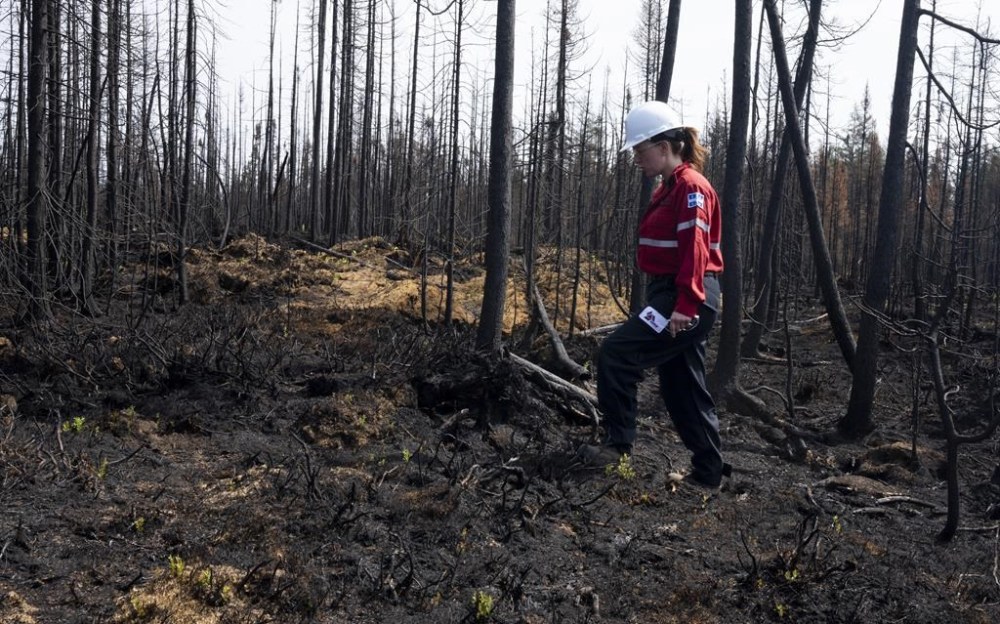
“Fire weather risk is increasing due to climate change,” said Dorothy Heinrich, one of the report’s 17 co-authors. “Adaptation strategies are going to be required to reduce the drivers of risk and decrease their impacts.”
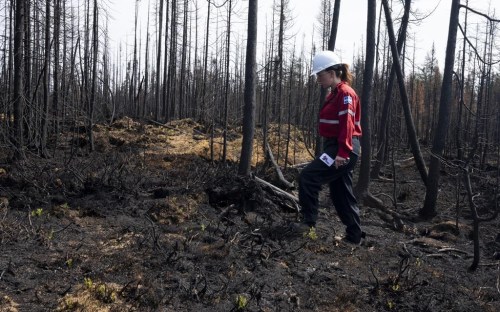
Wildfires have occurred in almost every province and territory this summer and have burned more than 137,000 square kilometres — about twice the previous record set in 1995.
Some of the biggest fires happened in Quebec earlier in the season.
By Aug. 16, the province had lost 53,000 square kilometres of forest, including 12,000 square kilometres in a single blaze. Smoke from the fires spread to give Toronto some of the worst air quality in the world and cancelled major league baseball games in New York.
Increased wildfires have long been forecast by climate scientists and, about 20 years ago, scientists began looking for ways to measure the contribution of climate change to individual extreme weather-driven events.
Since then, hundreds of attribution papers have been peer-reviewed and published.
Canada has established its own attribution office. Governments, including the United Kingdom, Australia, the Netherlands, South Korea, Japan and the United States are using attribution science.
Attribution science works by comparing climate models. One set of models uses data drawn from actual records while another, otherwise identical, is constructed with the influence of greenhouse gases removed.
Simulations are be run using those two sets and the difference in the results reveals the effects of climate change. It allows scientists to say to what extent the presence of greenhouse gases increased the likelihood of the event in question.
That’s what the group did for the Quebec fires, using five different climate models.
The study broke down indicators forest experts use to measure wildfire risk. Those include weather-related measures such as temperature, humidity, wind and precipitation, as well as specialized indices such as fuel moisture and buildup.
Almost all of those measures were pointing to extreme fire hazard, the report says. Canada had the warmest June on record, for example, following a winter that left the second-least snow meltwater since 1950.
“All components of the fire-weather index, when averaged at the national scale, set record values and sometimes by huge margins,” says the report.
The hand of climate change was clearly visible in the resulting analysis, the scientists said.
Yan Boulanger, co-author and scientist for the Canadian Forest Service, said it’s irrelevant to ask whether the fires were started by fire, accident or arson.
“It takes very dry, very warm or windy conditions to have very, very big fires as we did this year regardless of source (of ignition),” he said. “It is because of weather conditions that those fires spread and it’s not a case of ignition sources.”
The authors warned the report’s conclusions are conservative.
“We are reporting what we consider conservative lower bounds,” said co-author Clair Barnes.
Federal Environment Minister Steven Guilbeault said the report’s findings show that Canadian jurisdictions need to come together to find solutions on emissions reduction and adaptation.
“(The federal government) can’t do everything,” he said. “Ensuring there is across-the-board co-operation will be key.”
He called the findings a warning.

“The climate impacts we’re seeing now are the result of one degree of increasing temperatures. Do people really want to see what a two-degree world looks like?
“If there’s one thing climate change won’t solve, it’s stupidity.”
The report suggests that future fiery summers are likely as the climate continues to warm. It points to previous research that looked at earlier periods of the Earth’s history to conclude that every degree of warming triples the size of wildfires in Northern Canada.
“The challenges posed by this year’s wildfires as well as the projected increases in wildfire weather risk raise important adaptation questions,” the report says.
This report by The Canadian Press was first published Aug. 22, 2023.