FBI and European partners seize major malware network in blow to global cybercrime
Advertisement
Read this article for free:
or
Already have an account? Log in here »
To continue reading, please subscribe:
Digital Subscription
One year of digital access for only $1.44 a week*
- Enjoy unlimited reading on winnipegfreepress.com
- Read the E-Edition, our digital replica newspaper
- Access News Break, our award-winning app
- Play interactive puzzles
*Billed as $5.77 plus GST every four weeks. After 52 weeks, price increases to the regular rate of $19.95 plus GST every four weeks. Offer available to new and qualified returning subscribers only. Cancel any time.
To continue reading, please subscribe:
Add Free Press access to your Brandon Sun subscription for only an additional
$1 for the first 4 weeks*
- Enjoy unlimited reading on winnipegfreepress.com
- Read the E-Edition, our digital replica newspaper
- Access News Break, our award-winning app
- Play interactive puzzles
*Your next Brandon Sun subscription payment will increase by $1.00 and you will be charged $17.95 plus GST for four weeks. After four weeks, your payment will increase to $24.95 plus GST every four weeks.
Read unlimited articles for free today:
or
Already have an account? Log in here »
Hey there, time traveller!
This article was published 29/08/2023 (1145 days ago), so information in it may no longer be current.
LOS ANGELES (AP) — U.S. officials said Tuesday that the FBI and its European partners infiltrated and seized control of a major global malware network used for more than 15 years to commit a gamut of online crimes including crippling ransomware attacks.
They then remotely removed the malicious software agent — known as Qakbot — from thousands of infected computers.
Cybersecurity experts said they were impressed by the deft dismantling of the network but cautioned that any setback to cybercrime would likely be temporary.

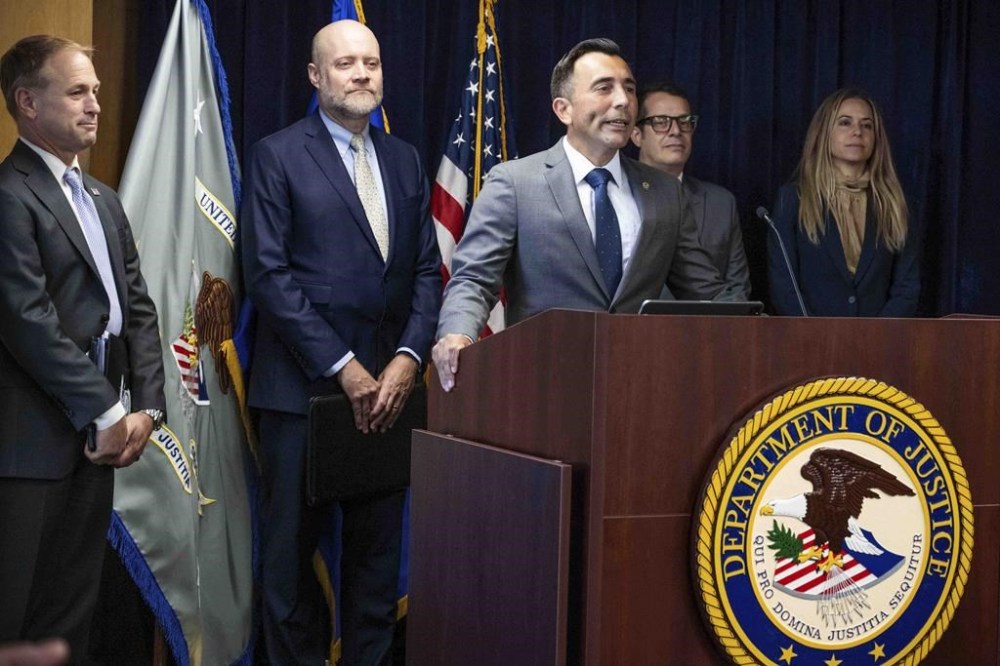
“Nearly ever sector of the economy has been victimized by Qakbot,” Martin Estrada, the U.S. attorney in Los Angeles, said Tuesday in announcing the takedown. He said the criminal network had facilitated about 40 ransomware attacks alone over 18 months that investigators said netted Qakbot administrators about $58 million.
Qakbot’s ransomware victims included an Illinois-based engineering firm, financial services organizations in Alabama and Kansas, along with a Maryland defense manufacturer and a Southern California food distribution company, Estrada said.
Officials said $8.6 million in cybercurrency was seized or frozen but no arrests were announced.
Estrada said the investigation is ongoing. He would not say where administrators of the malware, which marshaled infected machines into a botnet of zombie computers, were located. Cybersecurity researchers say they are believed to be in Russia and/or other former Soviet states.
Officials estimated the so-called malware loader, a digital Swiss knife for cybercrooks also known as Pinkslipbot and Qbot, was leveraged to cause hundreds of millions of dollars in damage since first appearing in 2008 as an information-stealing bank trojan. They said millions of people in nearly every country in the world have been affected.
Typically delivered via phishing email infections, Qakbot gave criminal hackers initial access to violated computers. They could then deploy additional payloads including ransomware, steal sensitive information or gather intelligence on victims to facilitate financial fraud and crimes such as tech support and romance scams.
The Qakbot network was “literally feeding the global cybercrime supply chain,” said Donald Alway, assistant director in charge of the FBI’s Los Angeles office, calling it “one of the most devastating cybercriminal tools in history.” The most commonly detected malware in the first half of 2023, Qakbot impacted one in 10 corporate networks and accounted for about 30% of attacks globally, a pair of cybersecurity firms found. Such “initial access” tools allow extortionist ransomware gangs to skip the initial step of penetrating computer networks, making them major facilitators for the far-flung, mostly Russian-speaking criminals who have wreaked havoc by stealing data and disrupting schools, hospitals, local governments and businesses worldwide.
Beginning Friday in an operation officials dubbed “Duck Hunt,” the FBI along with Europol and law enforcement and justice partners in France, the United Kingdom, Germany, the Netherlands, Romania and Latvia seized more than 50 Qakbot servers and identified more than 700,000 infected computers, more than 200,000 of them in the U.S. — effectively cutting off criminals from their quarry.
The FBI then used the seized Qakbot infrastructure to remotely dispatch updates that deleted the malware from thousands of infected computers. A senior FBI official, briefing reporters on condition he not be further identified, called that number “fluid” and cautioned that other malware may have remained on machines liberated from Qakbot.
It was the FBI’s biggest success against cybercrooks since it “hacked the hackers” with the January takedown of the prolific Hive ransomware gang.

“It is an impressive takedown. Qakbot was the largest botnet” in number of victims, said Alex Holden, founder of Milwaukee-based Hold Security. But he said it may have been a casualty of its own success in its staggering growth over the past few years. “Large botnets today tend to implode as too many threat actors are mining this data for various types of abuse.”
Cybersecurity expert Chester Wisniewski at Sophos agreed that while there could be a temporary drop in ransomware attacks, the criminals can be expected to either revive infrastructure elsewhere or move to other botnets.
“This will cause a lot of disruption to some gangs in the short term, but it will do nothing from it being rebooted,” he said. “Albeit it takes a long time to recruit 700,000 PCs.”
___
Bajak reported from Boston.