What makes Idalia so potent? It’s feeding on intensely warm water that acts like rocket fuel

Advertisement

Advertise with us

Feeding on some of the hottest water on the planet, Hurricane Idalia is rapidly strengthening as it bears down on Florida and the rest of the Gulf Coast. It’s been happening a lot lately.

Read this article for free:


or

Already have an account? Log in here »

To continue reading, please subscribe:

Subscribe and receive a limited-edition Free Press branded hat or tote.

Digital Subscription

One year of digital access for only $205*

  • Enjoy unlimited reading on winnipegfreepress.com
  • Read the E-Edition, our digital replica newspaper
  • Access News Break, our award-winning app
  • Play interactive puzzles

*First annual payment billed as $205.00 + GST for one year. This annual subscription will automatically renew at $233.00 + GST every 52 weeks (10% off the regular annual price of $259.35). Offer available to new and qualified returning subscribers only. Cancel any time.

To continue reading, please subscribe:

Add Free Press access to your Brandon Sun subscription for only an additional

$1 for the first 4 weeks*

  • Enjoy unlimited reading on winnipegfreepress.com
  • Read the E-Edition, our digital replica newspaper
  • Access News Break, our award-winning app
  • Play interactive puzzles
Start now

*Your next Brandon Sun subscription payment will increase by $1.00 and you will be charged $17.95 plus GST for four weeks. After four weeks, your payment will increase to $24.95 plus GST every four weeks.

Hey there, time traveller!
This article was published 29/08/2023 (1114 days ago), so information in it may no longer be current.

Feeding on some of the hottest water on the planet, Hurricane Idalia is rapidly strengthening as it bears down on Florida and the rest of the Gulf Coast. It’s been happening a lot lately.

“It’s 88, 89 degrees (31, 32 degrees Celsius) over where the storm’s going to be tracking, so that’s effectively rocket fuel for the storm,” said Colorado State University hurricane researcher Phil Klotzbach. “It’s basically all systems go for the storm to intensify.”

That water “is absurdly warm and to see those values over the entire northeast Gulf is surreal,” said University of Miami hurricane researcher Brian McNoldy.
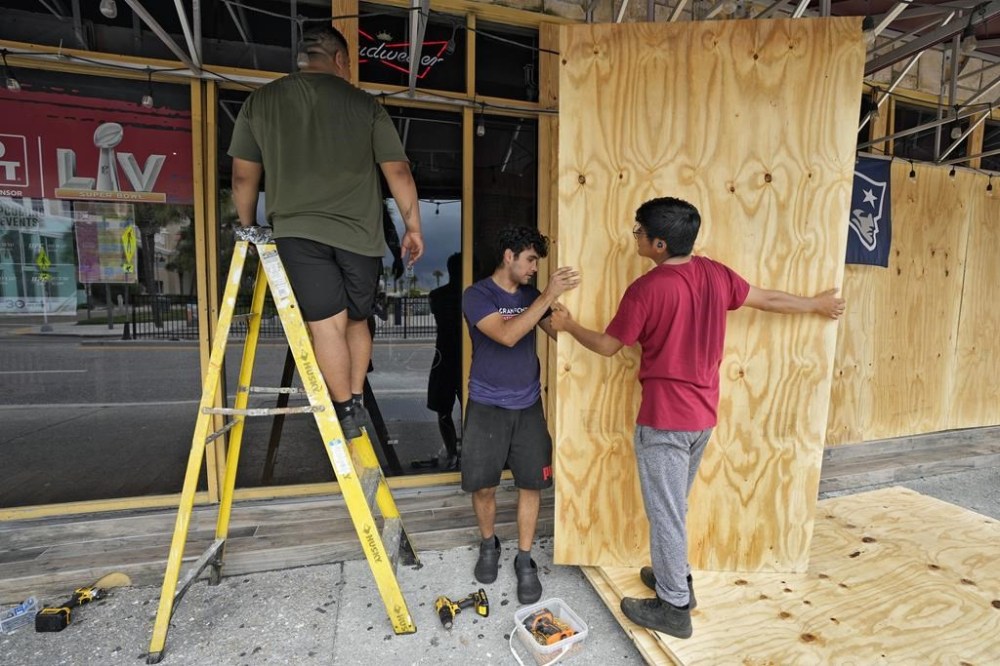
Workers at Toucans Bar and Grill board up the restaurant windows ahead of Hurricane Idalia near Clearwater Beach Tuesday, Aug. 29, 2023, in Clearwater, Fla. Residents along Florida's gulf coast are making preparations for the effects of Idalia. (AP Photo/Chris O'Meara)

Hurricanes get their energy from warm water. Idalia is at an all-you-can-eat buffet.

“What makes this so tough and so dangerous is” that Idalia is moving so fast and intensifying so rapidly, some people may be preparing for what looked like a weaker storm the day before instead of what they’ll get, said National Weather Service Director Ken Graham.

Idalia “stands a chance of setting a record for intensification rate because it’s over water that’s so warm,” said MIT hurricane professor Kerry Emanuel. On Tuesday, only a few places on Earth had conditions — mostly warm water — so primed for a storm’s sudden strengthening, he said.

“Right now I’m pretty sure Idalia is rapidly intensifying,” Emanuel said.

At the time Emanuel said that, Idalia was clocking 80 mph winds. A couple hours later it was up to 90 mph, and by 10 p.m. Idalia was a Category 2 hurricane with 110 mph winds, having gained 40 mph in wind speed in 21 hours. A storm officially rapidly intensifies when it gains 35 mph in wind speed in 24 hours.

Scientists have been talking all summer about how record hot oceans are at the surface, especially in the Atlantic and near Florida, and how deeper water — measured by something called ocean heat content — keeps setting records too because of human-caused climate change. The National Hurricane Center’s forecast discussion specifically cited the ocean heat content in forecasting that Idalia would likely hit 125 mph winds before a Wednesday morning landfall.

Idalia’s “rapid intensification is definitely feeding off that warmth that we know is there,” said University at Albany atmospheric sciences professor Kristen Corbosiero said.

That warm water is from a mix of human-caused climate change, a natural El Nino and other random weather events, Corbosiero and other scientists said.

And it’s even more. Idalia has been parked at times over the Loop Current and eddies from that current. These are pools of extra warm and deep water that flow up from the Caribbean and into the Gulf of Mexico, Corbosiero said.

Deep water is important because hurricane development is often stalled when a storm hits cold water. It acts like, well, cold water thrown on a pile of hot coals powering a steam engine, Emanuel said. Often storms themselves pull the brake because they churn up cold water from the deep that dampens its powering up.

Not Idalia. Not only is the water deeper down warmer than it has been, but Idalia is going to an area off Florida’s western coast where the water is not deep enough to get cold, Emanuel said. Also, because this is the first storm this season to go through the area no other hurricane has churned up cold water for Idalia to hit, Klotzbach said.

Another fact that can slow strengthening is upper level crosswinds, called shear. But Idalia moved into an area where there’s not much shear, or anything else, to slow it down, the hurricane experts said.

A hurricane getting stronger just as it approaches the coast should sound familiar. Six hurricanes in 2021 – Delta, Gamma, Sally, Laura, Hannah and Teddy – rapidly intensified. Hurricanes Ian, Ida, Harvey and Michael all did so before they smacked the United States in the last five years, Klotzbach said. There have been many more.

Storms that are nearing the coastlines, within 240 miles (400 kilometers), across the globe are rapidly intensifying three times more now than they did 40 years ago, a study published last week found. They used to average five times a year and now are happening 15 times a year, according to a study published in Nature Communications.
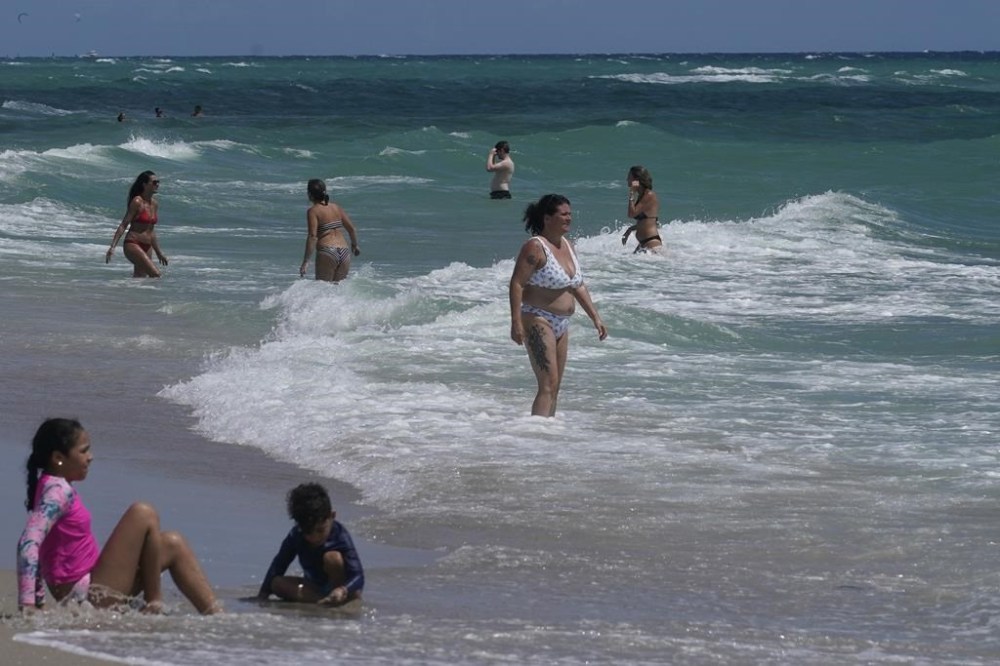
Beachgoers stay close to shore as choppy waves caused by gusty wind crash on Hollywood Beach, Fla., Tuesday, Aug. 29, 2023. Feeding on some of the hottest water on the planet, Hurricane Idalia is expected to rapidly strengthen as it bears down on Florida and the rest of the Gulf Coast, scientists said. (AP Photo/Marta Lavandier)

“The trend is very clear. We were quite shocked when we saw this result,” said study co-author Shuai Wang, a climatology professor at the University of Delaware.

Scientists, such as Wang and Corbosiero, said when it comes to a single storm such as Idalia, it’s hard to blame its rapid intensification on climate change. But when scientists look at the big picture over many years and many storms, other studies have shown a global warming connection to rapid intensification.

In his study, Wang saw both a natural climate cycle connected to storm activity and warmer sea surface temperatures as factors with rapid intensification. When he used computer simulations to take out warmer water as a factor, the last-minute strengthening disappeared, he said.

“We may need to be a little bit careful” in attributing blame to climate change to single storms, Wang said, “but I do think Hurricane Idalia demonstrates a scenario that we may see in the future.”

___

Follow AP’s climate and environment coverage at https://apnews.com/hub/climate-and-environment

___

Follow Seth Borenstein on Twitter at @borenbears

___

Associated Press climate and environmental coverage receives support from several private foundations. See more about AP’s climate initiative here. The AP is solely responsible for all content.


Report Error Submit a Tip

More Stories

Young Winnipeg Jet hopeful, Viggo Bjorck, shines brightly in prospects tournament

Mike McIntyre 6 minute read Preview

Young Winnipeg Jet hopeful, Viggo Bjorck, shines brightly in prospects tournament

Mike McIntyre 6 minute read Sunday, Sep. 13, 2026

It’s safe to say Viggo Bjorck made plenty of new friends and fans this past weekend — including members of his own Winnipeg Jets prospects team which split a pair of tournament games in Quebec.

Take Davis Burnside for example. The undrafted 22-year-old forward, who signed with the Manitoba Moose last spring after finishing up at Ohio State University, couldn’t believe his eyes when he was put on a line with Bjorck, the eighth-overall pick from this summer’s draft and one of the most exciting young players in 2.0 Jets history.

“You see all the highlights and you just can’t wait to play with him,” said Burnside.

It wasn’t long before they teamed up for a highlight of their own. Bjorck made a sensational through-the-legs, no-look pass to Burnside on Sunday afternoon, setting him up for a shorthanded snipe in an eventual 6-4 loss to the Toronto Maple Leafs young guns.

Read
Sunday, Sep. 13, 2026

MPI looks into motorcycle safety

Morgan Modjeski 4 minute read Preview

MPI looks into motorcycle safety

Morgan Modjeski 4 minute read Yesterday at 7:30 PM CDT

Manitoba Public Insurance is probing how to make regional roads safer for motorcyclists.

The public insurer is seeking feedback about restrictions on powerful bikes for new riders, mandatory training for older motorcyclists and limiting registrations to drivers who have a motorcycle licence (Class 6).

The Coalition of Manitoba Motorcycle Groups, which is set to gather at its regular meeting in Winnipeg Wednesday, will weigh in.

President Mary Johnson said some of the questions — such as those that relate to restricting new riders to bikes with engines under 500 cubic centimetres — are non-starters.

Read
Yesterday at 7:30 PM CDT

Winnipeg venues saying no to AI-made advertisements

Sheldon Birnie 8 minute read Preview

Winnipeg venues saying no to AI-made advertisements

Sheldon Birnie 8 minute read Monday, Sep. 14, 2026

Although the days when telephone poles and notice boards across the city were thick with gig posters, either slopped up with wheat paste or wrapped tight with packing tape, are behind us, the art of making an appealing visual ad for live music events is still a vital part of the local creative scene.

However, a widespread backlash against a new kind of slop — the use of generative AI images — has been building, especially among creatives when it comes to promoting live music.

“Live music is and always has been a DIY type of scene, especially locally,” says Evan Simpson, who has been working as a graphic designer for nearly a decade.

“For years people have been making their own flyers, or if they have the budget, hiring a designer or artist to come up with some artwork for their flyers. It’s a whole ecosystem, a scene supporting itself. If you take away the visual side of it, the spark, individuality and uniqueness of each gig poster is lost. What a sad world it would be if all art were made by AI.”

Read
Monday, Sep. 14, 2026

Transit safety drives first mayoral debate

Morgan Modjeski 4 minute read Preview

Transit safety drives first mayoral debate

Morgan Modjeski 4 minute read Yesterday at 2:01 AM CDT

The safety of Winnipeg Transit drivers was front and centre Monday as the first mayoral debate of the 2026 election focused on public transit.

Kevin Klein, the most experienced of the 10 candidates at the Amalgamated Transit Union 1505-hosted debate, said the time for partial safety shields has passed.

“The partial shields have failed drivers. That’s why we need change,” the former PC MLA and city councillor said, adding driver safety is not a staffing issue, but a “protection failure.”

If elected, Klein said he will bring in full-shield implementation across the city within two years and start a nine-bus pilot project immediately.

Read
Yesterday at 2:01 AM CDT

Menstruation, consent move up in sex-ed lesson plan

Maggie Macintosh 5 minute read Preview

Menstruation, consent move up in sex-ed lesson plan

Maggie Macintosh 5 minute read Monday, Sep. 14, 2026

Manitoba’s newest curriculum introduces the menstrual cycle earlier and repeatedly calls for explicit lessons on how students can give, seek, and decline to provide their consent.

The education department has released its sweeping proposal to overhaul how exercise, nutrition and sexuality are taught between kindergarten and Grade 12.

Grade 5 has long served as a key turning point for “the talk,” said J Fiedler, a sexual and reproductive health educator who provided input on the new curriculum.

“There’s no ‘the talk’ anymore. Now, there’s continuations of multiple ‘talks,’ which can hopefully reduce stress for students and stigma that people experience talking about sexuality.”

Read
Monday, Sep. 14, 2026

Seven years sought for serial harasser

Dean Pritchard 5 minute read Preview

Seven years sought for serial harasser

Dean Pritchard 5 minute read Yesterday at 2:01 AM CDT

Alexander Beaton finished serving a two-year jail sentence for criminally harassing six women and didn’t last two days in the community before he was back at it, sending unwanted obscene messages and videos to a dozen women.

Now prosecutors are seeking a seven-year prison sentence for the 30-year-old Winnipeg man, whose latest string of victims includes a police officer who investigated his earlier crimes.

“He essentially continued (offending) unabated,” Crown attorney Brett Rach told provincial court Judge Malcolm McDonald at a sentencing hearing Friday. “It caused more than a nuisance to these victims — it caused them to fear for their safety.”

Beaton pleaded guilty to 14 charges of criminal harassment, sending indecent communications and breaching court orders for a campaign of harassment waged between 2015 and 2025.

Read
Yesterday at 2:01 AM CDT