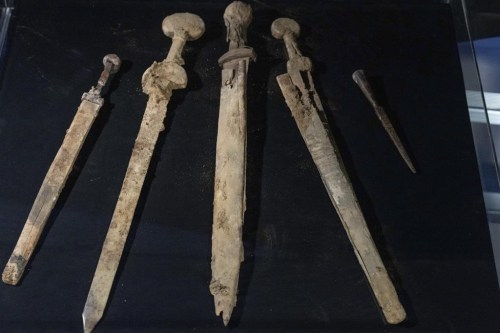
4 exceptionally preserved Roman swords discovered in a Dead Sea cave in Israel
Advertisement
Read this article for free:
or
Already have an account? Log in here »
To continue reading, please subscribe:

Digital Subscription
One year of digital access for only $205*
- Enjoy unlimited reading on winnipegfreepress.com
- Read the E-Edition, our digital replica newspaper
- Access News Break, our award-winning app
- Play interactive puzzles
*First annual payment billed as $205.00 + GST for one year. This annual subscription will automatically renew at $233.00 + GST every 52 weeks (10% off the regular annual price of $259.35). Offer available to new and qualified returning subscribers only. Cancel any time.
To continue reading, please subscribe:
Add Free Press access to your Brandon Sun subscription for only an additional
$1 for the first 4 weeks*
- Enjoy unlimited reading on winnipegfreepress.com
- Read the E-Edition, our digital replica newspaper
- Access News Break, our award-winning app
- Play interactive puzzles
*Your next Brandon Sun subscription payment will increase by $1.00 and you will be charged $17.95 plus GST for four weeks. After four weeks, your payment will increase to $24.95 plus GST every four weeks.
Read unlimited articles for free today:
or
Already have an account? Log in here »
Hey there, time traveller!
This article was published 06/09/2023 (1129 days ago), so information in it may no longer be current.
JERUSALEM (AP) — Four Roman-era swords, their wooden and leather hilts and scabbards and steel blades exquisitely preserved after 1,900 years in a desert cave, surfaced in a recent excavation by Israeli archaeologists near the Dead Sea, the Israel Antiquities Authority announced Wednesday.
The cache of exceptionally intact artifacts was found about two months ago and tells a story of empire and rebellion, of long-distance conquest and local insurrection.
Researchers, who published the preliminary findings in a newly released book, propose that the arms — four swords and the head of a javelin, known as a pilum — were stashed in the remote cavern by Jewish rebels during an uprising against the Roman Empire in the 130s.
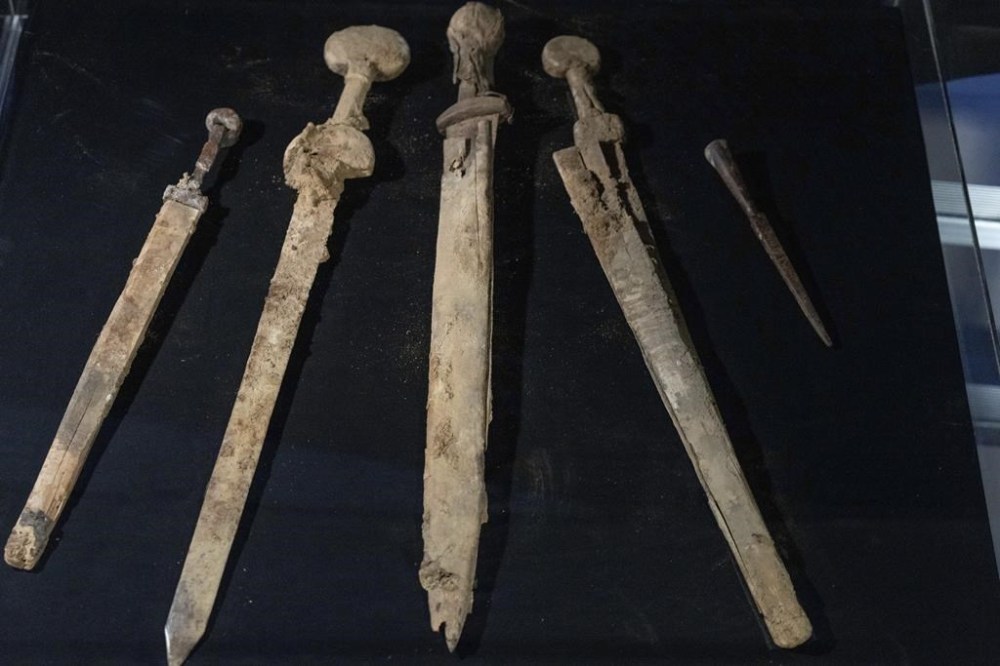
The swords were dated based on their typology, and have not yet undergone radiocarbon dating.
The find was part of the antiquities authority’s Judean Desert Survey, which aims to document and excavate caves near the Dead Sea and secure scrolls and other precious artifacts before looters have a chance to plunder them.
The cool, arid and stable climate of the desert caves has allowed exceptional preservation of organic remains, including hundreds of ancient parchment fragments known as the Dead Sea Scrolls.
Those Jewish texts, discovered last century and dated to the first centuries BCE and CE, contain the earliest known versions of the Hebrew Bible, as well an assortment of esoteric writings.
Archaeologists returned to this particular cave near the desert oasis of Ein Gedi to document an inscription found decades earlier.

“At the back of the cave, in one of the deepest part of it, inside a niche, I was able to retrieve that artifact — the Roman pilum head, which came out almost in mint condition,” said Asaf Gayer, an archaeologist with Ariel University.
But though the swords were found on the eastern edge of the Roman Empire, they were likely crafted in a distant European province and brought to the province of Judaea by soldiers in the military, said Guy Stiebel, a Tel Aviv University archaeologist specializing in Roman military history.
He said the quality of their preservation was exceptionally rare for Roman weapons, with only a small handful of examples from elsewhere in the empire and beyond its borders.
“Each one of them can tell you an entire story,” he said. Future research will focus on studying its manufacture and the origin of the materials in order to tease out the history of the objects and the people it belonged to — Roman soldiers and Jewish rebels.
“They also reflect a much grander narrative of the entire Roman Empire and the fact that from a small cave in a very remote place on the edge of the empire, we can actually shed light about those mechanisms is the greatest joy that the scientist can have,” he said.