Study says fish stocks along Atlantic, Pacific coasts unaffected by marine heat waves

Advertisement

Advertise with us

Marine heat waves haven't had a lasting effect on fish populations along Canada’s Atlantic and Pacific coasts, says a study showing there is still a chance to act on climate change.

Read this article for free:


or

Already have an account? Log in here »

To continue reading, please subscribe:

Subscribe and receive a limited-edition Free Press branded hat or tote.

Digital Subscription

One year of digital access for only $205*

  • Enjoy unlimited reading on winnipegfreepress.com
  • Read the E-Edition, our digital replica newspaper
  • Access News Break, our award-winning app
  • Play interactive puzzles

*First annual payment billed as $205.00 + GST for one year. This annual subscription will automatically renew at $233.00 + GST every 52 weeks (10% off the regular annual price of $259.35). Offer available to new and qualified returning subscribers only. Cancel any time.

To continue reading, please subscribe:

Add Free Press access to your Brandon Sun subscription for only an additional

$1 for the first 4 weeks*

  • Enjoy unlimited reading on winnipegfreepress.com
  • Read the E-Edition, our digital replica newspaper
  • Access News Break, our award-winning app
  • Play interactive puzzles
Start now

*Your next Brandon Sun subscription payment will increase by $1.00 and you will be charged $17.95 plus GST for four weeks. After four weeks, your payment will increase to $24.95 plus GST every four weeks.

Hey there, time traveller!
This article was published 11/09/2023 (1125 days ago), so information in it may no longer be current.

Marine heat waves haven’t had a lasting effect on fish populations along Canada’s Atlantic and Pacific coasts, says a study showing there is still a chance to act on climate change.

The study published Aug. 30 in the journal Nature looked at data from 1993 to 2019, which included 248 marine heat waves – described as prolonged periods of warm ocean temperatures.

“The expectation is that whenever there are heat waves, the fish stocks will be affected, and that the bigger the heat waves, the bigger the impacts. But what we find is that the impact is not consistent,” William Cheung, professor at the University of British Columbia’s Institute for Oceans and Fisheries, and co-author of the study, said in a recent interview.
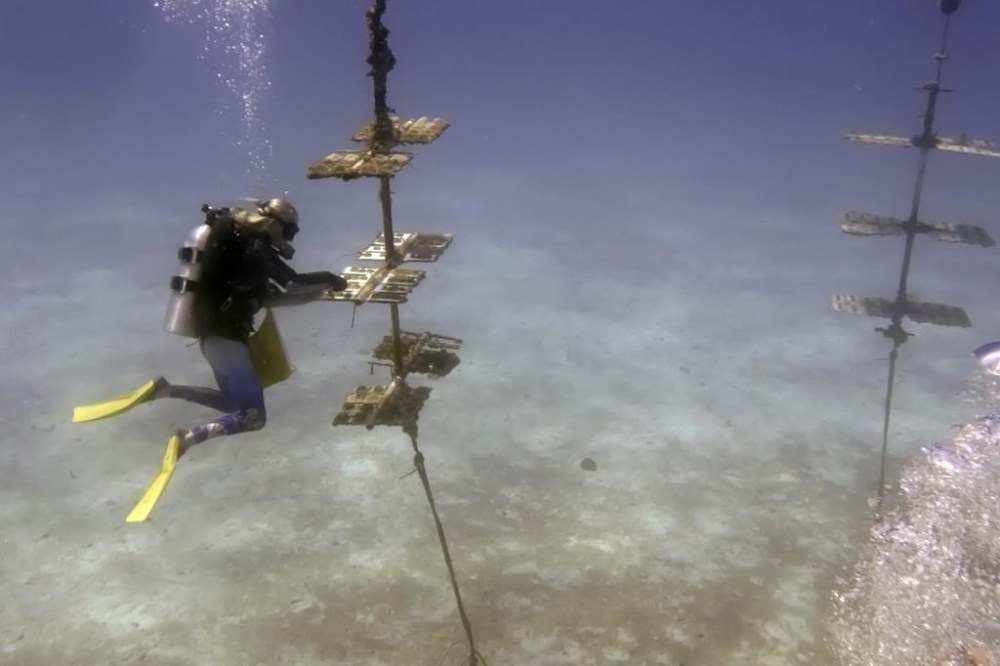
Marine heat waves haven't had a lasting effect on fish populations along Canada’s Atlantic and Pacific coasts says a study, showing there is still a chance to act on climate change. A diver with non-profit Reef Renewal USA cleans and maintains a coral nursery, Tuesday, Aug. 1, 2023, near Tavernier, Fla., in the Florida Keys. THE CANADIAN PRESS/AP/Wilfredo Lee

“What it suggested is that the relationship between heat waves and fish stocks can be more complicated.”

The study looked at 82,322 samples of heat wave data from long-term scientific surveys of marine ecosystems in North America and Europe spanning the subtropics to the Arctic. The authors defined a marine heat wave as a period of five days or more with extreme higher-than-average temperatures.

The data included notable marine heat waves, such as “the Blob,” which blanketed the Northeast Pacific from 2014-2016, and the 2012 one in the Northwest Atlantic. While “the Blob” caused a 22-per-cent loss of fish in the Gulf of Alaska, the 2012 marine heat wave led to a 70-per-cent gain in the number of fish in the Northwest Atlantic.

The authors said steep declines in fish populations – “occasionally occurred after marine heat waves, (but) these were the exception, not the rule … Marine heat waves have not driven biomass change or community turnover in fish communities that support many of the world’s largest and most productive fisheries.”

Cheung said while the study measured heat waves through temperature changes, there are other factors that affect fish, such as food availability, oxygen levels and salinity of the oceans.

“It may be that the relationship between temperature and those other changes in ocean conditions are more complex,” he said.

But the study warns that as marine heat waves get longer and more intense, fisheries may eventually be affected because marine life is more vulnerable to warming than is terrestrial life. Marine organisms tend to live close to the temperature limits of what their bodies can sustain, while oceans, compared with land, have fewer “thermal refugia” – areas with cooler temperatures than the surrounding ecosystem.

“As a future that is more than 1.5 C warmer looks increasingly likely, it is more critical than ever to develop a deeper understanding of what drives ecological responses to extreme climate events,” the study said.

Marine heat waves have also been linked to widespread coral bleaching and die-offs of kelp forests and reef fish in shallow coastal seas, Cheung said. As well, he said, scientists have observed fish migrating to cooler parts of the ocean as temperatures have risen.

“But the thing is that not all species will have the same ability to shift their distribution; some species may be limited by geography,” he said. “There are also other environmental conditions that may prevent fish from moving to even further, deeper waters.”

Cheung pointed to sockeye salmon – a species of fish important to First Nations and historically found in the coastal regions of British Columbia – which seem to be changing habitat in search of cooler waters. This shift in species habitat will be felt by people who rely on the salmon, he said, as well as on other organisms that feed on those animals.

Scientists are carefully studying the rare flash of good news about the lack of major impact caused by marine heat waves. But Cheung said marine life may be limited in its capacity to absorb a constant pummeling of high temperatures.

“It really highlights the urgency to do climate actions now,” he said.

“If we don’t take any actions now, with continuous climate change, we know it will increase the intensity and frequency of marine heat waves and it is going to lead to a bigger, scary impact.”

This report by The Canadian Press was first published Sept. 11, 2023.

Report Error Submit a Tip

More Stories

Phoneless concert a beautiful chance to bask in moment

Jen Zoratti 5 minute read Preview

Phoneless concert a beautiful chance to bask in moment

Jen Zoratti 5 minute read 2:01 AM CDT

Outside the Scotiabank Arena in Toronto, digital billboards flashed fans their singular photo op for the night: “I took this photo before I saw Phoebe Bridgers: The Lost Tour 2026.”

It is, as it is for so many other people, my only documentation of a concert by one of my favourite artists. The American singer-songwriter — who I discovered at the Winnipeg Folk Festival in 2018 — has had a meteoric rise in the past few years, winning three Grammys in 2024 as one third of Boygenius, the indie-rock supergroup rounded out by Lucy Dacus and Julien Baker, and opening for Taylor Swift on select dates of her titanic Eras Tour.

Now, Bridgers is touring in support of Lost Weekend, her third album and first since 2020’s Punisher. It’s a feat of a record, a richly textured meditation on loss and grief, written in the aftermath of the death of her dad, with whom she had a complicated relationship.

So she is in a position to not only play multiple sold-out arena shows, but also insist that those shows be phone-free.

Read
2:01 AM CDT

A Life's Story: Writer built bridges with genuine curiosity, compassion for diversity of religious practices

Janine LeGal 6 minute read Preview

A Life's Story: Writer built bridges with genuine curiosity, compassion for diversity of religious practices

Janine LeGal 6 minute read 6:00 AM CDT

Brenda Suderman knew how to make people feel comfortable. For a journalist, that character trait is a real strength, and it made people trust and appreciate her.

Whether covering musicals, worship spaces, the effects of pandemic shutdowns, death rituals and practices of different traditions, the discovery of the burial of 2,284 infants in unmarked graves, or any other of the countless topics she wrote about in her four- decade career, Suderman did it with genuine interest and care.

Born and raised in Winkler, Suderman grew up on a farm. Much of her childhood was spent in gardens and sugar beet fields.

Baptized at 16, she became a member of the Winkler Bergthaler Mennonite Church. The restrictions against women at the time contributed to planting the seeds of Suderman’s feminist perspective.

Read
6:00 AM CDT

Chopped trees will leave a ‘blight’ on Windsor Park

Kelly-Anne Riess 3 minute read Preview

Chopped trees will leave a ‘blight’ on Windsor Park

Kelly-Anne Riess 3 minute read Yesterday at 8:04 PM CDT

Robert Gordon has watched the trees grow along a popular Windsor Park walking path for nearly six decades.

Now, as Manitoba Hydro cuts them down to protect nearby power lines, he says a familiar part of his childhood neighbourhood is disappearing.

Although he no longer lives in the area, Gordon regularly returns to walk or cycle along the tree-lined path, which runs parallel to Archibald Street.

He was concerned when he recently spotted crews clearing vegetation near the entrance to the path, but initially assumed they were removing brush. When he returned, he discovered the clearing had extended farther along the corridor.

Read
Yesterday at 8:04 PM CDT

Letters, Oct. 10

6 minute read 2:01 AM CDT

Investing in adult vaccines

Last week, provincial and territorial health ministers held an emergency meeting on the looming expiration of federal health funding and the financial pressures facing health systems across the country.

As they gather again in Winnipeg later this month, there is a critical piece missing from the conversation — prevention.

Canada has a strong public-health tradition, but its gains cannot be taken for granted. In 2021, Canada reported zero measles cases. By 2025, more than 5,400 cases had been reported, costing Canada its measles elimination status and Manitoba saw this firsthand.

Fish stocks unaffected by marine heat waves: study

Hina Alam, The Canadian Press 4 minute read Preview

Fish stocks unaffected by marine heat waves: study

Hina Alam, The Canadian Press 4 minute read Monday, Sep. 11, 2023

Marine heat waves haven't had a lasting effect on fish populations along Canada’s Atlantic and Pacific coasts, says a study showing there is still a chance to act on climate change.

The study published Aug. 30 in the journal Nature looked at data from 1993 to 2019, which included 248 marine heat waves – described as prolonged periods of warm ocean temperatures.

"The expectation is that whenever there are heat waves, the fish stocks will be affected, and that the bigger the heat waves, the bigger the impacts. But what we find is that the impact is not consistent," William Cheung, professor at the University of British Columbia's Institute for Oceans and Fisheries, and co-author of the study, said in a recent interview.

"What it suggested is that the relationship between heat waves and fish stocks can be more complicated."

Read
Monday, Sep. 11, 2023

Puppies, stocks — ‘zoomies’ abound

Andrew Froese 4 minute read 2:01 AM CDT

This spring, I adopted a three-month-old rescued German Shepherd mix. To say she is easily excitable is an understatement.

It is not really her fault. A puppy’s frontal cortex, the part of the brain that helps with decision-making and impulse control, is still developing. When an older dog, or a human, gets tired, we generally understand we should rest. Puppies have not quite figured that out. They often interpret tiredness as a signal something is wrong, which makes them more alert, more reactive and harder to settle.

That creates a feedback loop. The puppy gets tired, which makes her frantic, which makes her more tired, which makes her even more frantic. Eventually, this becomes what people call the “zoomies”: frantic sprinting, biting, jumping and general chaos.

From the outside, it looks like the puppy has too much energy. In reality, the opposite is true. The zoomies are not a sign of excess energy. They are a sign the puppy is overtired and does not know it yet.