B.C. mule deer stressed by wildfire, but still much to learn about wildlife impacts
Advertisement
Read this article for free:
or
Already have an account? Log in here »
To continue reading, please subscribe:

Digital Subscription
One year of digital access for only $205*
- Enjoy unlimited reading on winnipegfreepress.com
- Read the E-Edition, our digital replica newspaper
- Access News Break, our award-winning app
- Play interactive puzzles
*First annual payment billed as $205.00 + GST for one year. This annual subscription will automatically renew at $233.00 + GST every 52 weeks (10% off the regular annual price of $259.35). Offer available to new and qualified returning subscribers only. Cancel any time.
To continue reading, please subscribe:
Add Free Press access to your Brandon Sun subscription for only an additional
$1 for the first 4 weeks*
- Enjoy unlimited reading on winnipegfreepress.com
- Read the E-Edition, our digital replica newspaper
- Access News Break, our award-winning app
- Play interactive puzzles
*Your next Brandon Sun subscription payment will increase by $1.00 and you will be charged $17.95 plus GST for four weeks. After four weeks, your payment will increase to $24.95 plus GST every four weeks.
Read unlimited articles for free today:
or
Already have an account? Log in here »
Hey there, time traveller!
This article was published 24/09/2023 (1079 days ago), so information in it may no longer be current.
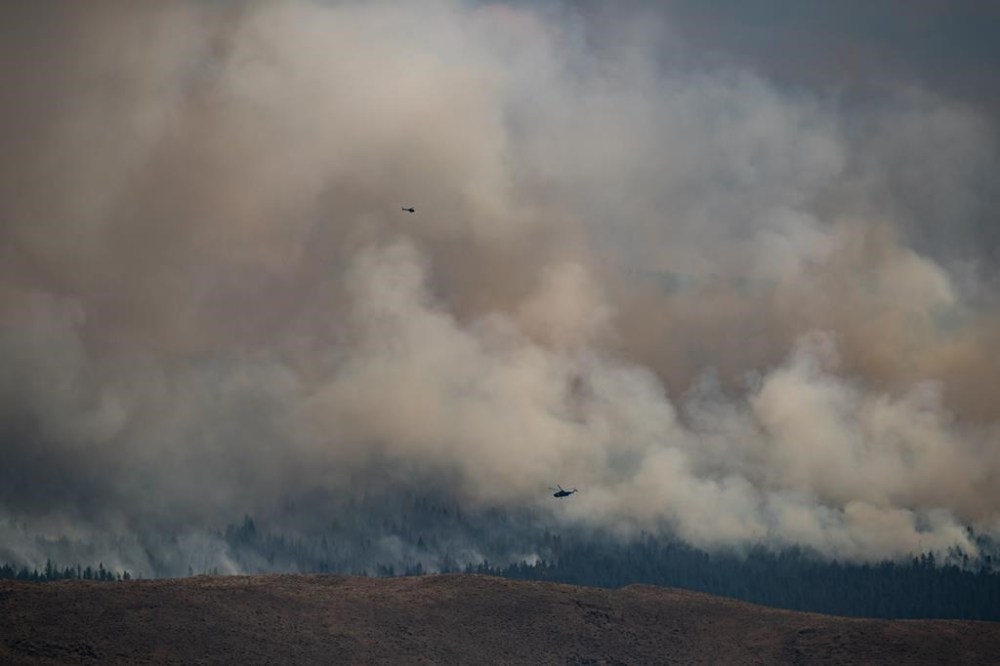
Proof that deer experienced elevated stress in response to wildfires in British Columbia’s southern Interior can be found in their poop, although researchers say there’s still much to learn about what increasingly severe blazes mean for wildlife.
Shaun Freeman, a wildlife and habitat biologist with the Skeetchestn First Nation, said his team began gathering mule deer pellets in August 2021, while two large fires were still burning in the area between Cache Creek and Kamloops, B.C.
The samples were sent to the Toronto Zoo, where testing revealed elevated concentrations of the stress-induced hormone cortisol.
Stress can affect the animals’ nutritional uptake, causing them to burn precious fat stores, and it can decrease their ability to produce offspring, Freeman said.
Cortisol levels have since dropped by around half in samples taken during more favourable conditions, he said, allowing the researchers to establish a baseline.
But the local mule deer population has been declining, and the Sparks Lake and Tremont Creek wildfires that together spanned 1,595 square kilometres scorched half of the animals’ key winter habitat in Skeetchestn territory, Freeman said.
The winter range has mature old-growth conifers, which help deer move through the forest by shielding the ground from deep snowfall. The trees’ needles and arboreal lichens also provide food during the sparse winter months, he explained.
Swathes of forests burned by the 2021 wildfires have shifted to the kind of habitat that deer would forage in during the summer, he said.
With access restrictions in response to the wildfires lifting this fall, the First Nation has asked people to stay out of the areas burned in 2021, especially at low elevations frequented by deer,in order to minimize stressors and disturbances.
Adam Ford, Canada research chair in wildlife restoration ecology based at the University of B.C.’s Okanagan campus, said there are many unknowns and variables when it comes to understanding the impacts of wildfire on wildlife.
The effects vary over the short and long term and across seasons and species, as well as different types of habitats and how animals use those areas, he said.
Ford said the return of fire to the landscape after decades of aggressive suppression efforts could actually be a “net benefit” for most wildlife.
But for that to happen it has to be the right kind of fire, and it must be combined with land-management approaches that support overall ecosystem health, he said.
“We’re going to have fires regardless,” Ford said.
“What we want to see is the return of good fire, cultural fire, prescribed fire.”
Cultural fire — the strategicblazes Indigenous Peoples used to steward the land before fire suppression ramped up with colonization — would have led to explosions of vegetation for wildlife to feast on, among other benefits, Ford said.
Yet climate change is fuelling increasingly large, severe wildfires, and their effects interact with other disturbances, such as clear-cut logging and reforestation.
As fire returns to the landscape, Ford said it’s important to manage those impacts.
If an ecosystem is already “sputtering along, then fire could be bad,” he said.
The predominant approach in B.C. is to replant logged or burned areas with coniferous trees intended to feed the forest industry. It’s also common practice to remove deciduous treesthat would otherwise play important roles in the ecosystem, including support for wildlife, Ford said.
“The problem is people think restoration is planting trees. You’re restoring people’s access to timber, but you’re not restoring the habitat (or) the ecosystem,” he said.
“If we want (wildfire) to be a benefit, then maybe we don’t let all these other activities come in after the fire,” Ford said. “Maybe we enjoy the flush of deciduous understory and don’t see it as competition for softwood lumber species.”
Fire can be used to promote regeneration and biodiversity on the landscape, agreed Sarah Dickson-Hoyle, an ecologist working with the Secwepemcul’ecw Restoration and Stewardship Society, of which Skeetchestn First Nation is a member.
“But that contrasts really drastically with these extensive high severity burns.”
The onset of “megafire” has prompted calls for scientists to deepen their understanding of the long-term effects and trajectories of recovery, she said.

Secwepemc territories have been affected by several large, high-intensity blazes in recent years, including the 1,900-square-kilometre Elephant Hill fire in 2017.
Work so far has revealed limited short-term recovery in areas that wereseverelyscorched, said Dickson-Hoyle, an intern with the innovation organization Mitacs and a postdoctoral research fellow at the University of B.C.’s faculty of forestry.
“We’re seeing much lower diversity for those understory plants, for the shrubs, the grasses, the wildflowers that are not only the biggest part of biodiversity in those forests, but are really important for wildlife forage,” she said.
“Understanding the impacts of these megafires is also bringing to the forefront that these fires in many of the landscapes in B.C. are not what those areas would have been adapted to. It’s outside the historical range,” she added.
This report by The Canadian Press was first published Sept. 24, 2023.