Canada to get rare asteroid sample after OSIRIS-REx drops cargo to Earth on Sunday

Advertisement

Advertise with us

MONTREAL - Seven years after it blasted into space to snag a sample of an asteroid, a spacecraft delivered its rare cargo on Sunday — and Canada is getting a piece of the interstellar bounty.

Read this article for free:


or

Already have an account? Log in here »

To continue reading, please subscribe:

Subscribe and receive a limited-edition Free Press branded hat or tote.

Digital Subscription

One year of digital access for only $205*

  • Enjoy unlimited reading on winnipegfreepress.com
  • Read the E-Edition, our digital replica newspaper
  • Access News Break, our award-winning app
  • Play interactive puzzles

*First annual payment billed as $205.00 + GST for one year. This annual subscription will automatically renew at $233.00 + GST every 52 weeks (10% off the regular annual price of $259.35). Offer available to new and qualified returning subscribers only. Cancel any time.

To continue reading, please subscribe:

Add Free Press access to your Brandon Sun subscription for only an additional

$1 for the first 4 weeks*

  • Enjoy unlimited reading on winnipegfreepress.com
  • Read the E-Edition, our digital replica newspaper
  • Access News Break, our award-winning app
  • Play interactive puzzles
Start now

*Your next Brandon Sun subscription payment will increase by $1.00 and you will be charged $17.95 plus GST for four weeks. After four weeks, your payment will increase to $24.95 plus GST every four weeks.

Hey there, time traveller!
This article was published 24/09/2023 (1057 days ago), so information in it may no longer be current.

MONTREAL – Seven years after it blasted into space to snag a sample of an asteroid, a spacecraft delivered its rare cargo on Sunday — and Canada is getting a piece of the interstellar bounty.

The NASA-led mission launched OSIRIS-REx into space in 2016 to collect from the surface of an asteroid material that scientists hope will offer them insight into the formation of the solar system. The spacecraft began orbiting the asteroid — called Bennu — in 2018 and grabbed a sample in 2020.

It started its return trip to Earth in 2021, and a capsule with the rocks and space dust landed Sunday morning in the Utah desert while the spacecraft continues on a mission to another asteroid.
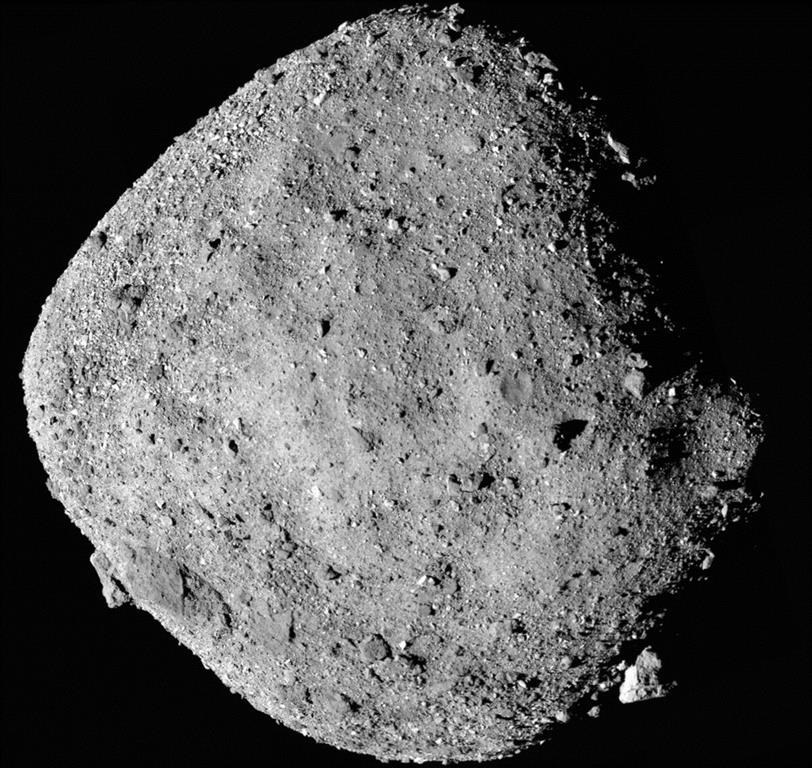
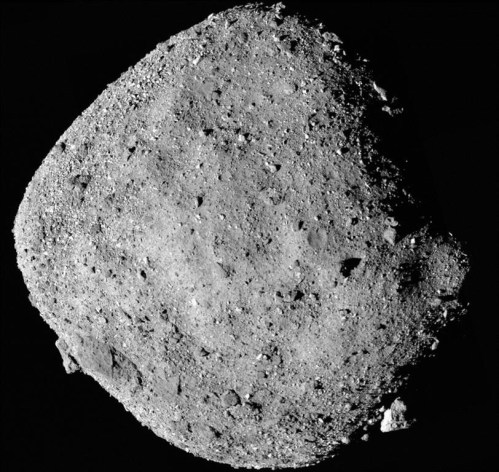
This Dec.14, 2018, handout image shows the asteroid Bennu in a composite of 12 images taken by the OSIRIS-REx spacecraft's PolyCam imager from a distance of 24 kilometres. Seven years after it blasted into space to snag a sample of the asteroid, a spacecraft is set to deliver its rare cargo on Sunday – and Canada is getting a piece of the interstellar bounty. THE CANADIAN PRESS/HO, NASA/Goddard/University of Arizona *MANDATORY CREDIT*

Scientists estimate the capsule holds at least a cup of rubble from the carbon-rich Bennu, but won’t know for sure until the container is opened. Some spilled and floated away when the spacecraft scooped up too much and rocks jammed the container’s lid during collection three years ago.

Canada contributed a laser altimeter to the mission — a device that measures altitude and distance — that has allowed Bennu to become the “most precisely surveyed body in our solar system,” says Cameron Dickinson, a staff engineer at Canadian space company MDA Ltd., which designed the Canadian component of the spacecraft.

By taking billions of measurements of the asteroid over two years, Canada’s altimeter — known as OLA — helped scientists select the best location on the asteroid from which to gather a sample. The craft then briefly landed on the asteroid to collect the material.

“In total, we laid down more than three billion measurements … so this now provides a very highly precise map of the asteroid, Dickinson told a recent news conference.

NASA’s OSIRIS-REx is the first asteroid sample-return mission in which Canada has participated — and it entitles the country to some of the space rocks.

“In exchange for this contribution, Canadian scientists have been on the OSIRIS REx science team from the very beginning,” John Moores, science adviser to the president of the Canadian Space Agency, told a recent briefing on the mission.

“As well, Canada will become the fifth country in the world to receive a sample collected in space.”

Tim Haltigin, planetary senior mission scientist with The Canadian Space Agency, has worked on the project for a decade. Asteroids, he said, are leftover ingredients from the formation of the solar system, and getting a sample from one “is sort of like going back into a cosmic mixing bowl and pulling out individual grains of sugar and a bit of flour and, you know, maybe a chocolate chip.”

“And so this is how we’re able to study the raw ingredients of the solar system as they were billions and billions and billions of years ago,” Haltigin said.

The mission selected Bennu because it was close enough to reach and large enough from which to secure a sample — and also because of what it is made of.

“There was only about a handful (of asteroids) that were made of some of the most interesting scientific materials that allow us to answer some of these fundamental questions about the origins of the solar system,” Haltigin said.

A piece of Bennu won’t be coming to Canada right away — the country’s space agency needs to first build a facility in which to store the rare find.

“We’re not on the same timeline as NASA to receive the sample — that’s been understood since the beginning,” said Caroline-Emmanuelle Morisset, program scientist, space exploration development with the CSA. “The sample will reside at NASA for a time before it’s transferred to Canada.”

“What we need is a clean room,” Morisset said. “Those are rooms where the air is all filtered to ensure that there’s no particulates from Earth that come in contact with the sample.”

The total size of the shipment of dust and pebbles is about 250 grams, plus or minus 100 grams; Canada’s portion is about four per cent of that — somewhere between six and 14 grams, Morisset said.

But she says that’s plenty to keep scientists busy for years. The two Japan-led Hayabusa missions brought back a total of about five grams of asteroid, which she said provided decades worth of science.

“You know, with milligrams of sample we can do a lot of science,” Morisset said.

This report by The Canadian Press was first published Sept. 24, 2023.

— with files from The Associated Press.

Report Error Submit a Tip

More Stories

Could renewed interest in strategically critical rare earth elements finally make sub-sector profitable?

Joel Schlesinger 6 minute read Preview

Could renewed interest in strategically critical rare earth elements finally make sub-sector profitable?

Joel Schlesinger 6 minute read Yesterday at 3:00 AM CDT

Rare earth elements are among the most critical of mined resources for modern economies.

They’re essential in manufacturing specialized magnets used in a host of technologies from wind turbines and electric vehicles to hard drives, smartphones, television screens, and fibre optics. Most notably, however, rare earth minerals are increasingly vital to the defence industry.

These 17 elements — closely related chemically and usually found all together in mineral deposits — have indeed been growing in geopolitical importance as the United States, Canada and other Western nations recognize their dependence on production from China.

It is the world’s largest producer and processor of rare earths, including the most in-demand elements neodymium and praseodymium used to manufacture very light and powerful magnets for an array of technologies, including the most advanced weapons of modern warfare.

Read
Yesterday at 3:00 AM CDT

West Kildonan Industrial residents call for speed bumps after child hit by truck

Morgan Modjeski 3 minute read Preview

West Kildonan Industrial residents call for speed bumps after child hit by truck

Morgan Modjeski 3 minute read Updated: Yesterday at 3:09 PM CDT

Residents in the West Kildonan Industrial neighbourhood are calling on the city to install speed bumps in their area after a child was hit and dragged by a vehicle Thursday.

Katelyn Bemister lives near the area where the child — who was hospitalized as a result of the incident and has been upgraded to stable condition — was struck. She says people frequently speed in the area.

“They’re going really fast, and they’re not really paying attention at all to the pedestrians in the area,” says Bemister.

In video supplied to the Free Press by a resident, the child can be seen riding a bike down a sidewalk along the 500 block of North Point Boulevard.

Read
Updated: Yesterday at 3:09 PM CDT

Oliveira shines in win over Redblacks, Collaros rocked again

Taylor Allen 5 minute read Preview

Oliveira shines in win over Redblacks, Collaros rocked again

Taylor Allen 5 minute read Yesterday at 8:57 PM CDT

It wasn’t a stellar performance by any stretch.

But at this point, the Winnipeg Blue Bombers will take a win no matter what it looks like.

The Blue and Gold outlasted the winless Ottawa Redblacks 33-21 on a rainy Friday night at Princess Auto Stadium to improve to 5-4.

“It’s great to finally get a win at home for our fans and to go out and play a better game is very encouraging,” said right guard Patrick Neufeld.

Read
Yesterday at 8:57 PM CDT

Rise of social media reflects rise of self-promotion — to the detriment of genuine storytelling

Reviewed by Matt Henderson 4 minute read Preview

Rise of social media reflects rise of self-promotion — to the detriment of genuine storytelling

Reviewed by Matt Henderson 4 minute read Yesterday at 3:00 AM CDT

A conversation is overheard between two people; one congratulates the other on their success, evident through countless posts on LinkedIn, but the other confesses the prolific aggrandizement is due to slumping success.

A young man on an airplane spends three hours poring over selfies taken on a vacation, zooming in on his biceps and using AI to retouch photos before posting on Instagram.

Anonymous and cowardly trolls on Reddit attempt to end another person’s career.

All this “storytelling” was observed in one day by this reviewer.

Read
Yesterday at 3:00 AM CDT

Today’s horoscope

Georgia Nicols 4 minute read Preview

Today’s horoscope

Georgia Nicols 4 minute read 2:00 AM CDT

MOON ALERT: There are no restrictions to shopping or important decisions today. The moon is in Libra.

ARIES (March 21-April 19)

The day is a mixed bag. For the most part, it’s romantic, friendly, congenial and a great time to socialize with others and enjoy playful activities with kids. Nevertheless, you might meet a real sourpuss or someone who is a wet blanket. Keep things light!

TAURUS (April 20-May 20)

Read
2:00 AM CDT

Corroded Arlington overpass yields way for new hope of spanning urban chasm

Melissa Martin 6 minute read Preview

Corroded Arlington overpass yields way for new hope of spanning urban chasm

Melissa Martin 6 minute read Yesterday at 2:00 AM CDT

It’s an interesting quirk of timing, perhaps, that the end of two of Winnipeg’s most unlovely features are coming into view in the same few weeks. The rail lines that split the city in half, and the bridge that was built to tie it back together. The original problem, and the solution.

And in the confluence of those two ends, we have an opportunity to dream of what a better Winnipeg can be.

At a news conference on Wednesday, former federal transport minister Lloyd Axworthy laid out a vision for a rail line bypass that would remove more than 120 railway crossings from Winnipeg, route them through Crown and Manitoba Hydro corridor land south of the city, and reclaim 250 acres in the urban core for greenspace and development.

The next step is to focus on how to make it happen. Nothing of this scope comes easy. This new bypass plan emerged from a two-year feasibility study that Premier Wab Kinew had tasked Axworthy with back in 2024. Now, Axworthy will helm a new 90-day feasibility study zooming in on that route specifically.

Read
Yesterday at 2:00 AM CDT