Birds nesting in agricultural lands more vulnerable to extreme heat, study finds

Advertisement

Advertise with us

As climate change intensifies extreme heat, farms are becoming less hospitable to nesting birds, a new study found. That could be another barrier to maintaining rapidly eroding biodiversity that also provides benefits to humans, including farmers who get free pest control when birds eat agricultural pests.

Read this article for free:


or

Already have an account? Log in here »

To continue reading, please subscribe:

Subscribe and receive a limited-edition Free Press branded hat or tote.

Digital Subscription

One year of digital access for only $205*

  • Enjoy unlimited reading on winnipegfreepress.com
  • Read the E-Edition, our digital replica newspaper
  • Access News Break, our award-winning app
  • Play interactive puzzles

*First annual payment billed as $205.00 + GST for one year. This annual subscription will automatically renew at $233.00 + GST every 52 weeks (10% off the regular annual price of $259.35). Offer available to new and qualified returning subscribers only. Cancel any time.

To continue reading, please subscribe:

Add Free Press access to your Brandon Sun subscription for only an additional

$1 for the first 4 weeks*

  • Enjoy unlimited reading on winnipegfreepress.com
  • Read the E-Edition, our digital replica newspaper
  • Access News Break, our award-winning app
  • Play interactive puzzles
Start now

*Your next Brandon Sun subscription payment will increase by $1.00 and you will be charged $17.95 plus GST for four weeks. After four weeks, your payment will increase to $24.95 plus GST every four weeks.

Hey there, time traveller!
This article was published 19/10/2023 (1081 days ago), so information in it may no longer be current.

As climate change intensifies extreme heat, farms are becoming less hospitable to nesting birds, a new study found. That could be another barrier to maintaining rapidly eroding biodiversity that also provides benefits to humans, including farmers who get free pest control when birds eat agricultural pests.

Researchers who examined data on over 150,000 nesting attempts found that birds in agricultural lands were 46% less likely to successfully raise at least one chick when it got really hot than birds in other areas.

“I don’t think we expected it to be as extreme as it was,” said Katherine Lauck, a PhD candidate at University of California, Davis and lead author of the study published Thursday in the journal Science.
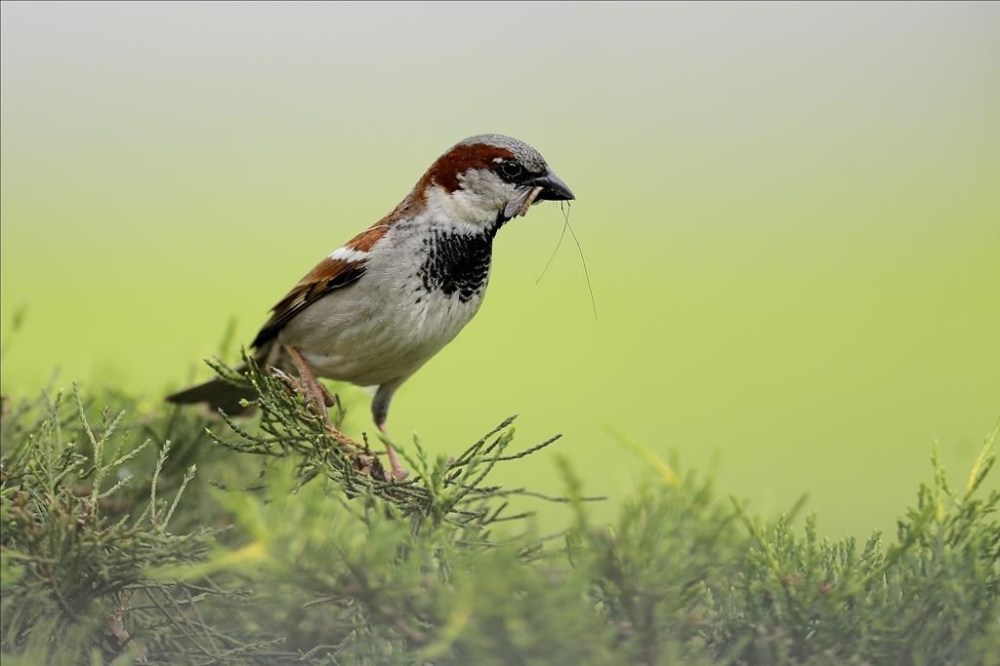
FILE - A house sparrow is seen with an insect in its beak, May 25, 2020, in Lutherville-Timonium, Md. As climate change intensifies extreme heat, farms are becoming less hospitable to many nesting birds, including the house sparrow, a new study found on Thursday, Oct. 19, 2023. (AP Photo/Julio Cortez, File)

Bird scientists have been tracking the decline of avian wildlife for years. In 2019, a comprehensive study showed that there were three billion fewer wild birds than in 1970. The new study represents a closer look at what might be behind the dramatic decline.

Intense commercial farming is known to harm birds — fields completely clear of trees and other natural barriers lack shelter for wildlife, and pesticides and other agricultural chemicals can hurt birds.

The study concluded that species of higher conservation concern in the U.S. — those closer to being listed as federally threatened or endangered — were more vulnerable to extreme heat events in agricultural settings. But across the board, birds in forests were 14% more likely to achieve reproductive success in times of extreme heat.

The study’s findings were not surprising to Ken Rosenberg, a biologist with the Road to Recovery initiative who formerly worked as a conservation biologist at the Cornell Lab of Ornithology and was lead author on what he calls the “three billion birds study.” The idea that forest birds could benefit slightly from warmer temperatures makes sense, he said, since shade from trees provides a buffer from extreme heat that agricultural areas don’t have.

Rosenberg, who was not affiliated with this study, said he was pleased to see a paper in a prestigious journal using large datasets built from citizen science data. In this case, the observations came from NestWatch, a nationwide nest-monitoring program that anyone can participate in.

However, Rosenberg cautioned that more data might be needed to confirm that species of higher conservation concern were more vulnerable, since the overwhelming majority of the data involved species of low conservation concern.

The researchers predicted how different bird species might fare in each landscape during extreme heat events. They concluded that in agricultural areas, species of greater conservation concern, like the oak titmouse, would see worse outcomes than species of lower concern, like the house sparrow.

Rosenberg and David Bird, a professor emeritus of wildlife biology at McGill University, said the study contributes to the understanding of the negative effects of intensive single crop farming. Bird said the study “sings the praises of the need for preserving our forests,” which not only protect birds from hot weather but also help protect ecosystems from global warming by absorbing carbon.

The study suggests that if farmers purposefully left just a little more natural space around farms with a few trees or native plants — not necessarily changing everything about their operations — birds could better coexist with humans, Rosenberg said.

“Some of these open country birds don’t really need a lot of habitat or a lot of space,” he said. “They just need some.”

Lead author Lauck is now working to better understand exactly why birds experience such large differences in nesting success between farmed and forested areas, hoping that would point toward useful interventions.

“New solutions that are neutral for farmers but helpful for biodiversity in the long term will create a more resilient biosphere for all of us,” they said.

___

Read more of AP’s climate coverage at http://www.apnews.com/climate-and-environment

___

Follow Melina Walling on X, formerly known as Twitter: @MelinaWalling.

___

Associated Press climate and environmental coverage receives support from several private foundations. See more about AP’s climate initiative here. The AP is solely responsible for all content.


Report Error Submit a Tip

More Stories

’Disgusting’ posters being investigated by police

Morgan Modjeski 4 minute read 2:22 PM CDT

The Winnipeg Police Service major crimes unit is investigating what some have labelled offensive and hateful posters on full-display at a Winnipeg home.

One of the people irked by the display is Gracie Garrett. She’s has lived on Ashburn Street in Winnipeg’s Minto neighbourhood for almost ten years. She’s never felt unsafe in the neighbourhood before, but now, a set of posters plastered on a nearby house are making her feel uneasy.

The five signs, posted facing the street prominently on a front window, contain a slur, refer to Nazis as “heroes” and call Muslims, Christians and other groups “evil.”

Learning of the signs Friday, Garrett said she’ll be reporting the posters to police, as she worries they incite and promote violence.

Broadening prediction-market gambling a bad idea

Editorial 4 minute read Preview

Broadening prediction-market gambling a bad idea

Editorial 4 minute read 2:01 AM CDT

Let’s make a prediction: sooner or later, when Canadian governments find a way to take their own cut of the action, prediction-contract gambling on everything from sports to entertainment to political decisions is going to come to Canada.

And that’s a horrible, dangerous, pernicious idea.

Unless you have particular access to information — either inside information or strategic information based on skills or education — you’re not likely to make money at it. In fact, structurally, you’re likely to lose. In prediction markets, you basically pay an amount, plus fees from the company involved, to bet on whether something will or will not happen within a certain time frame. The amount you pay for your contract depends on how other people are also betting.

As Wealthsimple describes it, “You buy whichever side you think is right. Prices move with demand, so if the market leans towards one outcome, the more that side costs. If a lot of people are backing the TSX to finish above 38,000, yes gets more expensive and no gets cheaper.”

Read
2:01 AM CDT

Gordon Bell rings in a century

Maggie Macintosh 13 minute read Preview

Gordon Bell rings in a century

Maggie Macintosh 13 minute read Updated: Yesterday at 8:06 PM CDT

Mischka Valencia had gotten used to the hum of heavy machinery at Gordon Bell High School.

“Ever since I’ve been here, it’s all been under construction,” the Grade 12 student said, standing on the sidelines of the brightly painted revamped outdoor basketball court. “I had no idea this was a court.”

The Filipina teenager landed in Winnipeg several months after the inner-city campus had transformed into a construction site.

It was the fall of 2023 and Mischka’s priorities were fitting in, befriending classmates and learning a third language via first-period French.

Read
Updated: Yesterday at 8:06 PM CDT

Health minister warns $1.2 billion in annual federal funding set to expire in March

Scott Billeck 4 minute read Preview

Health minister warns $1.2 billion in annual federal funding set to expire in March

Scott Billeck 4 minute read Thursday, Oct. 1, 2026

Manitoba’s health minister is warning of possible cuts to health care with $1.2 billion in annual funding from Ottawa set to expire next year.

“We’re very concerned that what would be the largest cut to health care in a generation is right in front of us,” Health Minister Uzoma Asagwara said Thursday at the Manitoba legislature. “It means that services that Manitobans depend on will be in jeopardy and be at risk.

“Any reductions, any cuts from Canada, will have direct impacts on the health outcomes of Manitobans.”

Asagwara, who serves as the provincial and territorial health minister lead, chaired a virtual meeting Tuesday with provincial and territorial health ministers to discuss federal funding for health care, mental health care and substance use services, which is scheduled to expire March 31, 2027.

Read
Thursday, Oct. 1, 2026

Letters, Oct. 3

7 minute read 2:01 AM CDT

A morning in the life …

My very first lesson does not start when I walk into that lecture hall, oh no — it starts long before. It begins when I walk to my car, check the estimated arrival time to the University of Manitoba and hope that Winnipeg traffic agrees with it.

A drive that appears completely manageable changes almost immediately when I’m greeted by a tsunami of orange pylons and a line of cars that appears to go on forever. Traffic moves by the inch, lanes magically disappear and the detour I took yesterday now has a detour of its own. These factors make me do a calculation that I have become all too familiar with. How late can I arrive and still find parking, run to my class across campus and get to class with enough time left to make it worth it?

I have grown used to people saying, “Why not just leave earlier?” I do. But when I’m already leaving for my 8:30 a.m. class at 7 a.m., there’s only so much I can do. This drive that some would think is relaxing is one that feels like an assignment that I didn’t know I had to complete and is due at 8:30 a.m.

Brandonmeat packer thriving on its own

Abiola Odutola 3 minute read Preview

Brandonmeat packer thriving on its own

Abiola Odutola 3 minute read 2:01 AM CDT

BRANDON — Canada Packers has strengthened its business and laid the foundation for future growth during its first year as an independent company, its president says.

The Brandon-based pork producer, separated from Maple Leaf Foods in October 2025, established its own leadership, strategy, systems, culture and identity while continuing operations across its hog production farms and regional hog barns in southern and eastern Manitoba.

The company’s first year was focused on building a successful standalone business while continuing to serve customers, communities and shareholders, president Dennis Organ said.

“Market conditions over the past year have been more challenging than we anticipated when we became a separate entity,” he said in an email. “Despite that, we continued to execute against our priorities, including increasing processing volumes, maintaining disciplined operations and strengthening the business.”

Read
2:01 AM CDT